Travel
The Red Silence: Finding Stillness in the Ancient Gorges of the Kimberley Wilderness
In the far northwest of Australia, a vast expanse of red earth and turquoise water defies the modern clock. Spanning three times the size of England, the Kimberley is a primordial sanctuary where ancient stone and resilient life endure in one of Earth's last great intact savannahs.
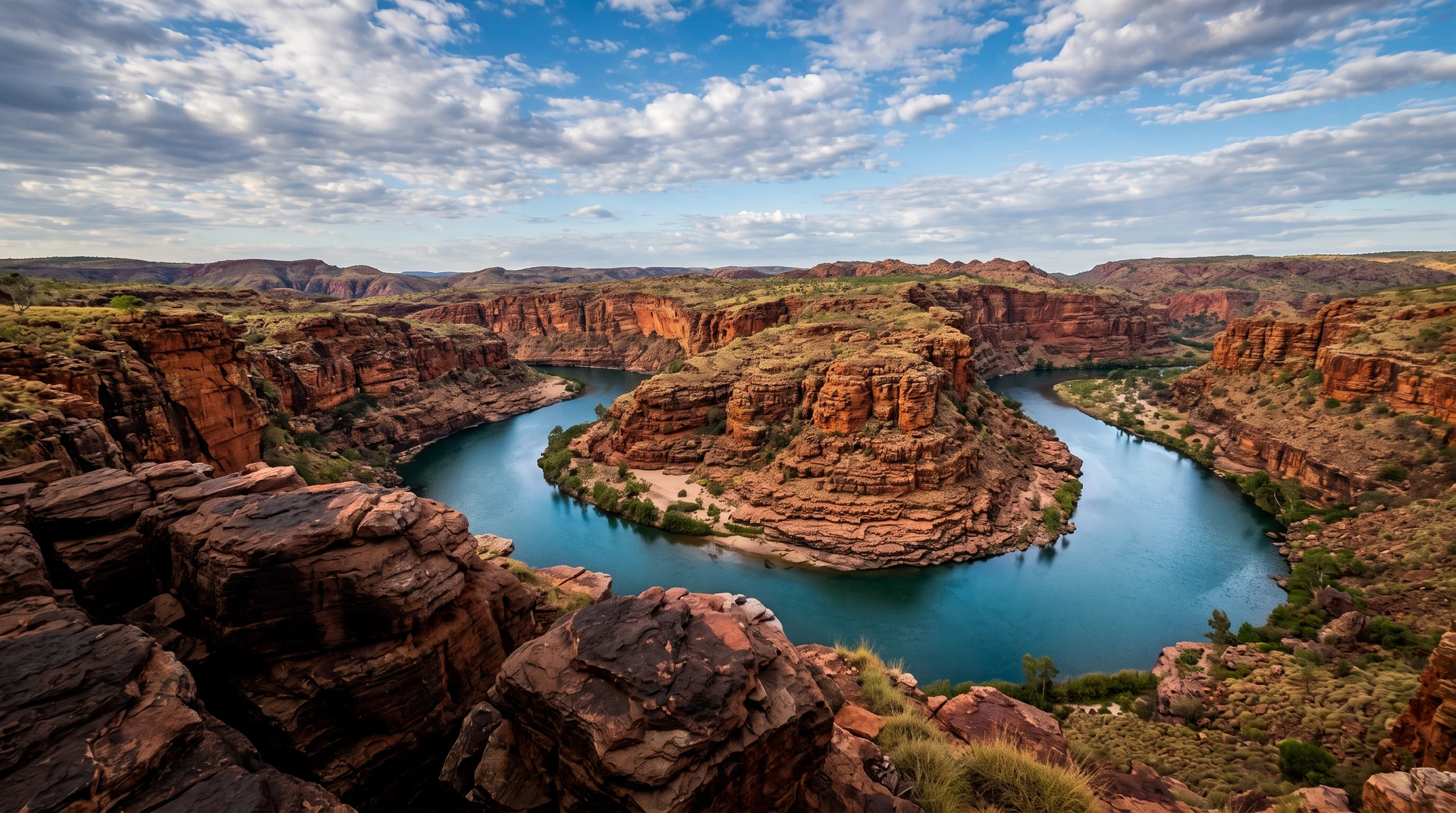
The scale of the Kimberley is not something one merely sees; it is felt in the sudden, heavy silence that follows the engine’s cut. Spanning approximately 423,000 square kilometers, this corner of Western Australia is roughly three times the size of England, yet it possesses one of the lowest population densities on the planet [1]. To traverse its expanse is to enter a landscape that feels less like a destination and more like a separate geological era. Here, the red dust meets the sapphire fringes of the Indian Ocean. It is a place where the horizon is an invitation, stretching across a terrain that has remained indifferent to the modern world.
At the heart of this wilderness lies Purnululu National Park, home to the Bungle Bungle Range. These unique, beehive-shaped sandstone domes are 350 million years old, their orange and black stripes a testament to the slow work of cyanobacteria and iron oxide [1]. Walking through the narrow chasms of Cathedral Gorge, the air cools significantly, and the sound of one's own footsteps echoes against walls that have stood since before the first dinosaurs. The sheer verticality of the formations creates a sense of profound humility; you are a brief visitor in a cathedral of stone that has watched the slow drift of continents. The light here is transformative, turning the orange bands to fire.
The artery of the Kimberley is the Gibb River Road, a 660-kilometer track that demands respect and a high-clearance four-wheel-drive vehicle [1]. It is not a road for the faint of heart; the corrugated surface rattles the bones, and the occasional river crossing requires a steady hand. Yet, the rewards for this rugged transit are unparalleled. Every few hours, the track yields to a hidden oasis—a deep, limestone-walled gorge where permanent pools of emerald water offer a cool, shaded respite from the sun. Bell Gorge and Manning Gorge are not just swimming holes; they are geological sanctuaries where the water has carved intricate steps into the rock.
The most remarkable aspect of the Kimberley is its ecological integrity. The North Kimberley bioregion stands as a rare global anomaly: it is the only area on mainland Australia where no recorded animal or plant extinctions have occurred since European settlement [1]. In a world where biodiversity is often in retreat, this vast savannah remains a stronghold for species that have vanished elsewhere. To sit quietly by a billabong at twilight is to witness a flourishing ecosystem in its most natural state. The air is thick with the calls of honeyeaters and the rustle of wallabies, while the occasional glimpse of a freshwater crocodile serves as a reminder of the region’s prehistoric lineage.
The Kimberley’s coastline is defined by massive tidal movements that create phenomena found nowhere else on Earth. The Horizontal Falls in Talbot Bay are the most famous example, where the volume of water rushing through narrow cliff gaps creates a waterfall effect that lies flat against the sea [1]. It is a display of raw, gravitational power that humbles any observer. The turquoise water churns into a white froth as the tide turns, a reminder that the ocean here is a dynamic, living force. Further north, the Montgomery Reef emerges from the sea as the tide drops, a massive coral platform that seems to rise like a lost continent, with waterfalls cascading.
This is also a deeply cultural landscape, cared for by Aboriginal people for tens of thousands of years. The rock art of the Kimberley, including the ancient Wandjina and Gwion Gwion figures, represents one of the oldest continuous artistic traditions in human history. These paintings are living connections to the Dreamtime, etched into the sandstone shelters of the high country. Visitors must respect these sacred sites, obtaining necessary permits and staying strictly on marked paths to ensure the preservation of this heritage [1]. To stand before a Wandjina figure is to feel the weight of a history that spans generations, a narrative of stewardship that continues to this day.
The vegetation of the Kimberley is as resilient as the stone it clings to. The iconic boab tree, with its swollen, silver-barked trunk and skeletal branches, stands like a sentinel across the savannah. Some of these trees are over a thousand years old, their hollow interiors once used as temporary shelters by early travelers. During the wet season, the landscape undergoes a violent transformation; the parched red earth turns to a vibrant green, and the dry creek beds become raging torrents. The smell of the first rain on the hot dust signals the renewal of life in a land that knows how to wait.
Traveling here requires a shift in perspective. It is a place where distance is measured in days, and where the lack of infrastructure ensures that the Kimberley remains one of the world’s last great wilderness areas. The nights are profound; far from light pollution, the Milky Way arches across the sky with a clarity that is almost disorienting. The stars are so bright they seem to cast shadows, and the silence is punctuated only by the distant howl of a dingo. To leave the Kimberley is to carry its red dust in your boots and a lingering sense of its vast, quiet power in your soul.
| Feature | Detail | | :--- | :--- | | Area | ~423,000 sq km [1] | | Age | 350 million years [1] | | Status | UNESCO World Heritage [1] |
**References** [1] Australia's North West Tourism. "Explore the Kimberley." https://www.australiasnorthwest.com/explore/kimberley/