Travel
The Last Sanctuary: Finding Stillness Amidst the Volcanic Peaks of Lord Howe Island
On a remote volcanic sliver in the Tasman Sea, a strict visitor cap preserves a prehistoric world. Here, the world’s southernmost coral reef meets misty mountain forests, offering a rare, intimate encounter with a landscape where time and nature exist in perfect, protected suspension.
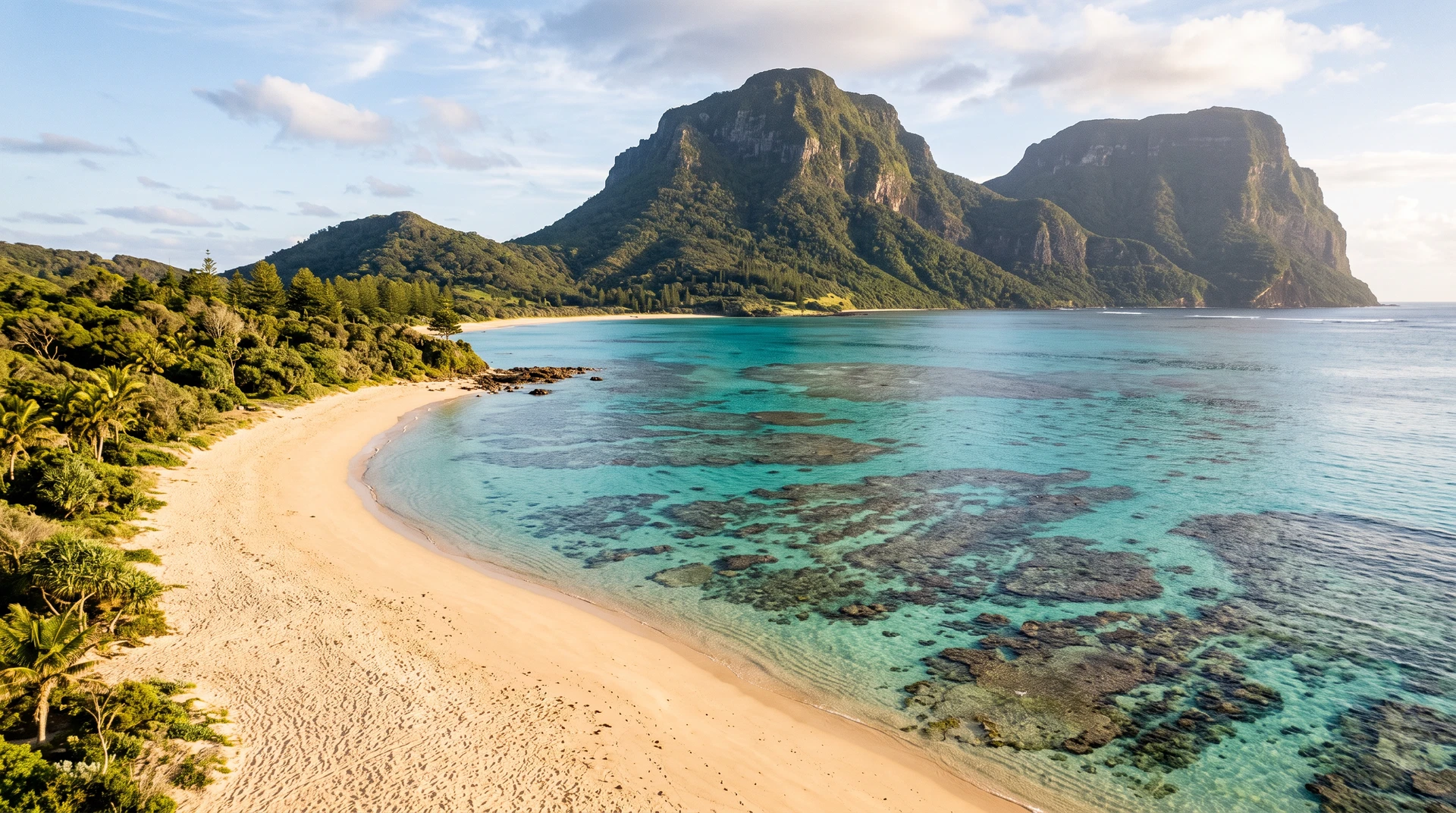
The approach to Lord Howe Island is an exercise in perspective, a transition from the featureless blue of the Tasman Sea to a sudden, jagged verticality. From the window of a small plane, the island appears as a verdant crescent anchored by the imposing basalt monoliths of Mount Gower and Mount Lidgbird. These twin peaks, rising nearly nine hundred meters from the surf, are the landmarks of a volcanic remnant that has spent seven million years weathering the elements. There is a profound sense of arrival that comes with touching down on a strip of land so narrow that the ocean is visible on both sides, a reminder that you have reached a place where geography dictates the terms of existence.
What defines the experience here is not just what is present, but what is intentionally absent. With a strictly enforced cap of four hundred visitors at any given time, the island avoids the frantic energy of most global destinations. This limit is central to the island’s identity, ensuring the human footprint remains light enough for the natural world to speak. Walking along the shoreline or through the palm-shaded lanes, one is struck by a rare, heavy silence, broken only by the rhythmic call of nesting seabirds or the wind through the canopy. It is a luxury of space and stillness that feels like a deliberate choice to prioritize the ecosystem over mass tourism.
The island’s geology is a visible narrative of fire and erosion, the skeletal remains of a massive shield volcano that once spanned twenty kilometers. Today, only a fraction of that original mass remains, sculpted by the sea into a complex arrangement of cliffs and a lagoon. The sheer basalt walls of the southern mountains are often shrouded in a persistent cap of clouds, creating a microclimate that supports a unique array of flora. To stand at the base of these cliffs is to feel the weight of deep time, observing how the relentless Pacific has carved out caves from the ancient rock. It is a landscape that demands a slower pace and observant eye.
Beneath the surface of the turquoise lagoon lies the world’s southernmost coral reef, a biological anomaly sustained by warm currents mixing with cooler temperate flows. This confluence creates a vibrant transition zone where tropical species mingle with those found in colder latitudes. The clarity of the water is startling, offering an unobstructed view of intricate coral gardens just meters from the shore. Because the waters are protected within a dedicated marine park, the fish are unafraid, often gliding alongside snorkelers in a curiosity rare in more heavily trafficked regions. It is a fragile, underwater sanctuary that serves as a sentinel for the health of our changing oceans.
Moving inland, the landscape shifts into a prehistoric forest dominated by the endemic Kentia palm, a species that has become a global staple of interior design but finds its only natural home here. These palms create a cathedral-like atmosphere, filtering sunlight into soft, dappled patterns on the forest floor. Three-quarters of the island is designated as a Permanent Park Preserve, protecting the primary forest from the pressures of development. Within these shadows, one might encounter the Lord Howe woodhen, a flightless bird once on the brink of extinction that now roams the undergrowth with a bold nature. The forest is a living museum where evolution followed its own path.
Visiting such a pristine environment comes with practical responsibilities that ground the traveler in modern conservation. Stewardship here is an active, daily requirement. Upon arrival, and before entering the park’s many trails, visitors must adhere to strict biosecurity protocols, including scrubbing footwear to prevent the introduction of invasive fungi. These measures are a necessary defense for an ecosystem that evolved without many of the threats found on the mainland. It is a reminder that the beauty of the island is a fragile inheritance, requiring a collective commitment from both residents and guests to maintain the delicate balance that allows these rare species to thrive.
Life on the island moves at the speed of a bicycle, the primary transport. With few cars and no mobile phone reception, the digital noise of the outside world quickly fades, replaced by a tactile engagement with the surroundings. There is a communal intimacy to the scale of the place, where a day’s journey might involve nothing more than a ride to a remote cove or a hike through the banyan groves. This lack of connectivity is a liberation, forcing a return to the present moment and a deeper appreciation for the immediate environment. It encourages a style of travel that is observant, where highlights are found in the details.
For those who venture toward higher elevations, the environment undergoes a dramatic transformation. The summit of Mount Gower is home to a rare mist-shrouded cloud forest, an ethereal realm where mosses and ferns drape every surface and the air is thick with moisture. This high-altitude sanctuary hosts a density of endemic plants that exist nowhere else on Earth, thriving in the cool conditions provided by the persistent cloud cover. Reaching these heights requires physical commitment, but the reward is a glimpse into a world entirely detached from the tropical beaches below. It is a place of quiet beauty, where clouds weave through stunted trees in a silent dance.
As the sun sets behind the silhouette of the mountains, casting long shadows across the lagoon, the value of Lord Howe Island becomes clear. It is a model for sustainable travel, one that recognizes the inherent limits of our natural wonders and chooses to honor them. By capping visitor numbers and prioritizing the Permanent Park Preserve, the island has managed to retain its soul in an era of global homogenization. It remains a wistful reminder of what the world can look like when we choose to act as guardians rather than consumers. Leaving the island, one carries away a sense of gratitude for a place that exists on its own terms.