Travel
The emerald heart of Thailand beats within the ancient limestone cathedrals of Khao Sok.
Beyond the bustling shores of the Andaman, a prehistoric world remains anchored in the mist-drenched valleys of Khao Sok. Here, ancient rainforests and soaring limestone karsts surround the vast, silent expanse of Cheow Lan Lake, offering a rare sanctuary for elephants and the elusive Rafflesia flower.
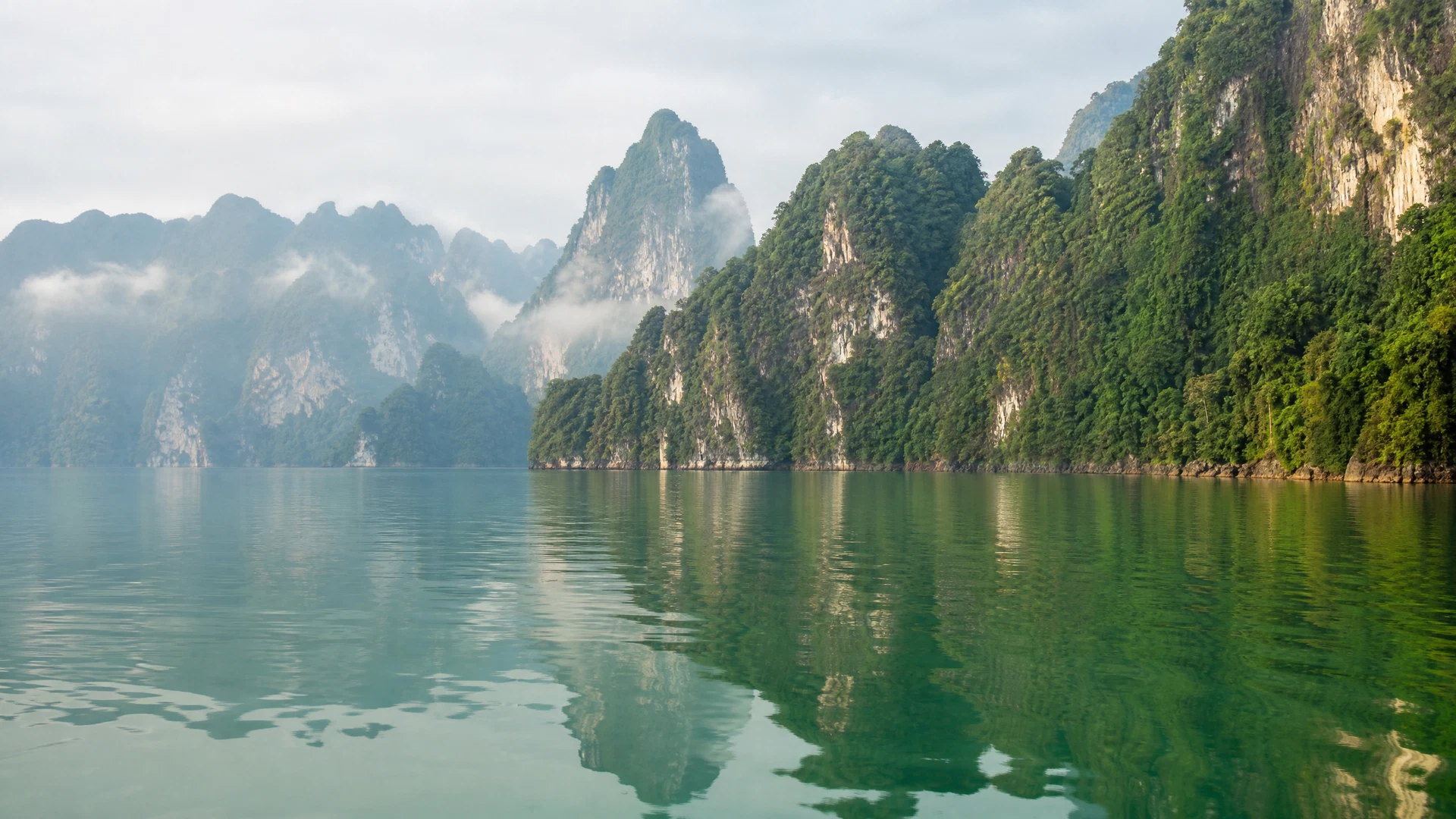
The humidity in Khao Sok does not merely hang in the air; it possesses a weight and a fragrance, a thick amalgam of damp earth and prehistoric ferns. As you move inland from the salt-sprayed coasts of Southern Thailand, the landscape undergoes a radical transformation. The horizon is suddenly interrupted by the jagged, vertical geometry of limestone karsts. These ancient pillars, draped in a tapestry of emerald vines, stand as sentinels over a wilderness that has remained largely unchanged for millions of years. It is a place where the modern world feels like a distant rumor, silenced by the presence of a forest that has outlasted empires.
At the center of this green labyrinth lies Cheow Lan Lake, a vast expanse created in the early 1980s by the construction of the Ratchaprapha Dam. The lake flooded a deep valley, turning mountain peaks into islands and ridges into winding shorelines. The resulting scenery is nothing short of cinematic. From a longtail boat, the scale of the limestone cliffs is dizzying, their white faces plunging directly into water so deep it appears as liquid jade. There is a profound stillness here, broken only by the rhythmic splash of the boat’s propeller and the occasional cry of a distant bird, echoing off the high stone walls.
The forest surrounding the lake is a remnant of a biological lineage that predates the Amazon. Walking beneath its canopy is an exercise in humility. The trees, reaching heights that challenge the sky, are buttressed by massive roots that crawl across the floor like sleeping dragons. Every square inch is teeming with life, from the microscopic fungi breaking down timber to the massive dipterocarps that provide the structural backbone of the ecosystem. The air is a constant symphony of cicadas, a high-pitched drone that serves as the heartbeat of the jungle, rising and falling with the intensity of the tropical heat.
Among the park’s most celebrated inhabitants is the Rafflesia kerrii, a botanical anomaly that defies the rules of floral beauty. This parasitic plant produces a flower of staggering proportions, sometimes reaching nearly a meter in diameter. Its five fleshy, blood-red petals are covered in pale protrusions, and it emits a faint odor to attract pollinating flies. To witness a Rafflesia in bloom is a rare privilege, as the flowering period lasts only a few days before the entire structure collapses into a black mass, returning its nutrients to the soil. It is a fleeting, strange masterpiece of an ancient and diverse ecosystem.
While the Rafflesia commands attention on the ground, the canopy belongs to the primates and birds. The morning air is frequently pierced by the haunting calls of lar gibbons, a sound that carries for miles across the mist-filled valleys. These acrobatic apes move through the high branches with a fluid grace, their long limbs swinging them from tree to tree. Below them, the forest floor provides a sanctuary for the endangered Asian elephant. Though they are elusive and hidden by the dense vegetation, their presence is felt in the trampled paths and the snapped bamboo stalks that mark their quiet passage through the thick undergrowth.
Navigating Khao Sok requires a respect for the rhythms of the natural world, particularly the powerful influence of the monsoon. Between May and October, the skies frequently open with a ferocity that can transform the landscape in minutes. These heavy rains are essential for the survival of the rainforest, replenishing the lake and feeding the countless streams that vein the park. However, they also bring significant risks. Flash floods can surge through narrow limestone canyons with little warning, and authorities often close specific trails to ensure safety. It is a reminder that this is a wild environment that demands caution and preparedness.
For those who stay within the park’s boundaries, the experience is defined by an intimacy with nature. The floating raft houses on Cheow Lan Lake offer a unique perspective, where the boundary between the living quarters and the wilderness is reduced to a few inches of timber. At night, the absence of light pollution reveals a sky crowded with stars, their reflections shimmering on the surface of the lake. The sounds of the forest become more pronounced in the darkness—the rustle of leaves, the splash of a fish, the distant hoot of an owl—creating a sensory immersion that persists even in the deepest hours of sleep.
The preservation of Khao Sok is the safeguarding of a critical reservoir of biodiversity. As a designated national park since 1980, it serves as a vital link in a chain of protected areas that allow wildlife to thrive. The challenges of stewardship are constant, balancing the needs of visitors with the fragile requirements of the ecosystem. Every traveler who treads lightly on the trails and respects the park’s regulations contributes to the longevity of this prehistoric sanctuary. It is a place that reminds us of the world’s original state, a green and watery realm where time is measured in geological epochs rather than minutes.
Leaving Khao Sok is a slow process of re-entry. As the longtail boat nears the pier and the limestone towers recede, the silence of the lake is replaced by the hum of human activity. Yet, the memory of the mist clinging to the karsts and the sound of the gibbons in the canopy remains. Khao Sok offers more than just a destination; it provides a perspective on the enduring power of nature and the importance of the wild places that remain. In the emerald heart of Thailand, the ancient world still breathes, waiting for those willing to listen to its quiet, enduring pulse.