Travel
The living architecture of Meghalaya where ancient roots bind the rainforest together
In the mist-drenched valleys of Northeast India, the Khasi people have spent centuries weaving the living roots of rubber trees into resilient bridges. These biological wonders grow stronger with every monsoon, offering a profound lesson in patience and ecological harmony.
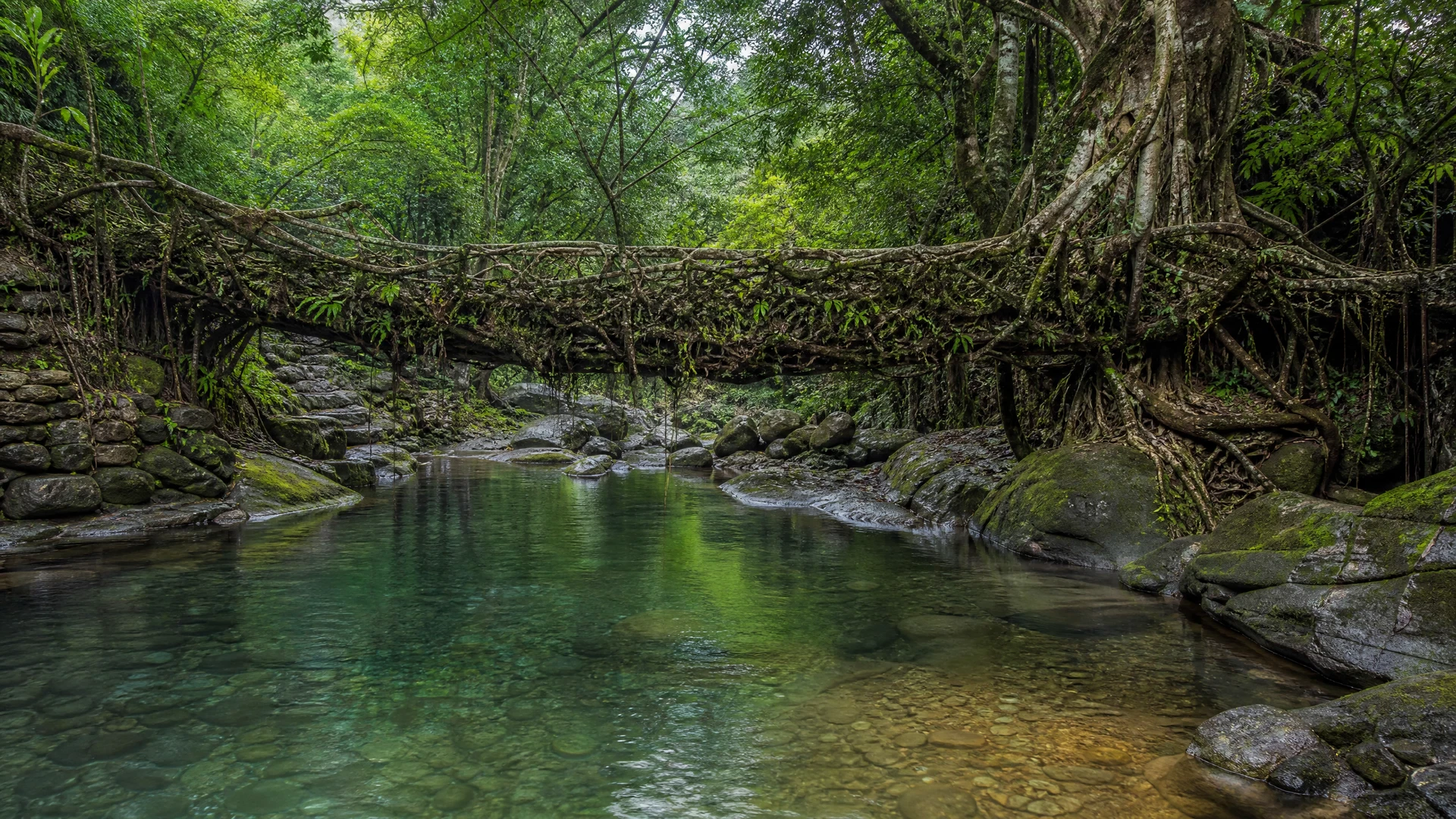
The air in Meghalaya is not just humid; it is a heavy, living thing, a silver-grey veil that drapes over the Khasi Hills. Here, in the wettest corners of the globe, the rain does not merely fall; it reshapes the world. Mawsynram and Cherrapunji are names synonymous with the deluge, places where the monsoon is not a season but a permanent resident. In this landscape of vertical ravines and churning rivers, the challenge of connectivity has historically been met not with concrete or steel, but with the patient guidance of nature itself.
Known locally as Jingkieng Jri, the living root bridges of Meghalaya represent one of the most sophisticated examples of bio-engineering found anywhere on the planet. Unlike the rigid structures of the industrialized world, which begin to decay the moment they are completed, these bridges are living organisms. They are grown, not built. Utilizing the aerial roots of the Ficus elastica, or the Indian rubber tree, the indigenous Khasi and Jaintia communities have developed a method of bridge-building that operates on a timescale far beyond the reach of modern architecture.
The process begins with a vision that spans generations. A young Khasi elder might plant a sapling on the bank of a volatile stream, knowing that he will never walk across the bridge he is initiating. For the first fifteen to twenty years, the tree is nurtured, and its flexible aerial roots are painstakingly guided through hollowed-out betel nut trunks or bamboo structures stretched across the water. These roots are directed toward the opposite bank, where they eventually take hold in the soil, beginning a slow process of thickening and strengthening that will continue for centuries.
As the roots mature, they are woven together, forming a dense, latticed network that eventually becomes a solid walkway. Over time, the bridge becomes a part of the ecosystem, its strength increasing as the roots grow thicker and the wood becomes more resilient. While a steel bridge might rust and a wooden one might rot in the relentless humidity of the Meghalayan rainforest, the Jingkieng Jri thrives. The more it rains, and the more the tree grows, the more secure the passage becomes, eventually becoming strong enough to support the weight of dozens of people simultaneously.
Walking across one of these bridges is a sensory experience that defies the standard definition of travel. The surface underfoot is uneven, a gnarled tapestry of bark and moss that feels strangely vital. Beneath the bridge, the river—swollen by the latest downpour—roars with a ferocity that would sweep away anything less anchored. There is a profound sense of stability here, a realization that you are being held aloft by the very life force of the forest. The air is thick with the scent of wet earth and crushed ferns, and the silence of the valley is punctuated only by the rhythmic pulse of the water.
These structures are more than just functional transit links; they are sacred cultural landscapes. For the Khasi and Jaintia people, the Jingkieng Jri are a testament to their ancestral wisdom and their deep-seated respect for the natural world. Each bridge is a community-maintained heirloom, a physical manifestation of a social contract between the people and the land. To damage a root is to harm the community’s future, and visitors are expected to move with a quiet reverence, adhering to the designated paths that have been trodden by generations of villagers carrying produce to market.
The most famous of these structures, the double-decker bridge of Nongriat, serves as a stunning example of this architectural patience. Stacked one above the other, these bridges represent a solution to the rising water levels of the monsoon, ensuring that the village remains connected even when the lower span is threatened by the torrent. To reach them, one must descend thousands of stone steps into the heart of the valley, a journey that serves as a necessary pilgrimage for those seeking to understand the true meaning of sustainable living.
In an era defined by rapid consumption and temporary solutions, the living root bridges of Meghalaya offer a quiet, powerful alternative. They remind us that the most enduring structures are those that work in harmony with their environment rather than in opposition to it. A bridge that takes twenty years to grow and lasts for five hundred is not an inefficiency; it is a masterpiece of foresight. As the mist clears momentarily to reveal the intricate web of roots spanning a deep green pool, the lesson is clear: true resilience is found in the slow, steady pulse of the living earth.
As you climb back out of the valley, the weight of the forest stays with you. The Jingkieng Jri are not merely relics of the past but living blueprints for the future. They stand as a challenge to our modern notions of progress, suggesting that perhaps the most advanced technology is not something we invent, but something we learn to steward. In the persistent rain of Meghalaya, these bridges continue to grow, their roots sinking deeper into the banks, binding the hills and the people together in a cycle of life that shows no sign of breaking.