Travel
Where the mountains hold their breath: The enduring silence of the Ladakhi plateau.
High in the Trans-Himalayan cold desert, Ladakh reveals a landscape of stark beauty and profound spiritual depth. From the thousand-year-old monasteries clinging to granite cliffs to the elusive snow leopards of Hemis, this "Land of High Passes" offers a resilient sanctuary where ancient traditions remain unbroken.
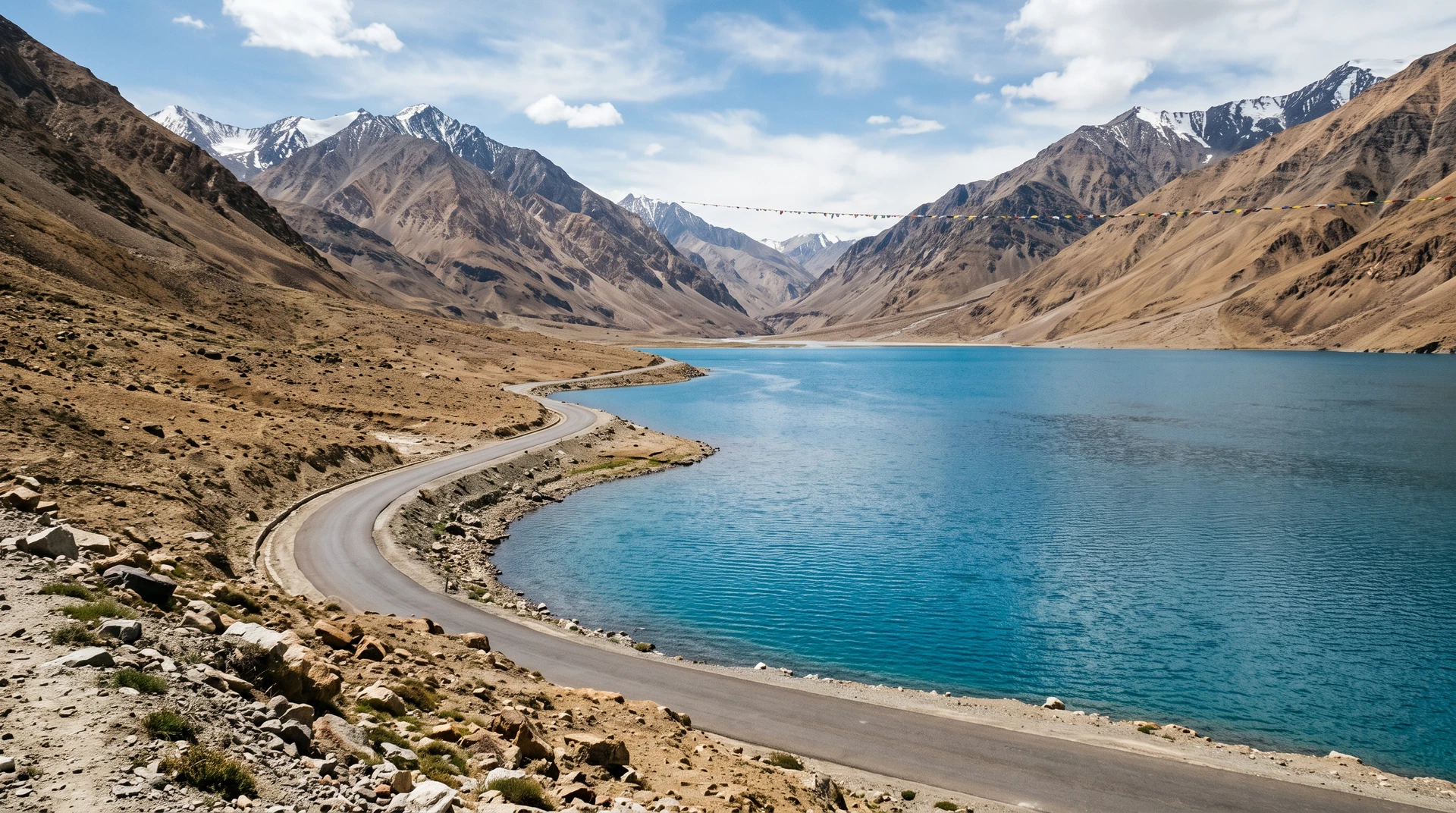
The first breath in Leh is a negotiation. At over 3,500 meters, the air is crystalline, carrying the scent of parched earth and juniper incense. Stepping off the plane, the world vibrates with an intensity that demands immediate stillness. The Trans-Himalayan plateau does not welcome the hurried; it insists on a slow, deliberate pace as the body learns to function where oxygen is a luxury. Around the town, stark mountains rise like frozen waves of ochre and violet, their jagged crests cutting into a sky so blue it feels artificial. This is the gateway to Ladakh, where geography is a spiritual challenge.
Ladakh is a realm of extremes, a high-altitude cold desert where the rain shadow of the Great Himalayas creates a landscape of surreal beauty. Here, the earth is stripped bare, revealing the raw bones of the planet in twisted strata of granite and shale. The Indus River snakes through deep gorges, a ribbon of turquoise cutting through the dust to provide life for tiny emerald oases of barley and apricot trees. To travel across this plateau is to witness the scale of geological time, where the silence is so profound it becomes a physical presence, scouring the mountain faces into architectural shapes.
Clinging to vertical cliffs like barnacles are the gompas, Buddhist monasteries that have served as spiritual anchors for over a millennium. At Thiksey or Hemis, whitewashed walls and red-ochre trim stand in sharp contrast to the monochromatic mountains. Inside, the air thickens with butter lamps and the low, rhythmic chanting of monks that vibrates through the floorboards. These are living centers of a resilient faith that has endured through centuries of isolation. The walls are adorned with intricate murals of deities, their colors still vibrant after a thousand years, telling stories of a cosmos that feels very close in this high-altitude sanctuary.
Beyond the prayer wheels lies the wild heart of the region, Hemis National Park. This rugged expanse is a critical global sanctuary for the endangered snow leopard, the "ghost of the mountains." Tracking these elusive cats requires a patience that matches the landscape, staring for hours at grey-blue scree until a shadow resolves into a living creature. The leopard is the perfect inhabitant of Ladakh—resilient, solitary, and camouflaged against the stone. Conservation efforts here balance protecting this apex predator with supporting local communities whose livestock share the same narrow valleys. It is a place where life’s fragility is always visible against the peaks.
While monasteries represent the Buddhist era, Ladakh’s history stretches further, etched into the stones of the valley floors. Recently protected prehistoric rock carvings, some dating back thousands of years, offer a glimpse into the lives of nomadic hunters and traders. These petroglyphs, depicting ibex and mysterious symbols, are scattered across the landscape, often overlooked by those rushing toward the next viewpoint. To stand before these carvings is to realize that this desert has been a crossroads for humanity for eons. The dark patina of the boulders, sun-baked for millennia, holds the records of a time before the first stone of any monastery was laid.
The people of Ladakh possess a hard-won resilience that mirrors their environment. Life is dictated by the seasons—a brief, intense summer of agricultural toil followed by a long, frigid winter where mountain passes close and communities turn inward. Traditional houses, built of sun-dried mud bricks and heavy timber, are designed to trap the sun's heat against sub-zero temperatures. There is a profound sense of community here, a necessity where survival depends on mutual aid and careful management of scarce water. Festivals, filled with masked dances and the sound of long horns, are essential social glues that bind the scattered villages together.
Travel in Ladakh involves bureaucratic and physical hurdles. Because of proximity to sensitive international borders, spectacular areas like Pangong Tso require mandatory Inner Line Permits. These documents are a reminder of the region's strategic importance and the constant presence of the military on winding roads. Furthermore, the necessity of strict altitude acclimatization cannot be overstated. A sudden ascent to the higher passes can lead to severe sickness, turning a dream journey into a medical emergency. Respecting these protocols, and environmental cautions regarding waste and water, is the price of admission to this fragile, high-altitude world.
To understand Ladakh, one must cross its passes—the Khardung La or the Chang La. These are the "High Passes" that give the land its name, places where prayer flags snap violently in the gale and the view stretches across a sea of peaks into Tibet. At these altitudes, the world falls away, and the sky presses down with physical weight. The transition between valleys is often a journey between different worlds, from the lush greenery of Nubra to the salt-crusted shores of high lakes. Each pass is a threshold, a moment of transition that requires both mechanical endurance and quiet, internal fortitude.
There is a specific quality to the light in Ladakh, especially in the late afternoon, that clarifies everything it touches. Shadows lengthen across the valleys, and peaks turn a deep, bruised purple, while golden light catches the stupas along the roadsides. In these moments, the spiritual resonance of the landscape becomes undeniable. It is a place that strips away the superfluous, leaving only the essential. Whether one is a believer or not, the combination of altitude, silence, and the scale of the mountains fosters a perspective hard to find elsewhere. The "Land of High Passes" is not just a destination but a state of mind.