Travel
Between the Earth and Sky: Finding Spiritual Resonance in Bhutan’s Verdant Paro Valley
As the gateway to the last Himalayan kingdom, Paro Valley balances the gravity of ancient cliffside monasteries with the gentle industry of red rice harvests, offering a profound encounter with Bhutan’s carbon-negative ethos and deeply rooted spiritual traditions.
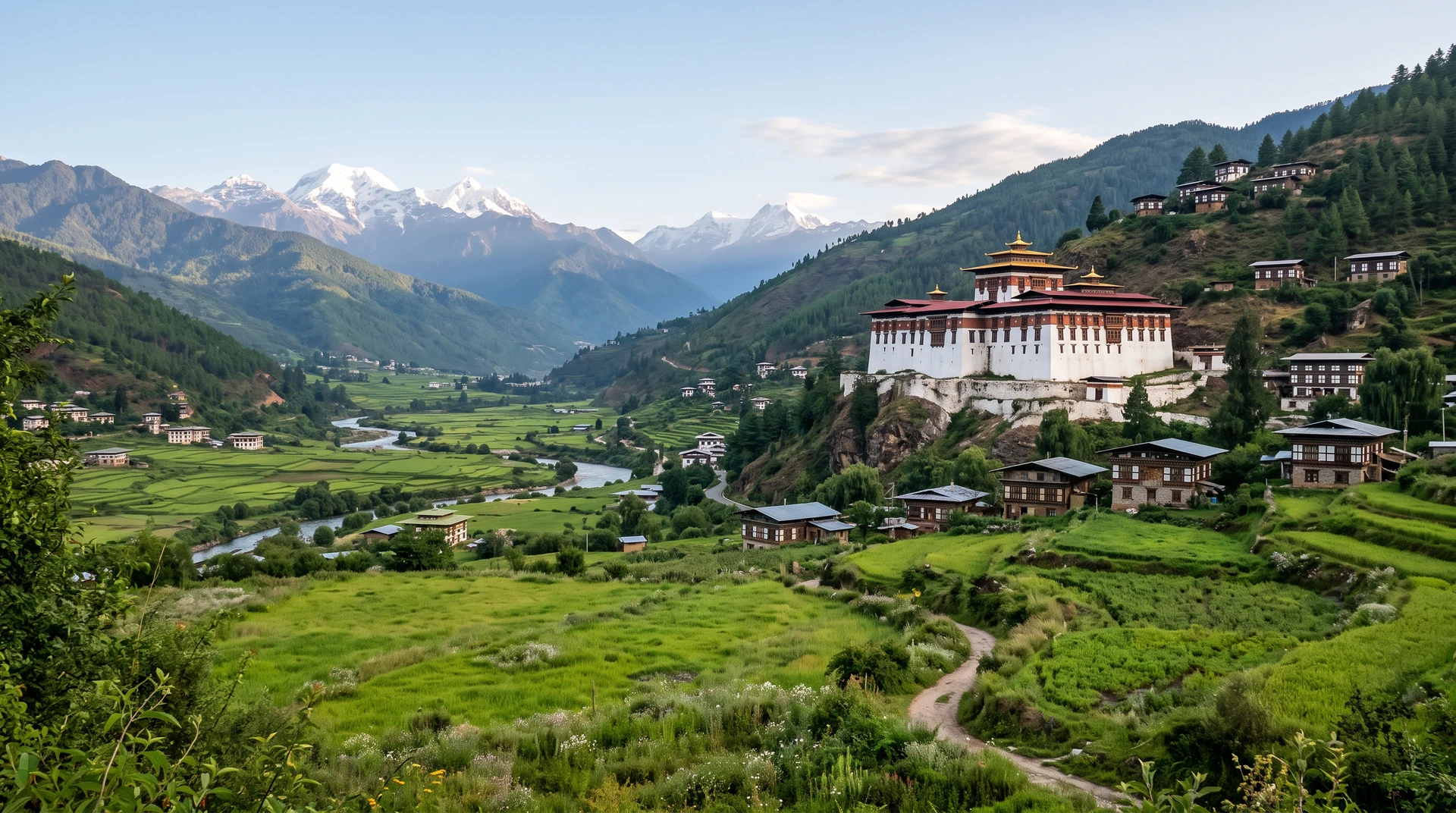
The descent into Paro Valley is an exercise in precision and awe, as the aircraft threads through narrow gaps between pine-clad ridges to reach one of the world’s most challenging international runways. Upon landing, the air is immediately different—thin, crisp, and scented with the faint, sweet smoke of juniper incense. This is the spiritual gateway to Bhutan, a kingdom that has famously chosen to measure its success through the lens of collective happiness rather than mere economic growth. In Paro, the transition from the modern world to a landscape defined by 17th-century fortresses and 8th-century legends is instantaneous, grounding every visitor in a pace of life that feels both ancient and intentionally preserved.
The valley floor is a tapestry of agricultural abundance, nourished by the glacial waters of the Paro Chhu river. As one of Bhutan’s most fertile regions, the landscape is dominated by the shimmering terraces of red rice paddies, a staple crop that defines the local culinary identity. During the harvest, the valley turns a brilliant ochre, with farmers working the land in a manner that has changed little over centuries. These fields are not merely sources of sustenance; they are the rhythmic heart of the community, reflecting a deep-seated connection to the earth that is central to the Bhutanese way of life and their commitment to remaining a carbon-negative nation.
Dominating the lower valley is the Rinpung Dzong, a massive 17th-century fortress whose name translates to "Fortress on a Heap of Jewels." Its towering whitewashed walls and intricate woodwork serve as the administrative center for the district and a vibrant religious hub for the local monastic community. Walking across the traditional cantilevered bridge that leads to the dzong, one senses the dual role these structures play—both as defensive bastions and as sanctuaries for the preservation of Buddhist art. The inner courtyards are often filled with the low hum of chanting monks and the vibrant colors of religious festivals, anchoring the valley’s daily life in a sense of sacred duty.
Historically, Paro Valley served as a critical nexus for trade, controlling one of the primary routes leading into the high plateaus of Tibet. This strategic importance brought wealth and cultural exchange to the region, necessitating the construction of the formidable dzongs that still stand guard. The remnants of the old trade paths can still be traced along the valley’s edges, where stone-paved trails once echoed with the bells of yak caravans carrying salt and spices. Today, these paths invite travelers to explore the hidden corners of the valley where the legacy of this ancient commerce remains etched into the architecture and the stories of the local elders.
No journey to Paro is complete without the arduous ascent to Paro Taktsang, or the Tiger’s Nest. This iconic monastery clings precariously to a sheer granite cliff, suspended 900 meters above the valley floor. The hike upward is a pilgrimage in itself, winding through dense forests of oak and rhododendron draped in Spanish moss. As the trail steepens, the sound of prayer wheels and the sight of colorful flags provide a rhythmic encouragement. Reaching the monastery requires a final traverse across a deep gorge, where a waterfall plunges into the abyss, heightening the sense of entering a realm that exists between the terrestrial and the divine.
The spiritual significance of Taktsang dates back to the 8th century, marking the site where Guru Rinpoche is said to have meditated for over three years. Legend holds that he arrived on the back of a flying tigress to subdue local spirits, consecrating the site as a cornerstone of Himalayan Buddhism. The monastery’s interior is a labyrinth of small chapels and meditation caves, where the air is thick with the scent of butter lamps and the weight of centuries of devotion. It is a place that demands silence and reverence, offering a rare opportunity to witness the living continuity of a faith that remains the bedrock of Bhutanese culture.
Bhutan’s approach to tourism is governed by a philosophy of high-value, low-volume travel. Visitors are required to pay a daily Sustainable Development Fee, a policy designed to ensure that the impact of tourism is managed responsibly and that the benefits are reinvested into the nation’s free healthcare and environmental conservation efforts. This stewardship is evident in the pristine condition of the valley’s forests and the authenticity of its villages. By visiting Paro, one becomes a participant in a grand experiment of sustainable living, where the preservation of cultural heritage is considered a vital necessity rather than an optional luxury.
Respecting local customs is an essential part of the Paro experience. When entering sacred spaces, travelers must adhere to strict cultural protocols, including modest dress that covers the shoulders and knees, and a total ban on photography within the interiors of temples. These rules are not intended to exclude, but rather to protect the sanctity of the sites and the privacy of those who worship within them. The resulting atmosphere is one of profound quietude, allowing the architecture and the natural environment to speak for themselves without the distraction of modern technology or the clamor of mass tourism.
Beyond the famous landmarks, the true essence of Paro is found in the quiet moments of daily life—the spinning of a prayer wheel, the communal effort of a village archery match, or the simple hospitality of a farmhouse meal. The valley’s traditional architecture, with its hand-painted floral motifs and shingle roofs weighted down by stones, creates a visual harmony that is rare in the modern world. In these smaller details, one sees the practical application of Bhutan’s spiritual values, where every action is performed with a sense of mindfulness and a respect for the interconnectedness of all living things.
As the sun sets over the ridges, casting long shadows across the red rice terraces, Paro Valley reveals its most enduring quality: a sense of profound stillness. It is a place that invites introspection, challenging the visitor to reconsider their relationship with time, nature, and the self. The journey through the valley is more than a physical exploration of a remote Himalayan landscape; it is a spiritual immersion that lingers long after the final descent from the Tiger’s Nest. In the quiet depths of Paro, the ancient echoes of the past and the sustainable promises of the future meet, offering a glimpse of a world where harmony is a lived reality.