Travel
The prehistoric giants of Komodo roam across a dramatic Indonesian volcanic archipelago
Amidst the rugged volcanic peaks of East Nusa Tenggara, Komodo National Park preserves a prehistoric world where the world’s largest lizards reign. This UNESCO-protected sanctuary offers a rare glimpse into the evolutionary divide of Wallacea, blending terrestrial majesty with some of the planet’s richest marine biodiversity.
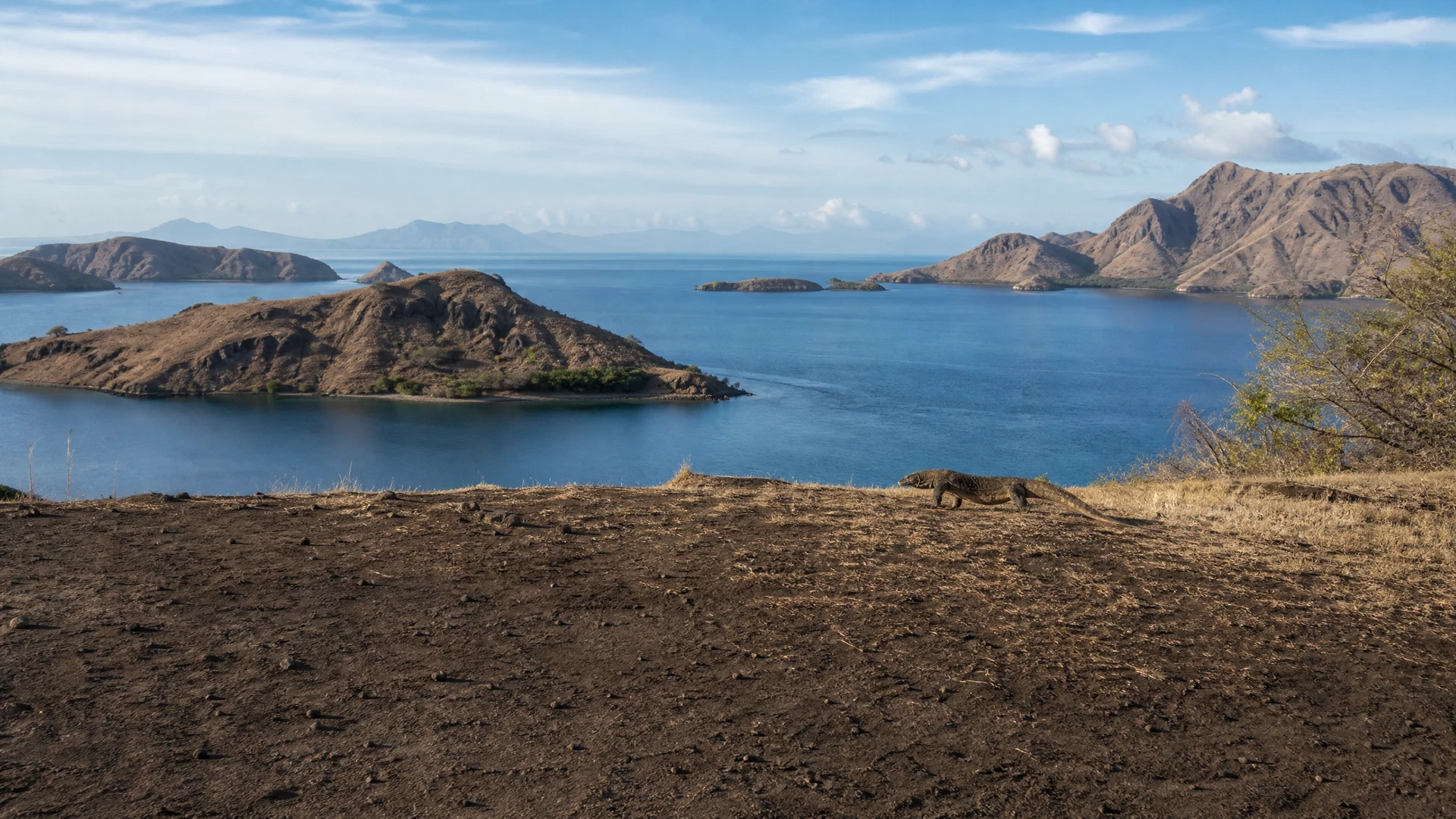
To step onto the sun-bleached shores of Padar Island is to feel the weight of deep time. The air is thick with a dry, salt-caked heat that shimmers over jagged ridges, where savanna-like hills rise sharply from the turquoise Flores Sea. From the summit of Padar’s central peak, the landscape unfolds in a dramatic display of geological artistry, revealing three distinct crescent bays—one with white sand, one with charcoal black, and one with a startlingly soft pink. This volcanic archipelago, spanning over two hundred thousand hectares, serves as a visceral reminder of the earth’s volatile origins, a place where tectonic forces have forged a bridge between the distinct evolutionary paths of Asia and Australia.
The primary residents of this rugged domain are the Komodo dragons. Encountering one of these five thousand seven hundred prehistoric survivors is an exercise in profound stillness and sudden, explosive power. They move with a heavy, rhythmic gait, their forked tongues flicking out to sample the air for the scent of prey, a sensory ritual unchanged for millions of years. Growing up to three meters in length, these apex predators possess a patient, calculating presence that commands immediate respect. Watching a dragon bask on the rust-colored earth of Rinca Island, one is struck by the texture of their armored scales and the prehistoric glint in their eyes, a sight that renders the modern world feel like a distant dream.
The park’s terrestrial grandeur is matched by the complexity of its marine environment. Beneath the surface of the swirling currents that pulse through the Sape Strait, biodiversity explodes into a kaleidoscope of life that has earned the region its status as a UNESCO World Heritage site. The reefs are vibrant and resilient, nourished by nutrient-rich upwellings that support everything from microscopic seahorses to the majestic manta rays that glide through the blue like shadows of clouds. Diving in these waters requires a keen awareness of the tides, as the powerful flows that sustain this ecosystem are the same forces that have kept these islands isolated and pristine for centuries.
Navigating this sensitive ecosystem is a privilege that comes with significant responsibilities. The Indonesian government has established strict protocols to ensure the survival of the endangered dragon population and the preservation of their volcanic habitat. Ranger-led trekking is a mandatory requirement for all visitors. These local guides possess an intimate understanding of the animals’ behavior and the rhythms of the islands. Their presence is a vital safeguard, providing the necessary distance between human curiosity and the raw, unpredictable reality of a wild predator’s territory.
The island of Komodo itself offers a different perspective, where the dry forest canopy provides shade for the smaller inhabitants of the park. Here, the orange-footed scrubfowl and the Timor deer share the landscape with the dragons, creating a delicate food web that the park’s management works tirelessly to maintain. The silence of the forest is often broken by the sharp call of a bird or the rustle of dry leaves, sounds that amplify the sense of being in a truly wild place. It is in these quiet moments that the importance of stewardship becomes most apparent, as the balance between tourism and conservation remains a constant, evolving challenge for the region.
For the observant traveler, the beauty of Komodo National Park lies in its contradictions. It is a place of harsh, unforgiving landscapes that harbor incredible life, and a site where the ancient past is visible in every scaly fold of a dragon’s skin. The practicalities of visiting—arranging boat charters from Labuan Bajo, securing permits, and timing arrivals to avoid the midday sun—are all part of the pilgrimage to this remote corner of the world. Each step taken on the dusty trails is a lesson in humility, a reminder that we are merely temporary guests in a kingdom that has belonged to the dragons since the dawn of their kind.
As the sun begins its descent, casting long, golden shadows across the savanna hills, the islands take on an ethereal quality. The silhouettes of the volcanic peaks sharpen against a sky that transitions from pale orange to a deep purple. It is at this hour that the true spirit of Wallacea is most felt, as the cool evening breeze carries the scent of the sea and the dry earth. The dragons retreat to their burrows, and the islands settle into a prehistoric slumber, undisturbed by the passage of centuries. To witness this transition is to understand why this archipelago is so fiercely protected; it is one of the few places where the wild still reigns.
Ultimately, a journey through Komodo National Park is an immersion into a living laboratory of evolution. The geological isolation that allowed the dragons to flourish also preserved a unique snapshot of the planet’s biological history. As global pressures on natural habitats increase, the continued success of the park’s conservation efforts serves as a beacon of hope. By respecting the rules of the rangers and the sanctity of the environment, visitors contribute to a legacy of protection that ensures the world’s largest lizards will continue to roam these volcanic shores for generations to come.
The park stands as a testament to the resilience of nature, where the prehistoric and the modern coexist in a beautiful tension. Leaving the archipelago, watching the islands recede into the horizon, one carries away a sense of wonder that is both humbling and exhilarating. The memory of a dragon’s gaze, the vibrant colors of a coral reef, and the stark majesty of the volcanic peaks remain etched in the mind, a vivid reminder of the extraordinary diversity of our world. Komodo National Park is not just a destination; it is a profound encounter with the raw, unyielding power of life itself.