Travel
Prehistoric stone meets the vibrant pulse of the Coral Triangle in Indonesia’s emerald karst.
Beyond the reach of modern noise, Indonesia’s Raja Ampat archipelago preserves a prehistoric landscape of limestone towers and unparalleled marine life. Grounded in ancient Papuan wisdom, this remote sanctuary offers a profound encounter with Earth’s geological history and the world’s most diverse coral ecosystems.
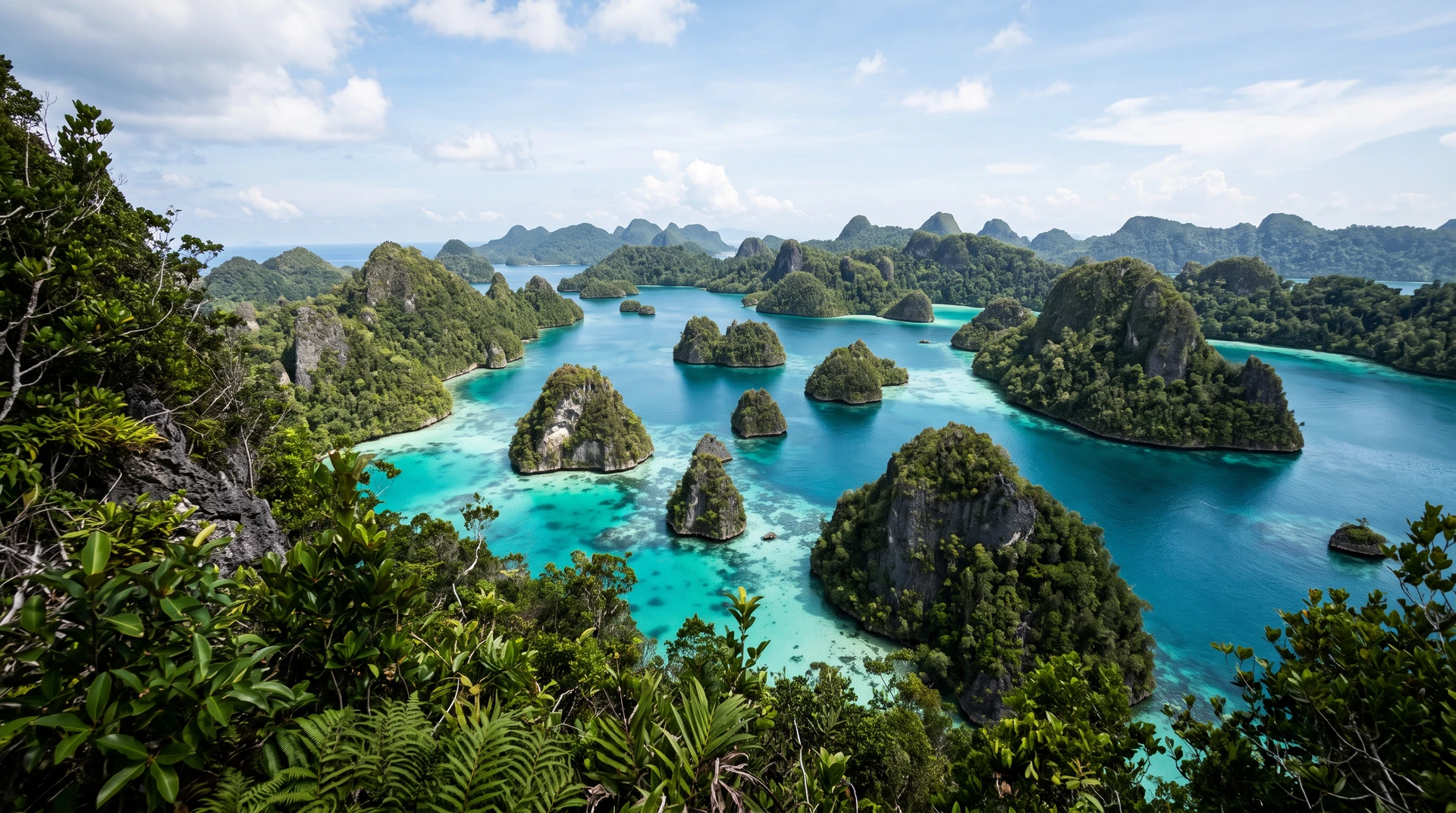
The air in Southwest Papua carries a specific weight, a humid thickness that smells of salt, crushed limestone, and the damp breath of primary jungle. As the boat weaves through the Dampier Strait, the horizon dissolves into a labyrinth of emerald-crowned karst formations. These are not merely islands; they are the jagged teeth of an ancient world, rising abruptly from a sea so clear it feels like a trick of the light. Here, at the eastern edge of the Indonesian archipelago, the passage of time feels less like a linear progression and more like a slow, rhythmic tide. The silence is punctuated only by the slap of water against the hull and the distant, haunting cry of a bird of paradise. It is a place where the map feels like a suggestion, and the primary colors of nature—deep greens, vibrant turquoises, and the blinding white of sun-bleached rock—dominate the senses.
To understand Raja Ampat is to look back four hundred and forty million years. The Silurian-Devonian rock formations that form the backbone of these islands represent nearly one-tenth of Earth’s entire geological history. Walking along the narrow, winding paths of a limestone ridge, one is literally treading on the remnants of prehistoric eras. The erosion of these ancient stones has created a surreal topography of hidden lagoons, steep cliffs, and cavernous overhangs that seem to defy gravity. These geological sentinels have witnessed the shifting of continents and the slow evolution of life, standing firm as the rest of the world accelerated. There is a humbling perspective to be found in these stones; they remind the visitor that our human presence here is but a fleeting moment in a much grander, more enduring narrative of planetary transformation.
Below the waterline, the narrative shifts from the stillness of stone to the frenetic energy of life. Raja Ampat sits at the absolute heart of the Coral Triangle, a region recognized by marine biologists as the global epicenter of marine biodiversity. The statistics are staggering: three-quarters of all known coral species on the planet can be found here, providing a kaleidoscopic home for over fifteen hundred varieties of reef fish. It is not merely the number of species that impresses, but the sheer density of the environment. In a single dive, one might encounter everything from the microscopic pygmy seahorse, perfectly camouflaged against a sea fan, to the majestic oceanic manta ray gliding through the blue. The reefs here are not just healthy; they are exuberant, a riot of color and form that challenges the imagination.
Submerging into these waters is like stepping into a living cathedral. The sunlight filters through the surface in dancing beams, illuminating forests of staghorn coral, massive brain corals, and delicate gorgonian fans that sway in the gentle currents. Schools of fusiliers and damselfish move in synchronized pulses, their scales glinting like scattered silver coins. Unlike many other reef systems around the world that are struggling under the weight of climate change, the waters of Raja Ampat retain a startling resilience. This vitality is not accidental; it is the result of a unique confluence of nutrient-rich currents and a deep-seated local commitment to protection. To witness this underwater wilderness is to see the ocean as it was meant to be—thriving, complex, and infinitely beautiful, a sanctuary where nature still holds its original power.
The stewardship of this fragile paradise is rooted in "sasi," an ancestral conservation system practiced by the indigenous Papuan communities. Sasi is not a modern regulation imposed from the outside, but a traditional law that governs the relationship between the people and their environment. It involves the seasonal closure of specific areas to fishing or harvesting, allowing the ecosystem time to recover and replenish itself. A wooden sign or a specific plant marker placed on a beach signals that a particular reef or forest area is under sasi, and this boundary is respected with a reverence that no modern fine could enforce. This ancient seafaring wisdom recognizes that human survival is inextricably linked to the health of the natural world, a philosophy that feels increasingly vital as global ecosystems face unprecedented pressure.
Today, this traditional wisdom is bolstered by a formal system of marine protected areas and community-managed "no-take" zones. Visitors are required to obtain a mandatory Marine Park Entry Permit, the proceeds of which directly support conservation efforts and local community development. This is a practical application of the idea that tourism must be a tool for preservation rather than a force for depletion. Navigating these zones requires a conscious effort from the traveler—a commitment to follow the guidance of local rangers and to leave no trace of their passage. The "no-take" policy is absolute; not a single shell or piece of coral is to be removed, ensuring that the bounty of the archipelago remains intact for the generations of Papuans who call this place home.
Traveling to Raja Ampat remains a logistical challenge, which is perhaps its greatest protection. The journey often involves multiple flights followed by long boat transfers to remote homestays or liveaboards. There are no sprawling resorts or high-speed highways here; instead, there are wooden jetties, solar-powered lights, and the sound of the jungle at night. This lack of conventional luxury is the price of admission for such raw beauty. Practicality is key: visitors must pack biodegradable sunscreen, reusable water bottles, and a deep respect for local customs. The experience is not about what the islands can provide for the visitor, but about how the visitor can exist within the islands without disrupting their delicate balance. It is a destination that demands patience and rewards it with a sense of profound connection.
As the sun sets over the Wayag Islands, casting long shadows across the emerald karst, the true spirit of Raja Ampat reveals itself. It is a place where the prehistoric and the present coexist in a fragile, beautiful harmony. The wisdom of the past, encoded in the sasi traditions, provides a roadmap for the future, proving that humans can indeed live in balance with the natural world. Leaving the archipelago, one carries away more than just photographs of turquoise lagoons and vibrant reefs; there is a lingering sense of responsibility, a realization that such places are rare and require our collective vigilance to protect. The "Emerald Karst of the Equator" stands as a testament to the enduring power of nature and the vital importance of the wisdom that guards it.