Travel
The ancient giants of Sabah stand as silent sentinels over the world's oldest primary rainforest.
Deep within the 130-million-year-old heart of Borneo, the Danum Valley Conservation Area remains a rare, primary lowland dipterocarp sanctuary. Here, endangered orangutans and pygmy elephants wander beneath the towering Meranti giants, offering a profound encounter with a landscape that has remained largely unchanged since the Mesozoic era.
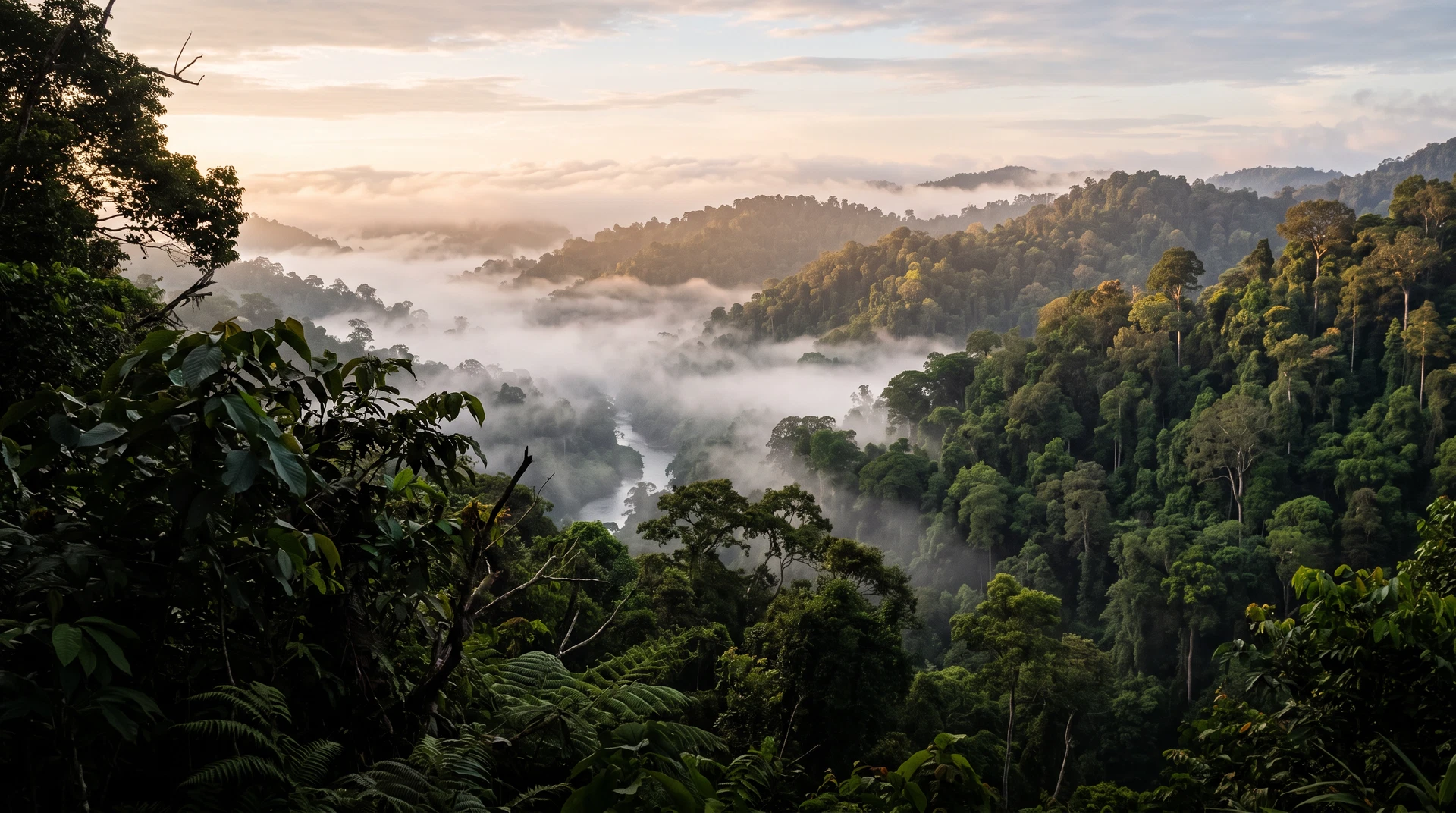
The air in Danum Valley does not just sit; it breathes, a heavy, humid respiration smelling of damp earth and the sharp, sweet sap of ancient timber. Entering this 43,892-hectare sanctuary in Sabah is a descent through time. This primary lowland dipterocarp forest is a 130-million-year-old ecosystem that has stood undisturbed while the world modernized. The canopy is so dense that midday sun only reaches the floor in fractured needles, illuminating a world claimed by moss and climbing lianas. To stand at the base of these giants is to feel the weight of an era predating the first flowers, a living relic of the Mesozoic pulsing with slow, deliberate energy.
Dominating this vertical kingdom are the Meranti trees, titans reaching for the clouds with staggering ambition. Among them stands 'Menara', a Yellow Meranti stretching 100.8 meters into the Bornean sky as the world's tallest tropical tree. Looking up from the forest floor induces a peculiar vertigo; the trunk rises straight and silvered for dozens of meters before erupting into a massive canopy. These trees are the scaffolding of the valley, supporting a complex aerial highway where life plays out far above the shadows. The scale of the Meranti reminds visitors that in Danum, humans are merely temporary observers in a landscape designed for giants, where time is measured in centuries.
Wildlife here is a presence earned through patience. The rustle of a branch often signals the slow movement of a Bornean orangutan, its copper fur glowing like a dying ember against deep green leaves. Unlike rehabilitated individuals elsewhere, Danum’s orangutans are wild, their lives dictated by the forest's fruiting cycles. On the floor, signs of the Bornean pygmy elephant are visceral—deep, mud-slicked footprints and the crashing of bamboo thickets. These smaller cousins of the Asian elephant move in family herds, a reminder that this valley remains one of the few places where large mammals follow ancient migratory paths without the intrusion of fences or roads.
The valley’s status as a Class 1 Protection Forest Reserve is the thin line between survival and the encroaching plantations. This designation ensures no logging or development pierces the perimeter, preserving a gene pool of biodiversity that is increasingly rare. The transition from secondary forests to primary growth is stark; trees become thicker, bird calls more varied, and the light changes quality. It is a fragile fortress of biology, where the complex relationships between fungi, insects, and trees have had millions of years to perfect. Scientists flock here not just to count species, but to understand how a truly healthy rainforest functions as a single, massive organism.
Within limestone outcrops, the valley holds the history of its original inhabitants. Ancient indigenous burial sites are tucked into cliff shadows, where traditional belian, or ironwood, coffins rest alongside weathered porcelain spirit jars. These ironwood containers have withstood the relentless rot of the tropics for centuries, bridging the living forest and the ancestors who once called it home. This presence adds spiritual gravity; it is not merely a biological laboratory but a sacred space where the line between the natural and the supernatural is thin. Respecting these sites is paramount, representing a cultural continuity as ancient as the trees themselves.
Accessing this remote interior requires a long, bone-jarring drive from Lahad Datu. Entry is strictly restricted to permitted vehicles and pre-booked visitors, a necessary gatekeeping to prevent the 130-million-year-old ecosystem from being overwhelmed. The road is a winding track of red clay that snakes through hills, often turned into a treacherous slide by torrential Bornean downpours. Visitors must prepare for the physical realities—the clinging humidity, the leeches in the damp leaf litter, and the constant chorus of cicadas. It is a place demanding ruggedness, rewarding those who tolerate discomfort with a sensory immersion that no luxury resort can replicate.
As the sun dips below the ridges, the valley shifts from a visual landscape to an auditory one. The transition to night is sudden; diurnal birds fall silent, and a new cast emerges. Flying squirrels glide like ghosts, and the reflective eyes of civets catch the torchlight. The night air carries the scent of nocturnal blooms that open only in the dark to attract specialized pollinators. Walking the forest at night is a lesson in humility; the world shrinks to the circle of your light, and every snap of a twig feels amplified. It is in these dark hours that the valley feels most ancient, a place where the primal rhythms of life take over.
Leaving Danum Valley is a slow decompression, a return to a world of straight lines. The stewardship required to maintain this ecosystem is a collective responsibility, demanding adherence to low-impact guidelines. We are reminded that places like this are critical lungs for the planet and repositories of a biological heritage we are only beginning to map. The wistful pull of the valley lies in its permanence; it feels as though it has always been there and, with care, always will be. To have walked among its giants is to carry a piece of that stillness back into the chaos of the everyday, a quiet reminder of nature's raw, unyielding power.