Travel
The Teardrop of the Pacific: Beyond the Breaks of Siargao’s Emerald Mangroves
While the world flocks to the thunderous peaks of Cloud 9, Siargao reveals its true heart within the labyrinthine silence of its ancient mangroves. Discover a teardrop-shaped sanctuary where community-led conservation and low-impact travel are preserving the Philippines' most vital coastal frontier.
Approaching Siargao from the air, the island reveals its geometry before its character—a distinct, verdant teardrop resting against the deep indigo of the Philippine Sea. It is a shape that suggests both fragility and a sharp, focused beauty, a landmass defined by its edges where the Pacific swells first meet the archipelago. Upon landing, the air is thick with the scent of salt and damp earth, a reminder that this is not just a destination but a living, breathing ecosystem. The rhythmic sound of the surf is a constant companion, yet as one moves inland, this roar softens into a humid silence.
For decades, the global narrative of Siargao has been written in the language of the surf. The legendary Cloud 9 reef break, with its hollow tubes and razor-sharp coral floor, transformed a quiet outpost into a premier international venue for professional competitions. Standing on the iconic wooden boardwalk, one can feel the raw power of the ocean as it collides with the reef. It is a place of high adrenaline where the culture of the wave dominates. However, to see Siargao only through its surf is to miss the complex, emerald-hued reality that lies just beyond the spray.
The island’s true significance is anchored in the Siargao Island Protected Landscape and Seascape, known locally as SIPLAS. Spanning approximately 278,914 hectares, this massive conservation area is a testament to the Philippines' commitment to preserving its most critical biodiversity zones. It is a sprawling tapestry of marine and terrestrial environments, where the protection of the land is inextricably linked to the health of the sea. Navigating this territory requires moving away from the concentrated energy of tourist hubs and into the expansive, quiet reaches of the island’s interior and its intricate, water-logged fringes.
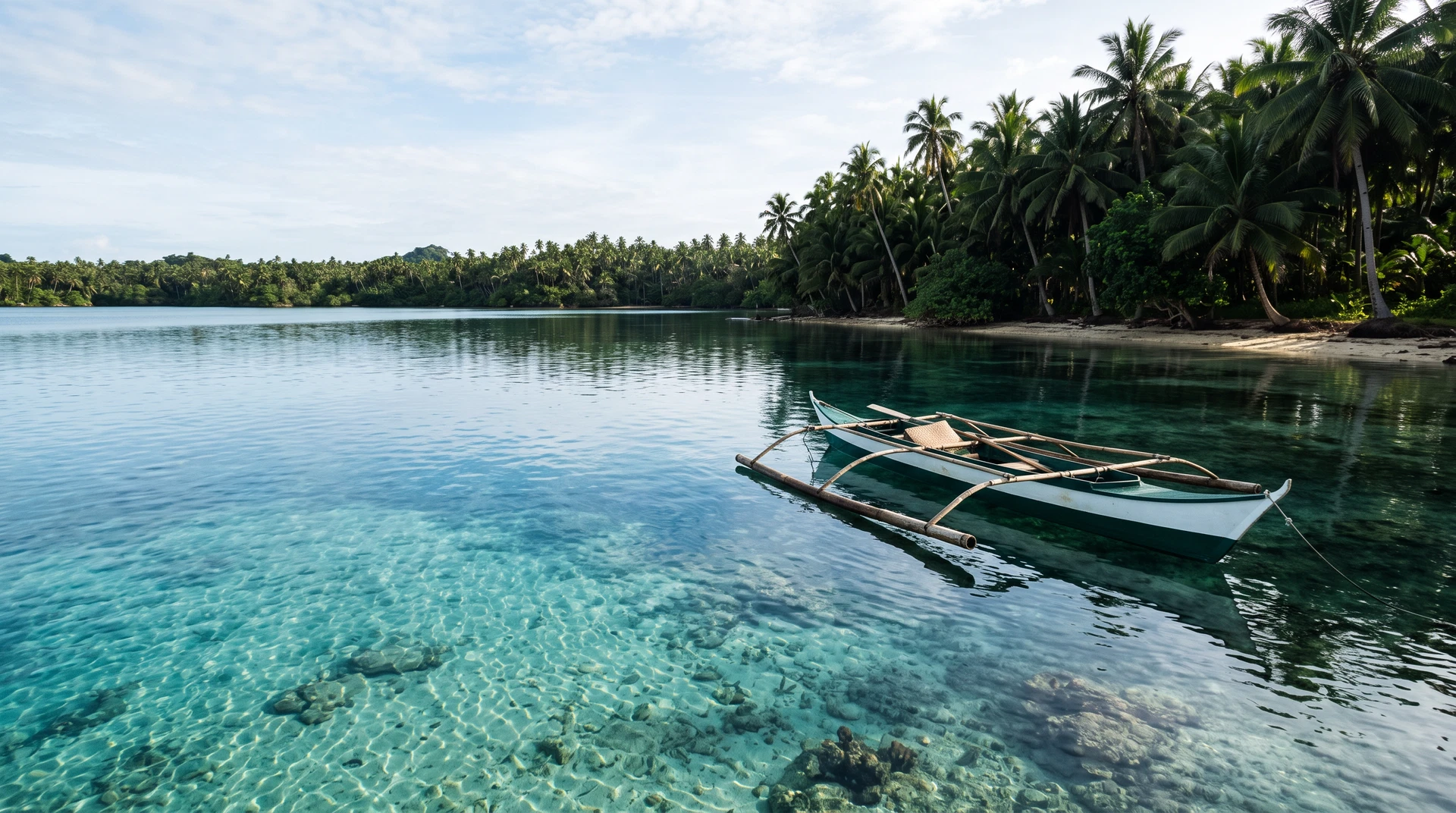
Deep within the island’s western reaches lies its most vital organ: the largest contiguous mangrove forest in the Philippines. Covering 4,800 hectares, this emerald labyrinth is a world of stilt roots and brackish water, where the tides dictate the rhythm of life. To drift through these narrow channels in a traditional boat is to enter a cathedral of green. The mangroves act as a silent fortress, protecting the coastline from Pacific storms and serving as a crucial nursery for countless marine species. The stillness here is profound, a stark contrast to the crashing waves of the coast.
This dense thicket of roots and mud is also a sanctuary for the rare and the ancient. The Siargao mangroves are one of the few remaining habitats for the saltwater crocodile, a creature that has navigated these waters since long before the first surfboard touched the sand. While sightings are rare, their presence adds a layer of prehistoric gravity to the landscape. It is a reminder that Siargao is not a manicured playground but a wild frontier where nature still holds sway. The biodiversity here is a functioning, fragile machine that sustains the island’s entire ecological balance.
Sustainability in Siargao is not a marketing buzzword but a necessity born of geographical isolation and environmental vulnerability. The community has led a rigorous movement toward low-impact travel, most notably through a strict island-wide ban on single-use plastics. Walking through local markets or dining in small eateries, the absence of plastic straws and bags is striking. It is a collective effort that requires constant vigilance and a shift in daily habits for residents and visitors alike. This community-led stewardship is the foundation upon which the island’s future is being built, ensuring that travelers do not erode the beauty they come to see.
Beneath the surface of turquoise lagoons and beyond the surf breaks, "no-take" marine zones offer a sanctuary for aquatic life. These protected areas are off-limits to fishing, allowing fragile coral reefs to recover and thrive. Snorkeling reveals a vibrant, kaleidoscopic world of parrotfish, sea turtles, and intricate coral formations that pulse with life. The health of these reefs is a direct result of stringent local ordinances that prioritize ecological integrity over short-term gain. It is a delicate balance, requiring a deep respect from every visitor who enters the water to ensure these underwater gardens remain intact for future generations.
The daily rhythm of Siargao is best experienced on two wheels, navigating the winding roads that cut through endless groves of coconut palms. The landscape is a blur of vibrant green, punctuated by small villages where life moves at a pace dictated by the sun and the tides. There is a tangible sense of place here, a feeling that the island’s identity is still firmly rooted in its soil and its seas. Whether it is the taste of a fresh coconut opened by the roadside or the sight of local fishermen returning, the authentic character of Siargao remains resilient despite its growing profile.
As the sun sets, casting a long, golden glow over the Pacific, the importance of low-impact travel becomes even more apparent. The beauty of Siargao is not just in its dramatic vistas or its world-class waves, but in the quiet spaces between them. It is found in the commitment to conservation, the respect for local traditions, and the understanding that we are merely temporary guests in a very old place. The future of this teardrop-shaped sanctuary depends on a continued dedication to these principles, ensuring that the narrative of its survival remains one of preservation rather than loss.
Siargao stands as a compelling model for the future of tourism in the Philippines and beyond. It proves that a destination can embrace its natural gifts—its waves, its forests, its reefs—without sacrificing them to the altar of mass development. By grounding its growth in community-led stewardship and environmental protection, the island has created a travel experience that is as meaningful as it is beautiful. To visit Siargao is to participate in a grand experiment in sustainability, a journey that challenges us to be better travelers and more mindful inhabitants of the planet we share.