Travel
The Stone Sentinels of Batanes: Where the Pacific Carves a Resilient Northern Frontier
In the northernmost reaches of the Philippines, the Batanes archipelago stands as a wind-swept testament to Ivatan endurance. Here, limestone dwellings and wave-cut cliffs mirror a culture shaped by the relentless rhythms of the sea and the seasonal passage of migratory birds.
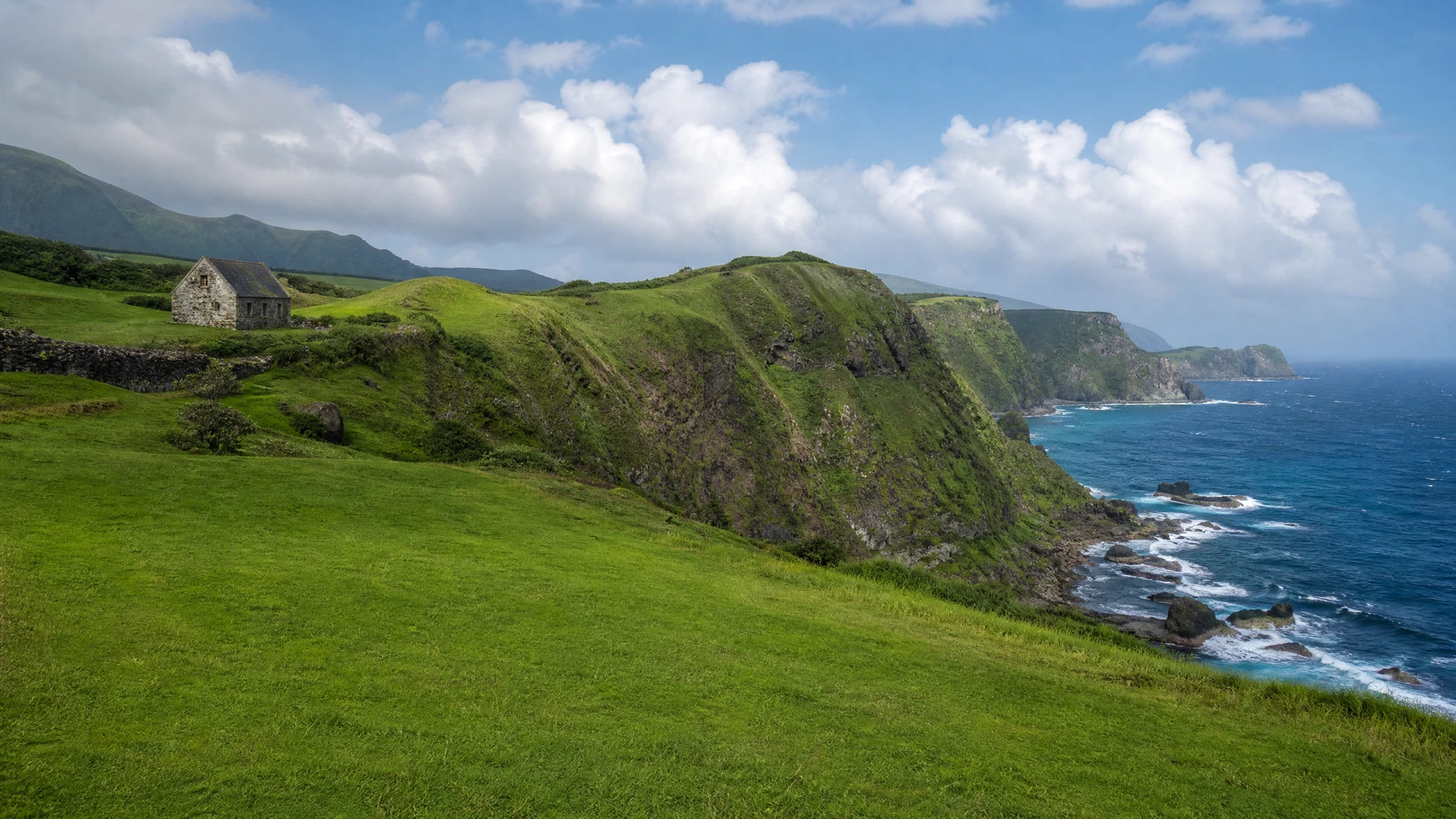
To reach the Batanes archipelago is to step beyond the familiar tropical shorthand of the Philippines and enter a realm defined by the sheer, unyielding physics of the North Pacific. Between the Bashi and Balintang Channels, these ten islands form a rugged bridge toward the northern horizon, where the sea is a churning engine of change. The air here carries a different weight, a salt-heavy pressure that signals the transition from the archipelago’s interior to its most exposed frontier. It is a landscape of high-contrast drama, where rolling hills are abruptly severed by wave-cut cliffs.
The most striking evidence of this negotiation is found in the Ivatan dwellings, which stand as architectural embodiments of survival. Unlike the lightweight structures found further south, the homes here are built with a formidable permanence. Thick limestone walls, often several feet deep, are paired with heavy, multi-layered thatched roofs of cogon grass. These structures do not merely shelter their inhabitants; they anchor them to the earth, providing a steady sanctuary when the wind reaches speeds that would strip lesser buildings to their foundations.
Walking through the narrow lanes of an Ivatan village, one senses the quiet discipline required to maintain such a life. The cogon roofs require a community-wide effort to repair and replace, a tradition of collective labor that mirrors the social cohesion necessary in such an isolated environment. The stones themselves, gathered from the nearby shores, carry the texture of the islands—pockmarked by salt and weathered by the sun. There is a profound stillness in the architecture that belies the volatility of the weather, a stoic grace that has allowed the Ivatan culture to persist through centuries of climatic and historical pressure.
The islands serve as a vital celestial crossroads, acting as a critical flyway for numerous migratory bird species that navigate the vast oceanic corridors. During the seasonal shifts, the skies above Batanes become a theater of transit, as thousands of wings catch the updrafts from the cliffs. For these travelers, the archipelago is a necessary waypoint, a rare speck of terrestrial stability in a thousand-mile stretch of water. This ecological significance adds a layer of transient beauty to the islands, where the residents share a deep, intuitive understanding of the wind’s direction and the sea’s temperament.
Below the surface of the churning channels, the environment is equally complex and rare. The marine territory of Batanes hosts vibrant colonies of pink and red corals, species that thrive in the oxygen-rich, high-energy waters surrounding the islands. These underwater gardens are as fragile as they are spectacular, shielded by the very isolation that makes them difficult to reach. The interaction between the deep oceanic trenches and the shallow coastal shelves creates a unique marine laboratory, where the biodiversity is sustained by the constant flow of nutrients. It is a world of hidden color that contrasts sharply with the monochromatic strength of the surface cliffs.
The geology of the coastline is a masterclass in erosion and endurance. The wave-cut cliffs, rising hundreds of feet above the surf, are etched with the history of every storm that has passed through the Bashi Channel. In between these massive headlands, one finds secluded white sand beaches, hidden alcoves of tranquility where the water turns a startling, translucent turquoise. These beaches are raw, shifting edges of the land, often littered with coral fragments and volcanic stones. They offer a rare moment of softness in a landscape that is otherwise defined by its sharp angles and vertical drops.
The Ivatan people maintain a relationship with their land that is both practical and deeply respectful. This is not a culture that seeks to dominate its environment but one that has learned to flow with its rhythms. The traditional farming plots, enclosed by stone walls to protect crops from the salt spray, create a patchwork of green across the hillsides. There is a deliberate pace to life here, dictated by the availability of transport and the constraints of the seasons. To visit Batanes is to accept these constraints, to understand that the schedule of the islands is set by the sea and the sky.
Preservation here is an active, ongoing process rather than a static goal. The Batanes Protected Landscapes and Seascapes designation reflects a commitment to maintaining the balance between human habitation and ecological integrity. Visitors are required to pre-register through the official provincial tourism portal, a measure designed to manage the footprint of outsiders on this sensitive frontier. This stewardship extends to the cultural realm as well, where respecting Ivatan traditions is not merely a courtesy but a prerequisite for engagement. It is a reminder that some of the world’s most beautiful places are also its most vulnerable.
The sensory experience of Batanes is dominated by the wind. It is a constant companion, a force that shapes the growth of trees, the tilt of the grass, and the very sound of the islands. Standing on a high ridge overlooking the Pacific, the roar of the ocean below is often drowned out by the whistle of the gale through the cogon thatch. This auditory landscape is both humbling and exhilarating, stripping away the distractions of modern life and focusing the mind on the immediate reality of the elements. It is here, in the face of the untamed Pacific, that the archipelago's character is revealed.
Ultimately, Batanes is a place of profound clarity. The isolation that once made it a fortress of survival now makes it a sanctuary of perspective. In the shadow of the limestone walls and the presence of the migratory birds, the complexities of the world beyond the channels seem to recede. What remains is a landscape of essential truths: the strength of a well-built home, the necessity of community, and the enduring beauty of a land that refuses to be tamed. It is a wistful frontier, where the wind always carries the scent of the open sea.