Travel
The gilded temples and river mists define the spiritual peninsula of Luang Prabang.
Nestled at the confluence of the Mekong and Nam Khan rivers, this UNESCO-listed sanctuary offers a rare synthesis of ancestral Lao craft and European architectural influence. Between the dawn alms and the evening glow of Wat Xieng Thong, Luang Prabang remains a bastion of contemplative, timeless grace.
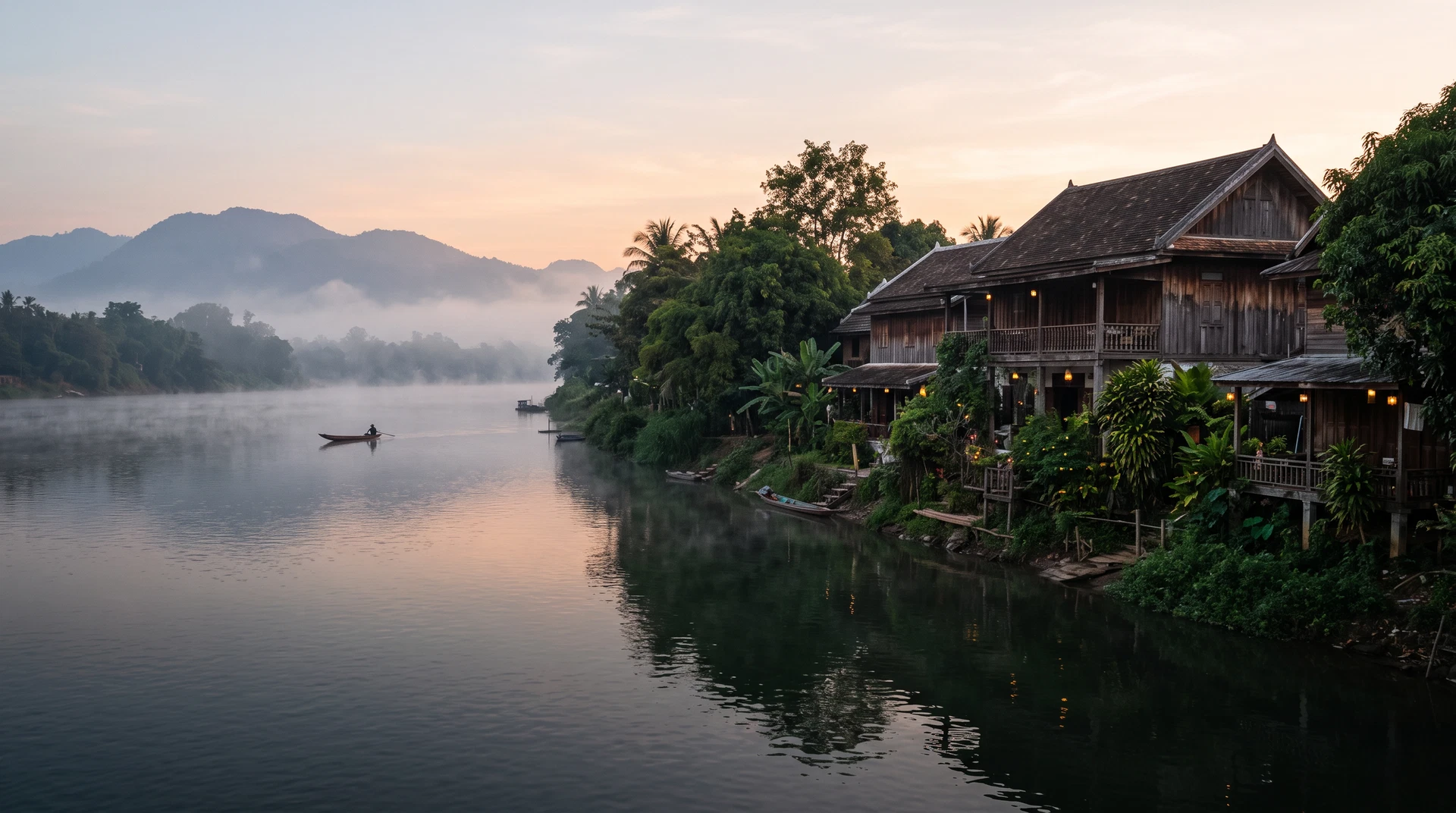
The mist rises from the Mekong with a slow, deliberate grace, clinging to the teak-lined banks of Luang Prabang. Here, at the tip of a narrow peninsula where the mighty Mekong meets the serpentine Nam Khan, the geography dictates the town’s rhythm. It is a place defined by the movement of water and the stillness of prayer. For centuries, this former royal capital has served as the spiritual heartbeat of Laos, a sanctuary where the air is heavy with the scent of frangipani and woodsmoke. To arrive here is to step into a landscape where the modern world’s frantic pace is replaced by the gentle creak of a rowing boat and the distant tolling of a temple bell.
Walking through the central grid, one is immediately struck by the architectural dialogue that defines its UNESCO status. On one side, traditional Lao wooden houses stand on sturdy stilts, their steep roofs designed to shed heavy monsoon rains. Directly opposite, two-story French colonial villas with shuttered windows and whitewashed walls draped in bougainvillea speak to a different era. This fusion is not jarring; rather, it creates a unique aesthetic harmony that feels organic to the peninsula. The weathered ochre of colonial facades complements the dark timber of Lao homes, all framed by a lush canopy of tropical greenery that seems to swallow the town’s edges.
Before the sun clears the horizon, the town undergoes its most sacred transformation. The morning alms-giving ceremony, known as Tak Bat, is a tradition that has remained largely unchanged for generations. In the pre-dawn indigo, hundreds of saffron-robed monks emerge from the town’s thirty active monasteries, walking in single file along the main thoroughfare. Local residents sit quietly on low stools, offering handfuls of sticky rice into the monks’ metal bowls. It is a silent exchange, a ritual of merit-making that reinforces the deep bond between the monastic community and the laity. For the observer, it is a lesson in humility, provided one maintains a respectful distance.
Among the many spiritual landmarks, Wat Xieng Thong stands as the architectural anchor of the peninsula. Built in the 16th century, the temple exemplifies the classic local style, characterized by roofs that sweep low to the ground, mimicking the wings of a bird. The exterior walls are adorned with intricate gold stenciling on a black lacquer background, depicting mythological scenes and daily life. Most striking is the "Tree of Life" mosaic on the rear wall of the main hall, a shimmering assembly of colored glass that tells the story of the cosmos. Inside, the dim light reveals rows of bronze Buddhas and the lingering scent of incense, offering a cool refuge from the midday heat.
Life in Luang Prabang is lived at the speed of a slow-moving river. There is no rush, partly because the town is small enough to navigate by bicycle, and partly because the heat encourages a certain languor. In the afternoons, the streets are quiet as residents retreat into the shade. This is the best time to wander the side alleys that lead down to the rivers. Along the Nam Khan, seasonal bamboo bridges are rebuilt every year after the rainy season, connecting the town to the rural villages on the opposite bank. Crossing these fragile, swaying structures is a reminder of the ephemeral nature of life here, where man-made structures must constantly adapt to the whims of the environment.
The culinary landscape is as diverse as the architecture, blending local ingredients with refined techniques. At the morning market, vendors display mounds of vibrant herbs, river weed known as kaipen, and the pungent, fermented fish paste that forms the backbone of Lao cuisine. In contrast, the town’s cafes serve delicate pastries and strong Lao coffee, a legacy of the French presence. One might spend an hour peeling a sweet pomelo by the river or enjoying a bowl of khao piak sen, a thick rice noodle soup, at a street-side stall. The flavors are bright and earthy, mirroring the landscape itself—bitter greens, spicy chilies, and the ubiquitous, comforting presence of sticky rice served in woven baskets.
As evening approaches, the town shifts its focus toward the night market that occupies the main street. Under blue and red silk canopies, local artisans from the surrounding hill tribes sell their wares. There are hand-woven textiles featuring complex geometric patterns, silver jewelry, and paper lanterns made from mulberry bark. Unlike the aggressive commerce found in larger cities, the market here is surprisingly quiet. Bargaining is done with a smile and a soft voice. It is an opportunity to see the craftsmanship that has been passed down through families, a tangible link to the rural heritage that surrounds the town’s more formal, royal history.
When the sun finally dips below the mountains, Luang Prabang settles into a deep, restorative silence. The tourists retreat, and the town belongs once again to the monks and the river. It is in these moments, when the only sound is the rustle of palms and the flow of the Mekong, that the true character of the place reveals itself. Luang Prabang is not a museum; it is a living community that has managed to hold onto its soul in a rapidly changing world. It remains a place of pilgrimage, not just for the faithful, but for anyone seeking a reminder that peace is a presence of mind.