Travel
The White Fortress of Hierapolis: Walking Through Türkiye’s Ancient Pools of Living Stone.
In the heart of southwestern Türkiye, the calcium-rich springs of Pamukkale have sculpted a surreal landscape of brilliant white travertine terraces and warm mineral basins. Beyond the petrified waterfalls, the sprawling ruins of Hierapolis reveal a sophisticated ancient spa city where history remains etched in bone-white stone.
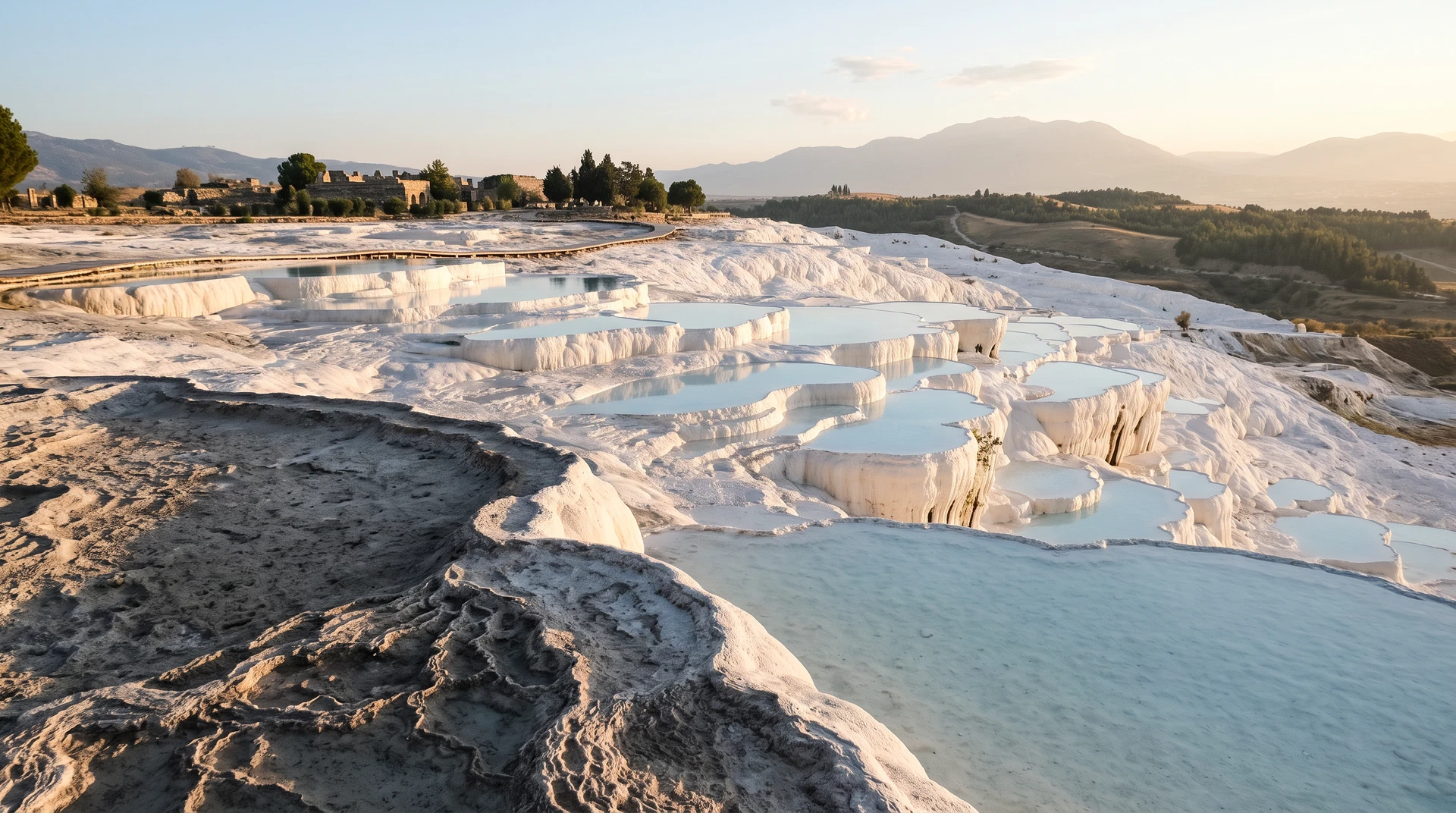
Approaching the Çürüksu Valley in southwestern Türkiye, the horizon yields to a sight defying the arid logic of the landscape. A massive, gleaming white cliff face, stretching nearly three kilometers, rises like a frozen glacier under the Aegean sun. This is Pamukkale, the "Cotton Castle," a geological marvel formed by the flow of mineral-rich thermal waters. These springs, saturated with calcium carbonate, emerge at body temperature, spilling over a 200-meter precipice. As the water cools, it leaves a residue of pure white calcite, hardening into petrified waterfalls and scalloped terraces that have beckoned travelers since antiquity. It is a landscape feeling less like geology and more like a slow-motion architectural event.
The experience of Pamukkale begins with a removal of the self from the modern world, starting with one’s shoes. To protect the delicate, porous travertine from abrasive soles, visitors must walk barefoot across designated sections. The sensation is unexpected; the stone is not slippery but textured, offering a natural grip even as warm water ripples over the ankles. Walking here is an act of tactile discovery, where the soles of the feet map the ridges of the calcite. The pools, terraced like rice paddies on a celestial scale, hold water of an ethereal, milky blue. Stepping into these basins, one feels the earth’s gentle warmth, a soothing contrast to the reflective glare of the white stone.
Rising above the shimmering terraces, the landscape transitions from geological wonder to archaeological majesty. Here lie the ruins of Hierapolis, an ancient Greco-Roman spa city founded in the second century BC. Unlike cities built for commerce, Hierapolis was established as a sanctuary of healing, where the weary immersed themselves in the waters that created the white cliffs below. The ruins are a narrative of a society that integrated wellness into its urban design. As you walk inland, white stone gives way to the sun-baked limestone of grand colonnaded streets, bathhouses, and gymnasiums. The air feels heavy with the weight of centuries, where the whispers of ancient physicians seem to linger in the warm breeze sweeping the plateau.
The crowning jewel of Hierapolis is the Roman theater, commanding the hillside with imposing dignity. Capable of seating 12,000 spectators, it remains one of the best-preserved examples in the Mediterranean. Its elaborate stage building still retains intricate friezes depicting mythological scenes and the life of Emperor Septimius Severus. Standing in the upper tiers, the scale of the ancient city becomes apparent. From this vantage point, the theater serves as a stone lens viewing the entire valley, with the modern town appearing like a miniature model at the foot of the massive white cliffs. The preservation is so complete that one can almost hear the echo of a performance, the acoustic precision of the Romans still evident in every row.
Stretching northward is the Necropolis, a silent city of the dead that ranks among the largest in the ancient world. More than 1,200 tombs line the road, ranging from simple sarcophagi to elaborate house-shaped vaults. Because Hierapolis was a healing center, many who sought a cure ultimately found their final resting place here. The variety of funerary architecture reflects the city's cosmopolitan nature, with styles influenced by Hellenistic, Roman, and early Christian traditions. Walking through this vast cemetery is a humbling experience, a reminder that the pursuit of health is a timeless human endeavor. The tombs, weathered by two millennia of sun and wind, stand as monuments to the individuals who once walked these streets, their names etched into enduring stone.
Near the temple of Apollo lies the Plutonium, or the Gate to the Underworld. This sacred cave was believed to be the physical entrance to the realm of Pluto. Ancient writers described how priests would lead animals into the cave, only for them to drop dead instantly from the invisible breath of the god. Modern science has demystified the miracle; the cave sits atop a geological fault releasing lethal concentrations of carbon dioxide. Today, the site is managed, but the sense of awe the ancients felt is still palpable. It serves as a reminder that the same geological forces creating healing waters also harbor the power of destruction, a duality the Romans respected through their sacred rituals.
Preserving Pamukkale is a delicate balance between public access and environmental stewardship. In the mid-20th century, hotels built directly on the ruins and wastewater flow caused the terraces to gray. Today, a rigorous conservation program has restored the site’s luster. The hotels are gone, and water flow is strictly controlled to keep the terraces hydrated and white. Visitors are restricted to specific paths, and the barefoot policy is strictly enforced. This stewardship is essential, as the travertine is a living landscape susceptible to pollution and physical damage. To walk here is to accept a responsibility to the future, ensuring the "Cotton Castle" remains a pristine marvel for generations to come.
As the sun descends, the white landscape undergoes a breathtaking transformation. The harsh glare of midday softens into a palette of pastels—pale pinks, deep oranges, and violet shadows. The water in the pools catches the light, shimmering like liquid gold against the bone-white stone. This is the hour when the site feels most ethereal, as if the boundaries between the physical world and myth have grown thin. The ruins of Hierapolis, bathed in long evening shadows, take on a beauty where weathered stones glow with a warmth that seems to come from within. It is a moment of profound stillness, where the rhythmic sound of flowing water provides the only soundtrack to the closing day.