Travel
Between the earth and the sky in the volcanic heart of Central Anatolia.
In the high plateaus of Türkiye, millions of years of volcanic breath and patient erosion have sculpted a landscape that defies terrestrial logic. From rock-hewn Byzantine sanctuaries to the silent depths of underground cities, Cappadocia offers a profound meditation on human resilience and geological wonder.
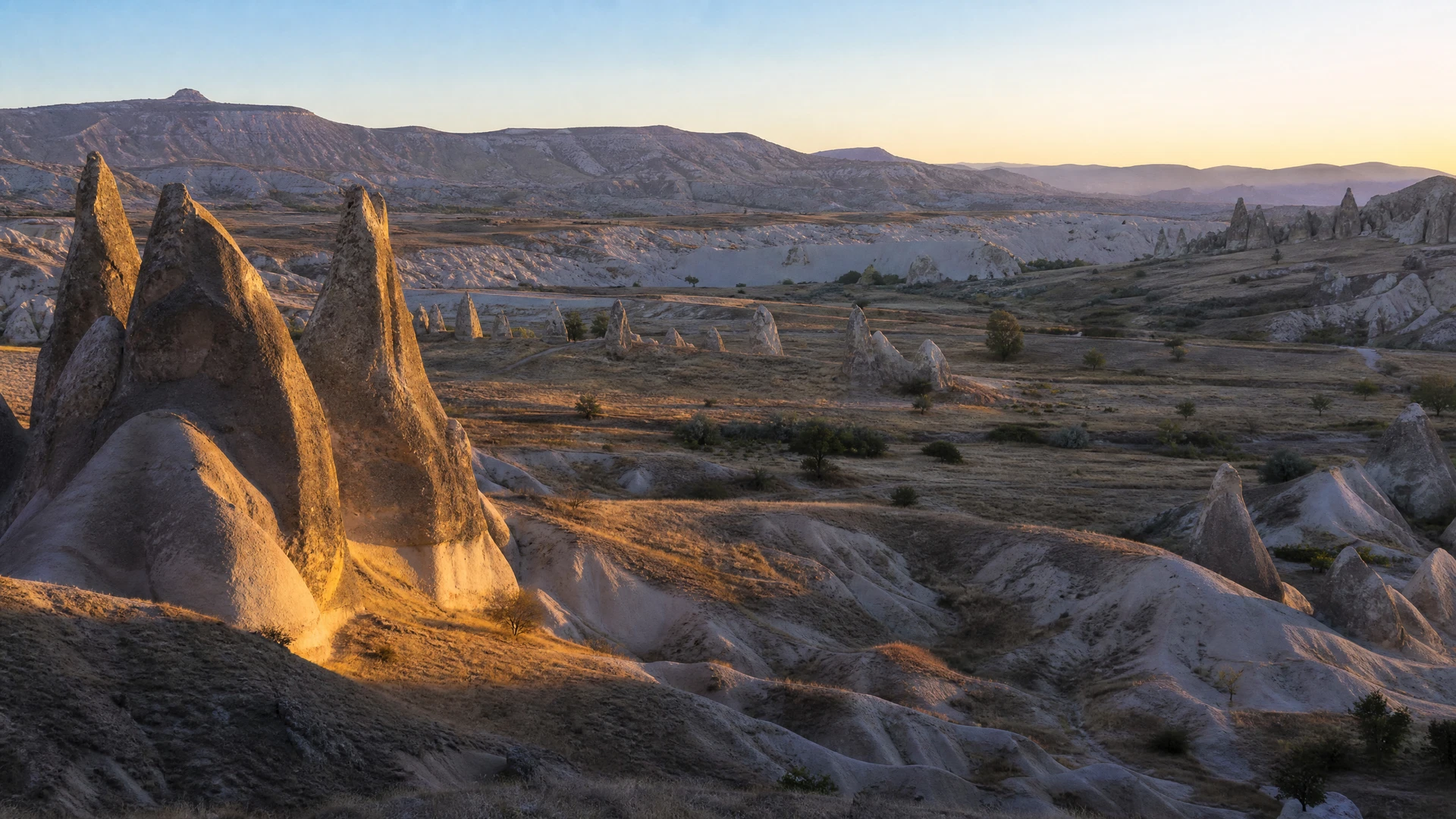
The first encounter with the Anatolian plateau is a study in cognitive dissonance. As the morning mist lifts from the valleys of Göreme, the horizon reveals a forest of stone that seems less grown and more exhaled by the earth itself. These are the iconic fairy chimneys, tall pillars of soft volcanic tuff capped by harder basalt, standing like silent sentinels across a landscape of undulating ripples and honeycombed cliffs. To walk among them is to lose one’s sense of scale; what looks like a child’s sandcastle reveals itself to be a towering monument to deep time. The colors shift with the sun, moving from pale cream to bruised purples and burnt oranges, creating a visual rhythm that dictates the pace of life in this high-altitude desert.
The origins of this surreal topography lie in the violent outbursts of Mount Erciyes, Mount Hasan, and Mount Melendiz millions of years ago. These volcanoes blanketed the region in thick layers of ash, which eventually compressed into the porous rock known as tuff. Over eons, wind and water carved away the softer sediment, leaving behind the harder caps that protected the pillars beneath. This geological process, while seemingly static, remains a living force. The landscape is perpetually in motion, as the very elements that created these formations continue to wear them down. It is a place where the fragility of the rock is its most defining characteristic, requiring a quiet reverence from those who traverse its winding paths.
Humanity did not merely observe this landscape; it moved into it. The soft nature of the tuff allowed for an extraordinary architectural tradition: the troglodyte dwelling. For centuries, the people of Cappadocia have carved their homes, stables, and storehouses directly into the cliff faces and fairy chimneys. These are not primitive caves but sophisticated structures providing natural insulation against the region’s extreme temperature swings. In the summer, the rock remains cool; in the winter, it retains the warmth of a central hearth. Stepping into a traditional Cappadocian home is to feel the weight of the mountain as a protective embrace, a testament to a culture that learned to live in harmony with its environment rather than attempting to dominate it.
Perhaps the most startling expression of this subterranean ingenuity is found beneath the surface. The region is home to dozens of multi-level underground cities, with Derinkuyu serving as the most formidable example. Reaching depths of over sixty meters, these labyrinthine complexes were designed as temporary refuges during times of invasion. They are marvels of ancient engineering, featuring ventilation shafts that reach the lowest levels, massive rolling stone doors to seal off corridors, and communal spaces for cooking and worship. To descend into the cool, quiet tunnels of Derinkuyu is to touch the pulse of a civilization that sought safety in the deep silence of the earth, creating a hidden world that could sustain thousands of lives.
Spirituality in Cappadocia found its most vibrant expression in the rock-hewn sanctuaries and monasteries that dot the Göreme Open Air Museum. Between the 4th and 13th centuries, monastic communities carved intricate churches into the cliffs, decorating their interiors with exceptional Byzantine frescoes. In the dim light of the Dark Church, the colors remain startlingly vivid—deep lapis lazuli, ochre, and cinnabar depicting biblical scenes that have survived the passage of centuries. These frescoes represent a critical bridge in Christian art history, preserved by the very rock that houses them. However, their beauty is as delicate as the tuff itself; the moisture from a visitor’s breath or the flash of a camera can cause irreparable damage to these ancient pigments.
While the earth holds the region’s history, the sky offers its most famous contemporary spectacle. Every morning, before the sun breaks the horizon, hundreds of hot air balloons rise in a coordinated dance over the valleys. From the wicker basket of a balloon, the true scale of the Cappadocian topography becomes clear. You drift over the rippling ridges of Rose Valley and the spires of Love Valley, watching the long shadows of dawn stretch across the tuff. The silence of the flight creates a sense of detachment from the world below. It is a perspective that reveals the landscape as a giant, petrified wave, a frozen moment of geological upheaval that feels both ancient and immediate.
Exploring this terrain on foot requires a commitment to the stewardship of the land. The trails that wind through Pigeon Valley and the Ihlara Canyon offer intimate encounters with the rock, but they also highlight the vulnerability of the ecosystem. The volcanic tuff is easily eroded by foot traffic, making it essential for hikers to stay on marked paths to prevent the degradation of the valley floors. Along these routes, one finds ancient pigeon houses carved into the cliffs, their entrances once decorated to attract birds whose guano fertilized the region’s vineyards. These small details serve as reminders that Cappadocia is not just a museum of geology, but a working landscape where agriculture and tourism must coexist within strict environmental boundaries.
As the sun sets over the Uçhisar Castle, the highest point in the region, the fairy chimneys cast long, haunting shadows that seem to reach back into the Byzantine past. Cappadocia is a place that demands a slower pace, a willingness to look closely at the texture of the stone and listen to the silence of the underground chambers. It is a landscape of contradictions—monumental yet fragile, ancient yet constantly changing. To visit is to be reminded of the fleeting nature of human endeavor when measured against the slow, grinding clock of the earth. In the end, one leaves with the sense that we are merely temporary guests in a world that belongs to the wind, the water, and the enduring rock.