Travel
The limestone cathedrals of Musandam rise where the desert meets the deep Arabian sea.
Separated from the Omani mainland by the Emirates, the Musandam Peninsula offers a stark, geological drama. Here, submerged mountains form deep turquoise fjords where traditional dhows navigate past ancient fishing villages and pods of dolphins, revealing the rugged soul of the "Norway of Arabia."
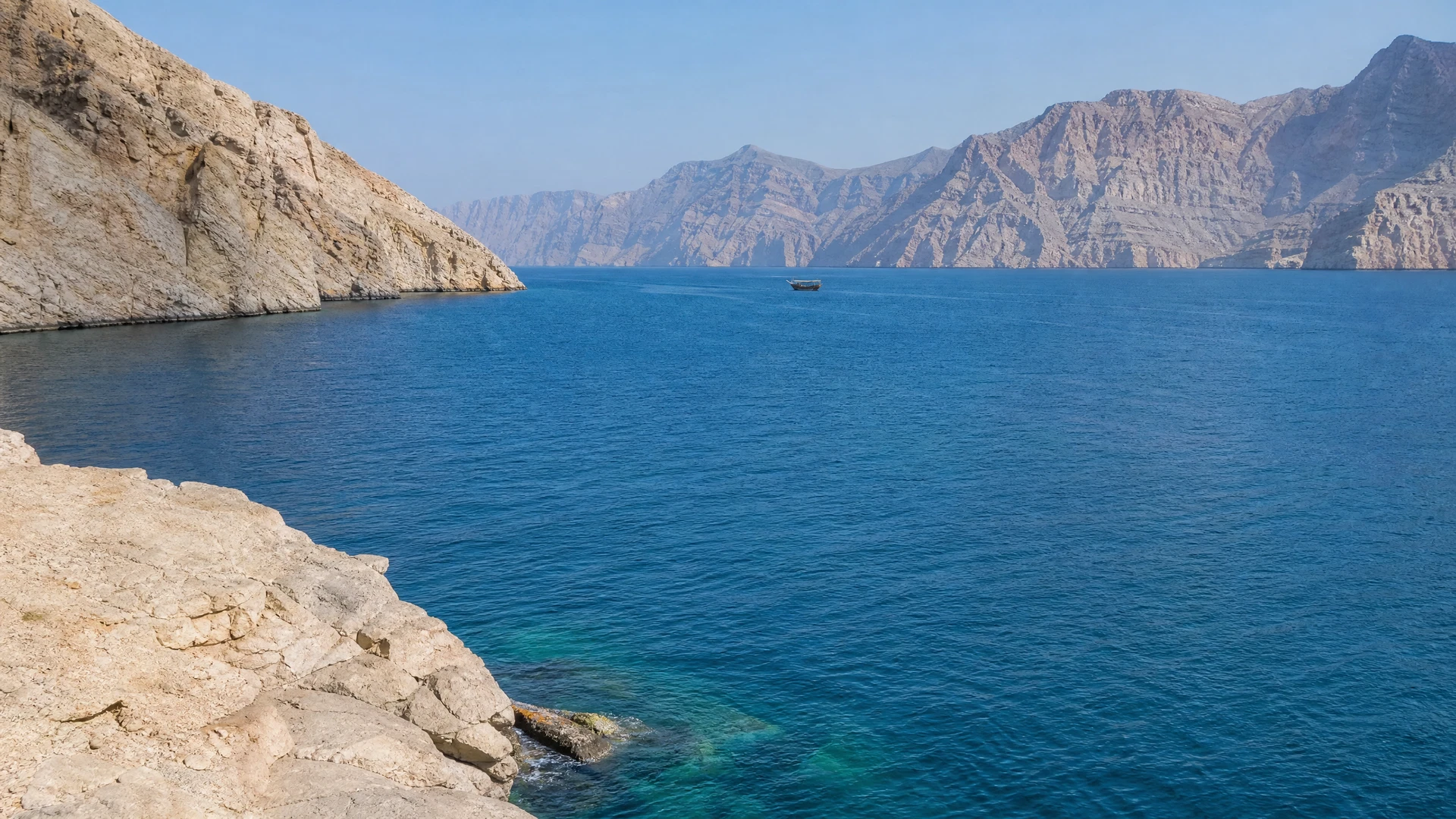
The Hajar Mountains do not simply end at the northern tip of the Arabian Peninsula; they surrender to the sea in a slow, tectonic descent. This is Musandam, an Omani exclave severed from the rest of the Sultanate by the jagged coastline of the United Arab Emirates. Often referred to as the "Norway of Arabia," this region is defined by its khors—deep, narrow inlets of turquoise water that wind between towering limestone cliffs. Unlike the lush, green fjords of the North Atlantic, these are sun-drenched and arid, a landscape of scorched earth and brilliant sea that feels less like a conventional tourist destination and more like a geological secret shared between the mountains and the tides.
To enter the heart of Musandam is to step aboard a traditional dhow, the wooden sailing vessels that have traversed these waters for centuries. As the boat glides away from the port of Khasab, the scale of the landscape becomes overwhelming. The limestone walls rise hundreds of meters above the water, their surfaces etched with the history of the earth’s movement. There is a profound silence here, broken only by the rhythmic splash of the hull against the waves and the occasional cry of a seabird. The air is thick with the scent of salt and the heat of the sun, creating a sensory experience that is both punishing and beautiful.
The peninsula occupies a position of immense strategic importance, overlooking the narrow Strait of Hormuz. Through this sliver of water, a significant portion of the world’s oil passes daily, yet within the winding reaches of Khor Sham, the geopolitical weight of the region feels remarkably distant. The fjords offer a sanctuary of stillness, where the modern world is obscured by the sheer mass of the Hajar range. It is a place where time is measured not by the ticking of a clock or the passage of tankers, but by the shifting shadows on the rock faces and the ebb and flow of the tide.
Tucked into the folds of these cliffs are villages that remain largely inaccessible by land. The most famous of these is Kumzar, a settlement located at the very edge of the peninsula. The Kumzari people who live here are the keepers of a unique cultural heritage, speaking a language that is the only non-Semitic native tongue in the Arabian Peninsula. Their dialect is a complex blend of Persian, Arabic, Hindi, and even Portuguese, a linguistic map of the ancient trade routes that once converged here. Visiting these areas requires a delicate balance of curiosity and respect, as these communities maintain traditional customs and value their privacy in their remote coastal home.
The waters of the khors are not merely a scenic backdrop; they are a vibrant ecosystem. Pods of Indo-Pacific humpback and bottlenose dolphins are frequent companions to the dhows, often racing alongside the bow in a display of natural exuberance. These encounters are a highlight for many travelers, but they carry a responsibility. Stewardship of this environment is critical, and visitors are encouraged to prioritize eco-conscious marine tours that minimize disturbance to these intelligent creatures. The health of the dolphin populations is intrinsically linked to the purity of these sheltered waters, which serve as both a nursery and a hunting ground for various marine species.
Geologically, Musandam is a marvel of tectonic activity. The peninsula is actually sinking, a result of the Arabian plate sliding beneath the Eurasian plate. This submergence has turned what were once mountain valleys into the deep inlets we see today. The limestone itself is a record of ancient marine life, compressed over millions of years and then thrust upward before being reclaimed by the sea. Walking along the accessible edges of these cliffs reveals fossils and mineral veins that tell a story of a world in constant, albeit slow, flux. The verticality of the landscape is a constant reminder of the immense pressures that shaped this corner of the world.
In the middle of Khor Sham lies a small, rocky outcrop known as Telegraph Island, or Jazirat al Maqlab. In the mid-19th century, the British established a repeater station here to facilitate communication between London and Karachi. The isolation was so extreme that the soldiers stationed here were said to have "gone around the bend"—a phrase that supposedly originated from the winding journey around the Musandam Peninsula. Today, the ruins of the station are a haunting reminder of the challenges of early global connectivity, standing as a testament to the sheer remoteness that still defines the region and the psychological toll of such profound solitude.
The rhythm of life in Musandam is dictated by the sea. In the small fishing hamlets that dot the coast, the daily catch remains the primary source of livelihood. Fishermen in small motorboats zip across the turquoise water, their nets laden with kingfish and tuna. There is a practical, unhurried quality to these settlements, where the architecture is functional and the pace is set by the elements. For the traveler, observing this way of life offers a grounding perspective on human resilience in a landscape that offers very little in the way of conventional comforts, reminding us of the enduring relationship between people and the ocean.