Travel
The Green Mountain of Oman offers a fragile sanctuary above the Hajar clouds
High above the shimmering heat of the Omani desert, Al Jabal Al Akhdar reveals a landscape of ancient stone villages and emerald terraces. Here, the scent of Damask roses and the cool mountain air create a sanctuary where time is measured by the flow of Aflaj water.
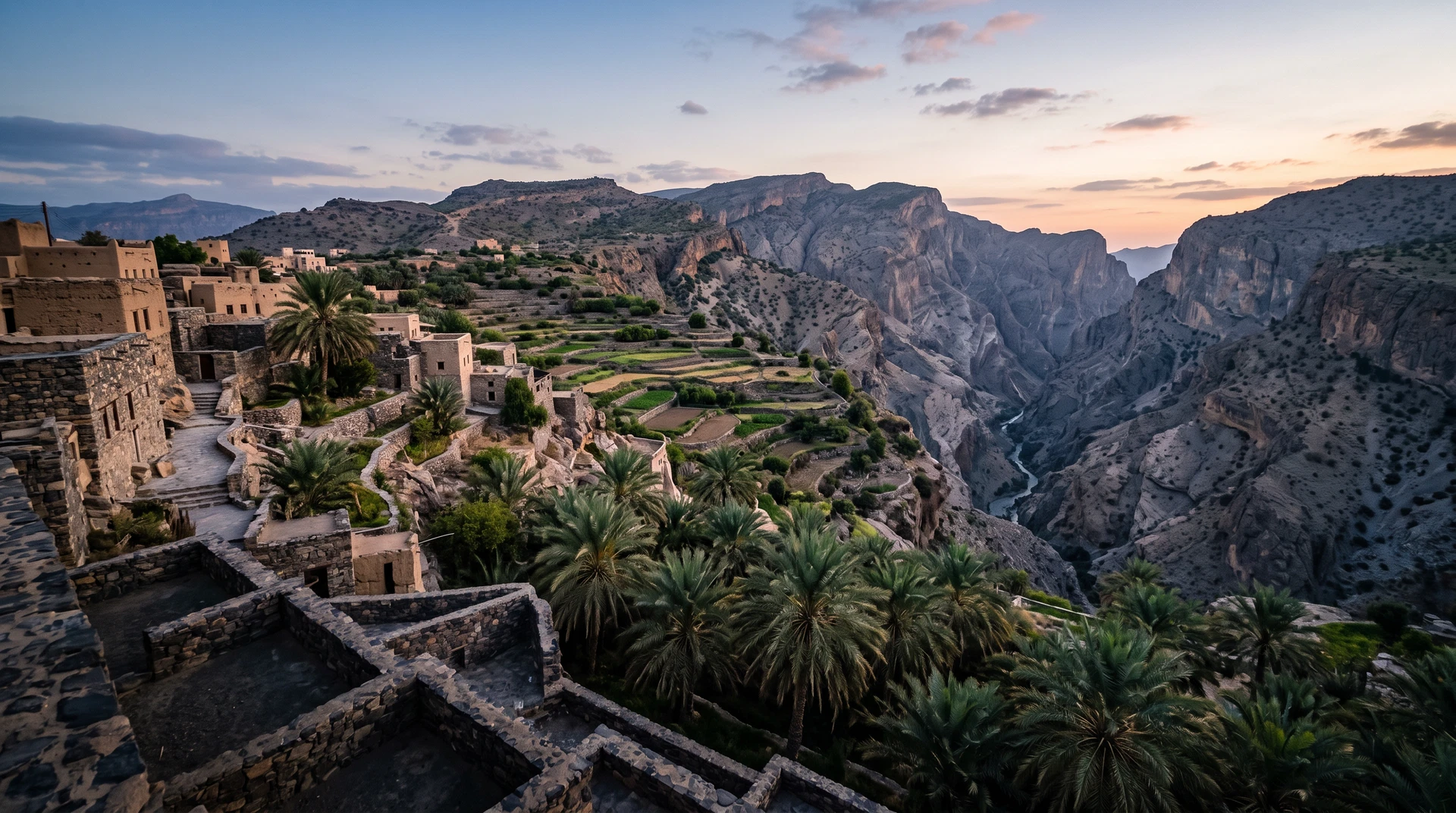
The ascent to Al Jabal Al Akhdar is a ritual of transition, a vertical journey that sheds the oppressive weight of the Omani desert heat with every hairpin turn. As the road winds upward into the Western Hajar Mountains, the thermometer in the 4WD drops steadily, and the air thins into something crisp and invigorating. Reaching nearly 3,000 meters above sea level, this limestone massif—the "Green Mountain"—defies the scorched expectations of the Arabian Peninsula. It is a world of verticality, where the horizon is defined by jagged peaks and the sudden, breathtaking depth of limestone canyons that fall away into the morning mist.
At these altitudes, the environment shifts from the sparse scrub of the lowlands to ancient, gnarled juniper forests that have stood sentinel for centuries. These trees, their branches twisted by the wind and the weight of time, form a critical part of a high-altitude ecosystem that earned Al Jabal Al Akhdar its designation as a UNESCO Biosphere Reserve in 2025. It is a fragile sanctuary, providing one of the few remaining habitats for the endangered Arabian Tahr, a mountain goat that navigates the precipitous cliffs with a grace that seems to defy gravity. To walk here is to tread lightly on a landscape that is as biologically significant as it is visually arresting.
The human story of the mountain is etched into the very rock of the cliffs. Ancient stone villages like Al Sogara and Saiq cling to the precipices, their dwellings constructed from the same limestone that surrounds them. These settlements appear almost as natural extensions of the mountain, their narrow alleys and weathered walls telling a story of survival and ingenuity that spans generations. The silence in these villages is profound, broken only by the occasional call to prayer or the rustle of wind through the orchards. Visitors are reminded that these are living communities, where privacy is a cherished commodity and the rhythm of life remains deeply rooted in tradition.
What truly defines the mountain, however, are the emerald terraces that cascade down the slopes like a giant’s staircase. In a region where water is more precious than gold, the ancient Aflaj irrigation systems continue to function as the lifeblood of the land. These narrow, stone-lined channels carry cool mountain water from hidden springs to the thirsty roots of pomegranates, walnuts, and apricots. The sound of running water is a constant, melodic companion as you walk along the terrace edges, a reminder of the centuries-old engineering that has transformed this rugged terrain into a productive, green oasis.
The most sensory experience on the mountain occurs in the spring, when the Damask roses bloom across the terraces. The air becomes thick with a heavy, intoxicating perfume that signals the start of the harvest. Local families have spent centuries perfecting the art of rose water distillation, using traditional clay ovens to extract the essence of the petals. The roses are not merely a crop; they are a cultural emblem, their fragrance woven into the identity of the mountain people. To witness the harvest is to see a landscape in full, vibrant color, a stark and beautiful contrast to the monochromatic browns of the desert below.
Accessing this high-altitude world requires more than just a sense of adventure; it demands practical preparation. A police checkpoint at the base of the mountain ensures that only 4WD vehicles proceed, a necessary precaution for the steep gradients and sharp turns that characterize the ascent. This barrier serves as a symbolic gatekeeper, preserving the mountain’s relative isolation and ensuring that those who reach the top are prepared for the unique environment. It is a reminder that Al Jabal Al Akhdar is not a typical tourist destination, but a rugged wilderness that requires respect and careful navigation.
Stewardship is a central theme for anyone visiting these heights. The delicate balance between the terraced orchards and the increasing number of visitors is a constant concern for the local communities. Signs and local guides emphasize the importance of staying on designated paths and, crucially, refraining from picking the crops that represent a family’s livelihood. A pomegranate plucked for a photograph is a loss for a farmer who has tended the tree through the seasons. Respecting these boundaries is essential for ensuring that the mountain remains a sustainable sanctuary for both its human and animal inhabitants.
As the sun begins to set over the Hajar range, the mountain undergoes another transformation. The limestone walls glow with a deep, honeyed light, and the shadows in the canyons stretch into long, indigo fingers. The temperature drops sharply, necessitating a sweater even in the height of summer, a delightful shock to the system for those arriving from the coast. It is in these quiet moments, looking out over the layered ridges of the Hajar, that the true character of Al Jabal Al Akhdar reveals itself. It is a place of profound stillness, a geological fortress that offers a rare perspective on the scale and beauty of the natural world.
Leaving the Green Mountain is as much a sensory experience as arriving. The scent of the juniper and the roses lingers in the cabin of the 4WD as you begin the long descent back toward the plains. The modern world waits below, with its highways and glass towers, but the memory of the stone villages and the cool, flowing water of the Aflaj remains. Al Jabal Al Akhdar is more than just a geographic anomaly; it is a testament to the enduring relationship between a people and their environment, a high-altitude sanctuary that continues to thrive against the odds in the heart of Oman.