Travel
The ancient green lungs of Rwanda breathe life into the great African rivers.
In the mist-shrouded highlands of southwestern Rwanda, Nyungwe National Park stands as a prehistoric Afromontane sanctuary. Home to thirteen primate species and a critical watershed for the continent, this UNESCO-listed rainforest offers a profound encounter with Africa’s deep ecological past and its vibrant, living future.
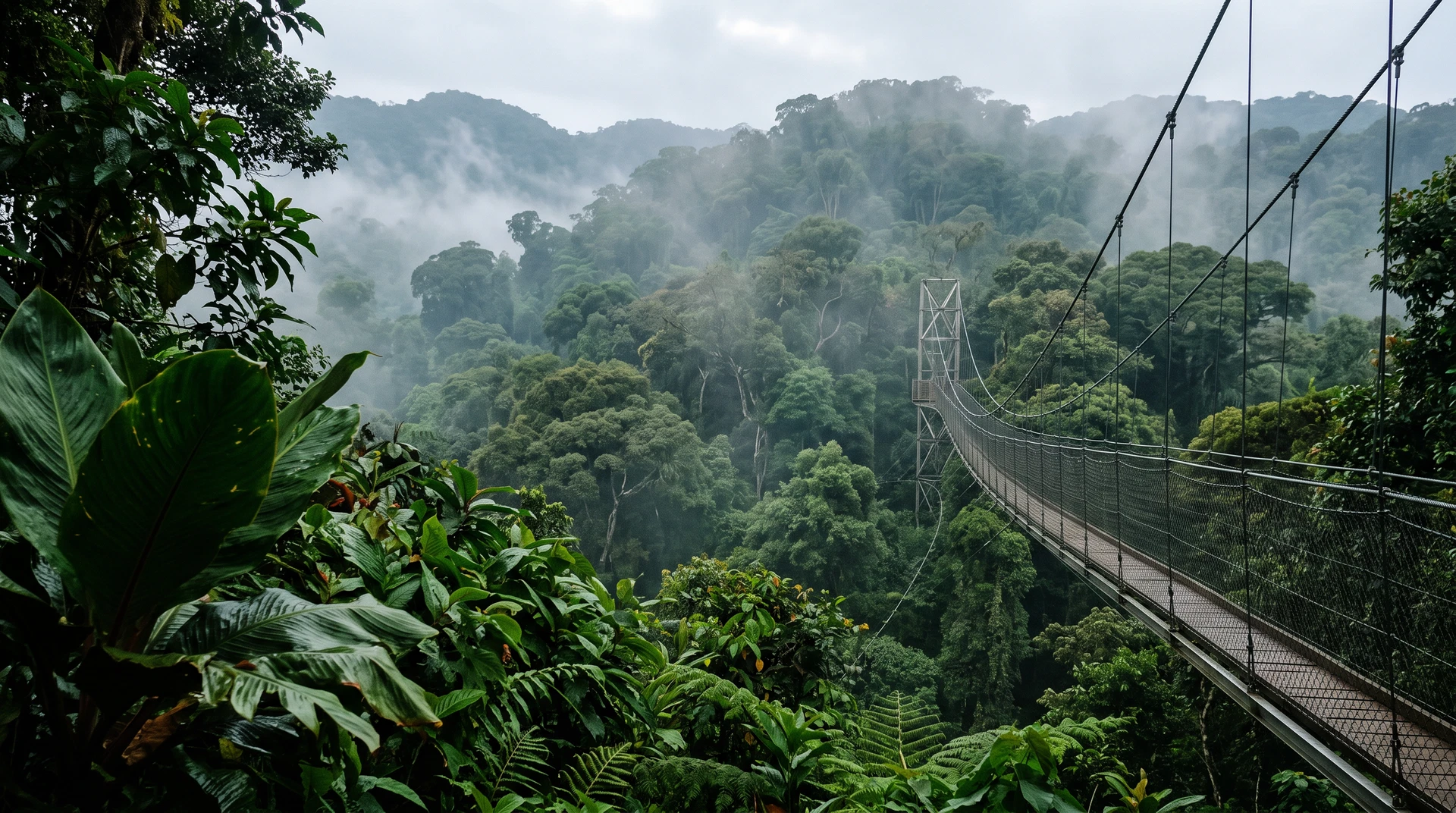
To enter Nyungwe National Park is to step into a world that has remained largely unchanged since the last Ice Age. This vast expanse of Afromontane forest, covering over 1,000 square kilometers, is a relic of a time when much of the continent was draped in similar verdant blankets. Here, the air is thick with the scent of damp earth and the heavy perfume of wild orchids, of which more than 140 species thrive in the humid understory. The canopy is a dense tapestry of mahogany, ebony, and giant tree ferns, their fronds unfurling like prehistoric banners against a sky that is often softened by a persistent, ethereal mist. This is not just a forest; it is a living museum of evolutionary history, where every moss-covered trunk and tangled vine tells a story of survival and continuity across millennia.
The park’s significance extends far beyond its borders, serving as a vital hydrological heart for the African continent. Nyungwe acts as a critical water catchment area, feeding the headwaters of two of the world’s most iconic rivers: the Nile and the Congo. The rain that falls on these high ridges eventually makes its way through a complex network of streams and peat bogs, sustaining millions of lives downstream. Standing on the continental divide within the park, one can almost feel the pulse of the planet’s water cycle. The stewardship of this landscape is therefore a global responsibility, and the Rwandan government’s commitment to its preservation is evident in the strict regulations that govern entry. Visitors must secure official permits and are required to stay on designated trails, always accompanied by authorized guides who possess an intimate knowledge of the forest’s delicate balance.
Biodiversity here is not merely a statistic; it is a constant, noisy presence. Nyungwe is home to thirteen distinct primate species, making it one of the most important sanctuaries for our closest relatives in East Africa. The eastern chimpanzee is the most famous resident, and tracking these intelligent creatures through the dense foliage is an exercise in patience and wonder. You might hear them before you see them—a sudden eruption of pant-hoots echoing through the valley—before catching a glimpse of a dark figure swinging through the branches. But the chimpanzees are just one part of the primate puzzle. L’Hoest’s monkeys, with their striking white ruffs, forage near the forest floor, while the acrobatic Ruwenzori colobus monkeys can be seen in troops of several hundred, moving like a silver-grey wave through the upper canopy.
For those seeking a different perspective, the park’s canopy walkway offers a rare bird’s-eye view of the rainforest. Suspended seventy meters above the forest floor, the bridge stretches across a deep valley, providing a vantage point that was once the exclusive domain of birds and monkeys. From this height, the sheer scale of Nyungwe becomes apparent. The rolling hills of the Albertine Rift are covered in an unbroken sea of green, punctuated only by the occasional flash of a colorful bird—perhaps the Great Blue Turaco or the elusive Kungwe Apalis. The walkway is a feat of engineering that allows for an immersive experience without disturbing the fragile ecosystems below, illustrating the park’s philosophy of low-impact, high-value tourism that prioritizes the health of the environment over mass accessibility.
The forest floor is equally captivating, though it requires a more observant eye to appreciate its smaller wonders. The park’s peat bogs, though often overlooked, are critical carbon sinks and home to specialized flora that can be found nowhere else. Walking through these areas, one notices the springy texture of the ground and the abundance of carnivorous sundews and delicate lilies. The guides are quick to point out the medicinal properties of various plants, sharing knowledge that has been passed down through generations of local communities who live on the forest’s edge. This intersection of traditional wisdom and modern conservation science is a hallmark of the Nyungwe experience, fostering a deep respect for the intricate connections that sustain this high-altitude wilderness.
In 2023, Nyungwe National Park was designated as Rwanda’s first UNESCO Natural World Heritage site, a recognition of its outstanding universal value. This status is a testament to the park’s role as a refuge for endangered species and its importance as a stable ecosystem in a rapidly changing world. The designation brings with it a renewed focus on conservation and sustainable development, ensuring that the park’s resources are managed with the utmost care. For the traveler, this means that every visit contributes to a larger mission of preservation. The park fees and permit costs are reinvested into anti-poaching efforts, community development projects, and ongoing research, creating a model where tourism and conservation work hand-in-hand to protect one of Africa’s most precious natural assets.
The sensory experience of Nyungwe is perhaps its most enduring legacy. It is the sound of a thousand cicadas rising to a crescendo at dusk, the sight of a mountain chameleon perfectly camouflaged against a lichen-covered branch, and the feeling of cool, crisp air on your face after a long hike. The weather here is unpredictable, with sudden rain showers that transform the forest into a glistening emerald kingdom. These moments of quiet observation, away from the distractions of the modern world, offer a profound sense of perspective. In the presence of trees that have stood for centuries and species that have survived for millions of years, the concerns of daily life seem to fade into the background, replaced by a deep appreciation for the resilience of the natural world.
Nyungwe National Park remains the jewel in Rwanda’s crown, a place where the practicalities of conservation meet the poetry of the wilderness, offering a journey that is as much about self-reflection as it is about exploration. Whether you are trekking through the mud in search of chimpanzees, crossing the canopy walkway in a light drizzle, or simply sitting quietly by a waterfall, the forest leaves an indelible mark on your soul. It is a reminder that there are still places on this earth where nature reigns supreme, and that our role is not to conquer these landscapes, but to witness them with humility and protect them for the generations that will follow in our footsteps.