Travel
Into the emerald heart of Bwindi where the ancient mountain gorillas still reign supreme.
Deep within Uganda’s ancient, mist-shrouded rainforest, a rare encounter with the world’s remaining mountain gorillas offers a profound connection to our evolutionary past. This UNESCO-protected sanctuary preserves a 25,000-year-old ecosystem where biodiversity thrives across steep ridges, deep valleys, and life-giving rivers.
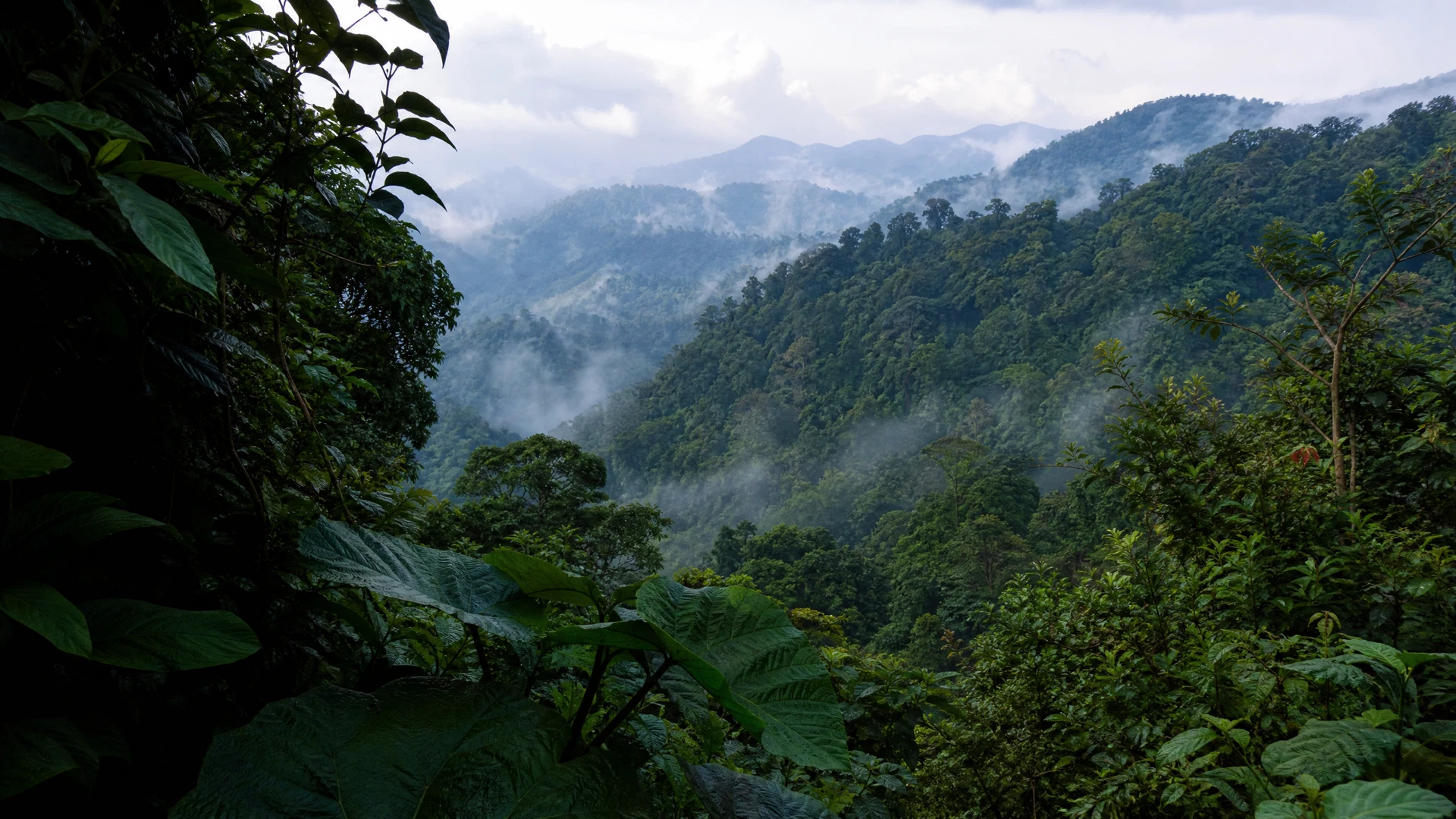
The word "impenetrable" is a literal description of the prehistoric wall of green that defines Bwindi. Located in southwestern Uganda, this national park is a remnant of an Afromontane forest that has endured for over 25,000 years. The air is thick with the scent of damp earth and crushed vegetation, a humid perfume that hints at the density of life within. The mist, or ruhinga, clings to jagged ridges like a soft blanket, occasionally parting to reveal a landscape entirely removed from the modern world. It is a place where time is measured not in hours, but in the slow growth of giant ferns and the patient flow of rivers that have carved these valleys since the last Ice Age.
Navigating Bwindi requires a physical commitment few other destinations demand. The terrain is a succession of steep, razor-backed ridges and deep valleys, cloaked in a chaotic weave of vines and bamboo. There are no manicured paths; trackers use machetes to clear temporary passages through the undergrowth, only for the forest to reclaim the space within days. This rugged topography serves a vital ecological purpose, acting as a critical watershed for five major rivers—the Ivi, Munyaga, Ihihizo, Ishasha, and Ntengyere—which eventually pour their waters into Lake Edward. For the traveler, every step is a reminder of the forest’s raw power and our status as temporary guests in a domain unchanged for millennia.
While headlines are dominated by the park’s famous residents, Bwindi is a masterclass in biodiversity extending far beyond primates. It is a UNESCO World Heritage site harboring an extraordinary array of life in the vertical layers of the canopy. Bird enthusiasts will find a high-altitude paradise with over 350 species, including the regal sunbird and elusive African broadbill. The air is equally alive with color, as more than 200 species of butterflies flit through sun-dappled clearings. To walk through Bwindi is to be immersed in a constant symphony of calls and the rustle of hidden movements, a sensory overload that underscores the importance of protecting this fragile, high-altitude sanctuary.
The gravitational pull of Bwindi is centered on the mountain gorilla. The park houses approximately 459 individuals, nearly half of the global population of this endangered species. These are not the gorillas of a zoo; they are wild, powerful beings living in the social structures they have occupied for generations. In a world where habitat loss has pushed so many species to the brink, Bwindi stands as a defiant stronghold. The gorillas are divided into several habituated families, each with complex dynamics, led by an imposing silverback whose sheer physical mass is matched only by his surprising gentleness with the group’s infants.
Finding a gorilla family is an exercise in patience and endurance. It begins before the sun reaches the valley floor, as trackers head into the forest to locate the nests where the gorillas spent the night. From there, they follow the trail of bent branches and discarded bamboo, communicating via radio with guides leading small groups of visitors. The trek can last anywhere from two to seven hours, depending on the family's movement. There is palpable tension as you scramble over mossy logs and duck under hanging vines, the silence broken only by the heavy breathing of the climb. Then, a crackle on the radio signals that the moment has arrived.
The first encounter with a mountain gorilla is often described as a spiritual experience. There is an uncanny intelligence in their amber eyes, a gaze that acknowledges your presence with a mix of curiosity and indifference. You are permitted exactly one hour in their company, a window that feels both short and profoundly significant. During these sixty minutes, you might witness a mother grooming her child or the patriarch resting his massive head on his arms. The proximity is startling, yet the strict requirement to maintain a seven-meter distance is a vital boundary that ensures the safety and health of these animals.
This proximity comes with heavy responsibility. Because gorillas share about 98 percent of our DNA, they are highly susceptible to human diseases. The stewardship protocols in Bwindi are among the most rigorous in the world. Visitors must be in good health, and face masks are mandatory when in close contact. These rules are the frontline of a conservation strategy that has successfully seen gorilla numbers rise over the past decade. By limiting daily permits and strictly controlling the duration of encounters, Uganda has created a sustainable model where tourism directly funds the protection of the habitat and the anti-poaching patrols that keep the forest secure.
As you descend from the ridges and leave the emerald shadows behind, the impact of Bwindi lingers. It is a place that humbles the visitor, replacing the distractions of modern life with a primal connection to the natural world. To visit Bwindi is to participate in a delicate balancing act between human curiosity and the preservation of a prehistoric legacy. It is a reminder that some places are meant to remain "impenetrable," protected by their own rugged beauty and the collective will of those who recognize their irreplaceable value. This ancient forest does not just house a species; it preserves a piece of the world’s soul.