Travel
The Subterranean Sanctuary of Lalibela Where Faith is Carved from Volcanic Stone
In the high-altitude reaches of Ethiopia’s Amhara Region, a thirteenth-century vision of Jerusalem remains etched into the living earth. These eleven monolithic churches, hand-carved from solid volcanic tuff, continue to serve as a vibrant heart for Orthodox devotion, where the ancient and the eternal meet.
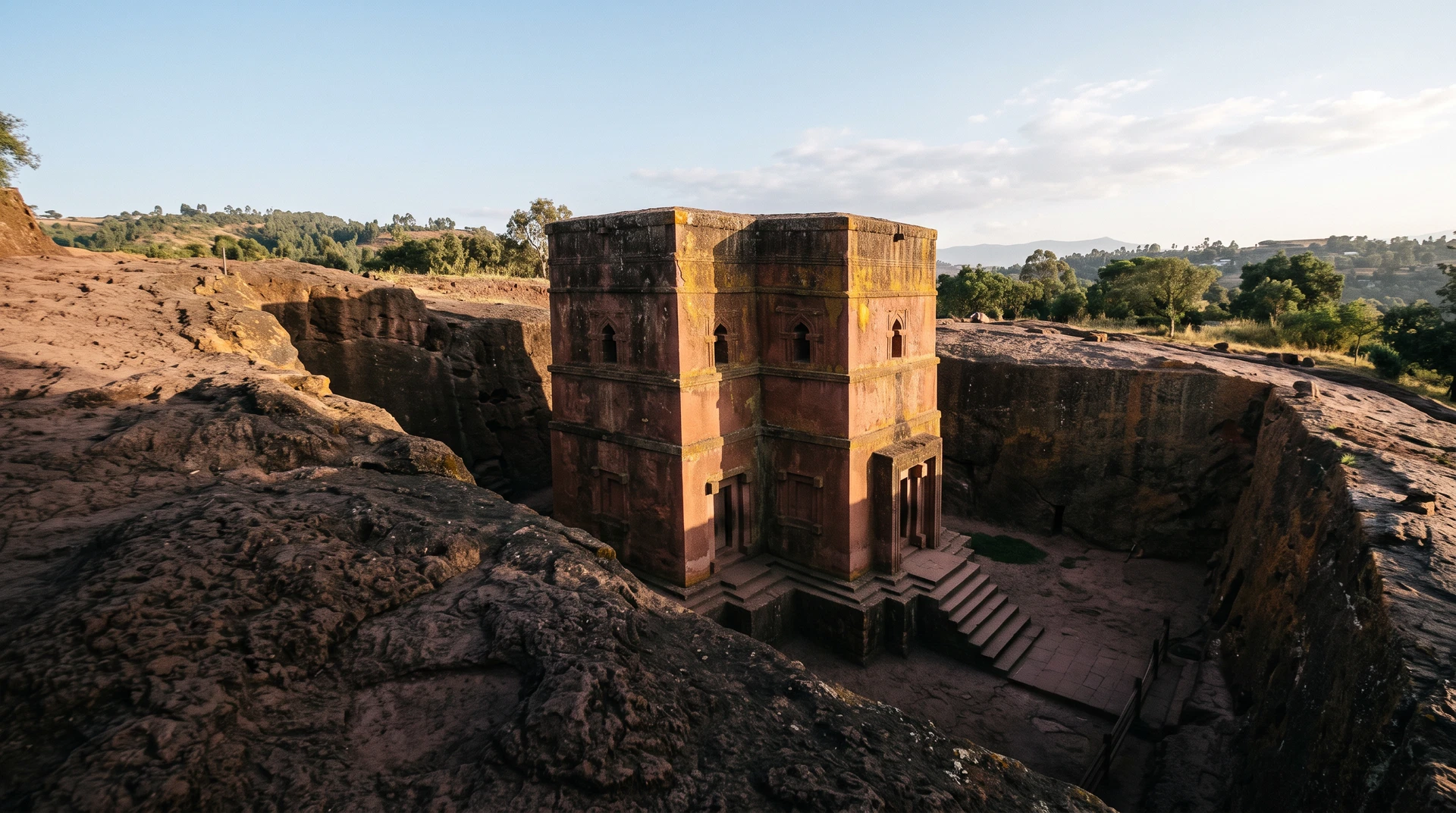
The air in the Lasta Mountains is thin and sharp, carrying the scent of eucalyptus and the fine, red dust of the Amhara highlands. At first glance, the landscape around Lalibela appears much like the rest of northern Ethiopia—a rugged tapestry of basalt plateaus and deep, sun-scorched valleys. Yet, as one approaches the sacred precinct, the perspective shifts entirely. Here, the ground does not merely support structures; it is the structure itself. To see the churches of Lalibela is to look down into the earth rather than up at the horizon, discovering a subterranean world where the line between geology and theology has been meticulously erased by the strike of a chisel.
This is a place born of a singular, feverish ambition. In the late twelfth and early thirteenth centuries, King Lalibela sought to recreate the Holy City of Jerusalem on African soil, providing a pilgrimage site for those who could no longer reach the Levant due to the shifting tides of the Crusades. The result is a collection of eleven monolithic churches, each hewn from a single block of volcanic tuff. Unlike the cathedrals of Europe, which were assembled stone by stone, these sanctuaries were excavated. Thousands of tons of rock were removed to reveal the windows, the columns, and the vaulted ceilings that were already waiting within the mountain’s core.
Standing at the edge of the trench surrounding Biete Medhane Alem, the House of the Saviour of the World, the scale of this undertaking becomes overwhelming. It is the largest monolithic church in the world, a massive rectangular block supported by thirty-four external columns. The red stone is porous and weathered, showing the scars of eight hundred years of wind and rain. To enter, one must descend a steep, narrow staircase cut into the rock, passing from the blinding glare of the Ethiopian sun into a cool, dim interior that smells of beeswax and centuries of prayer. The transition is not just physical; it feels like a descent into a different era of human devotion.
The layout of the site is a map of spiritual geography, with the man-made River Jordan dividing the northern and southern clusters of churches. Every trench, tunnel, and courtyard serves a symbolic purpose, mirroring the topography of the Jerusalem the King so admired. Navigating this labyrinth requires a certain physical humility. One moves through dark, narrow passages that connect the churches, some so low that you must stoop, others so narrow that your shoulders brush the damp, cool rock. These tunnels are meant to represent the path to heaven or the journey through purgatory, reinforcing the idea that every step taken here is an act of faith.
Perhaps the most visually arresting of the group is Biete Giyorgis, the House of Saint George. Set apart from the main clusters, it is carved in the shape of a perfect Greek cross, its roof level with the surrounding ground. From the rim of its pit, the church looks like a massive, three-dimensional emblem pressed into the earth. There are no scaffolding marks, no mortar joints, and no errors in the symmetry. It stands as a testament to an architectural precision that seems almost impossible for the 13th century, a moment where the hardness of the volcanic rock was made to yield to the softness of a vision.
However, Lalibela is not a museum; it is a living, breathing sanctuary for the Ethiopian Orthodox Tewahedo Church. At dawn, the precinct is filled with the low murmur of Ge'ez chanting, the ancient liturgical language of the empire. Pilgrims wrapped in white cotton shamas appear like ghosts against the dark red stone, their silhouettes moving slowly through the trenches. Some lean their foreheads against the rock, whispering prayers into the very substance of the church. The devotion here is tactile and visceral, a reminder that these stones were not just carved for beauty, but to house a presence that the local community still feels acutely.
The practical reality of preserving such a site is a delicate balancing act. In recent decades, large, modern UNESCO shelters have been erected over several of the churches to protect the porous tuff from the erosive power of the summer rains. While these white, angular structures are visually jarring against the organic curves of the landscape, they are a necessary intervention for the site’s survival. The rock is fragile, and the footfalls of thousands of pilgrims and visitors take a toll. Visitors are rightly cautioned to stay on designated paths and to avoid touching the walls, as the oils from human hands can accelerate the degradation of the ancient stone.
Inside the churches, the atmosphere is one of profound stillness. The floors are covered in layers of heavy, hand-woven carpets, and the walls are occasionally adorned with faded frescoes of saints and biblical scenes. Priests in colorful robes occasionally emerge from the shadows, carrying ornate silver crosses for the faithful to kiss. There is no electricity here; the light filters in through small, high windows, illuminating the swirling smoke of frankincense. In the quiet, one can almost hear the echoes of the original stone-masons, their rhythmic hammering a form of worship that continues to resonate through the silence of the chambers.
Leaving the sacred precinct and returning to the bustling town of Lalibela is always a disorienting experience. The modern world, with its cell phones and plastic water bottles, feels thin and temporary compared to the permanence of the excavated rock. There is a specific kind of melancholy in watching the sun set over the Lasta Mountains, knowing that beneath the surface, the 'New Jerusalem' remains anchored in the deep time of the earth. It is a place that demands a slow pace and a quiet mind, offering a rare opportunity to witness what happens when human spirit and geological reality collide with such uncompromising force.