Travel
The Rooftop of Africa: Navigating the Jagged Peaks and Ancient Gorges of the Simien Mountains
Across the high-altitude plateaus of northern Ethiopia, the Simien Mountains offer a surreal landscape of 1,500-meter cliffs and endemic wildlife. From the social troops of Gelada monkeys to the elusive Ethiopian wolf, this UNESCO-listed wilderness remains a dramatic sanctuary where the earth meets the sky in spectacular fashion.
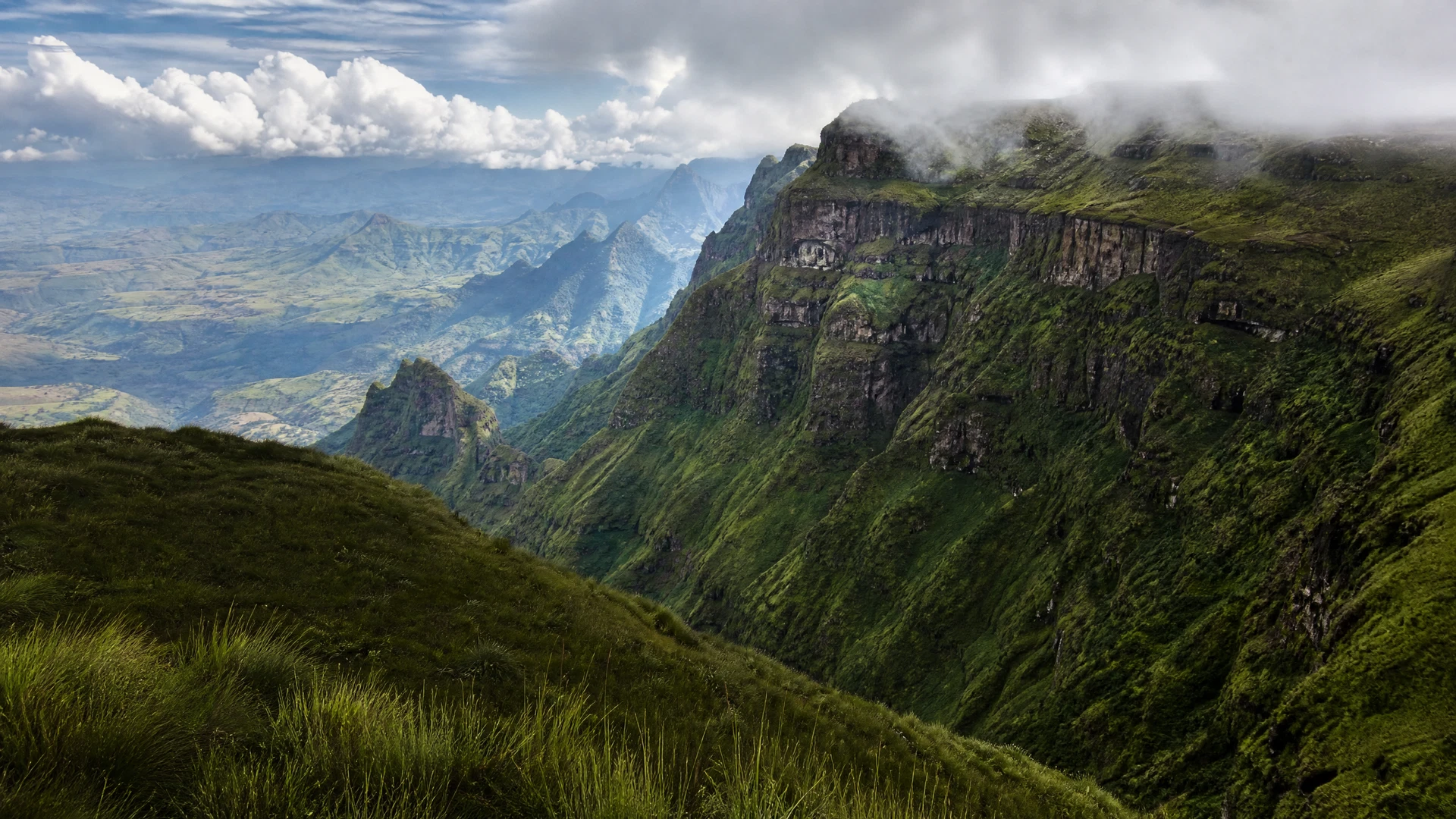
The air at three thousand meters does not merely thin; it sharpens, carrying a crystalline clarity that peels back the layers of the world. Standing on the Simien precipice, one is confronted with a landscape defying conventional geography. This is the "Roof of Africa," a high-altitude plateau where the earth appears torn open by giants. Below the serrated escarpment, the ground falls away into dizzying voids carved by millions of years of erosion. Massive basalt towers look like mere pebbles, and the distant calls of raptors are swallowed by the immense silence of the abyss.
Geologically, the Simiens are a testament to the violent birth of the Great Rift Valley. Massive volcanic eruptions millions of years ago deposited basalt layers thousands of meters thick, subsequently sculpted by water and ice. The result is a fortress of rock with sheer cliffs dropping 1,500 meters into deep, shadowed gorges. These vertical walls are the definitive boundaries of a lost world. To walk the escarpment is to balance on a narrow threshold between sky and earth, where the weather can shift from equatorial sun to bone-chilling mist in minutes.
In this thin, cool air, the Gelada baboons make their home. Unlike savanna-dwelling cousins, these "bleeding-heart" monkeys are terrestrial specialists, grazing on high-altitude grasses. They move in massive, chattering troops numbering in the hundreds, their golden-brown fur shimmering against the green turf. To sit among them is to be ignored with polite, busy indifference. They are focused on plucking individual blades of grass, their nimble fingers moving with the precision of a watchmaker. The crimson, hourglass-shaped patch on their chests stands out vividly against the plateau, a biological signal flashing in the highland sun.
The flora of the Simiens is as specialized as its fauna. The landscape is dominated by the giant lobelia, a plant looking like a prehistoric sentinel guarding the heights. These botanical giants reach several meters, their thick stems topped by a rosette of silver-green leaves. In the harsh Afro-alpine environment, where temperatures frequently drop below freezing, lobelias have evolved "biological antifreeze," protecting their delicate core. They stand scattered across the rolling moorlands like alien pillars, punctuating a terrain of heather and moss that feels more like the Scottish Highlands than East Africa, were it not for the intense, unfiltered tropical light.
Higher still, where grass gives way to scree, lives the Ethiopian wolf. It is the world’s rarest canid, a slender, rufous-colored hunter that stalks the high plateaus for giant mole-rats. They are solitary hunters but social animals, maintaining complex pack structures threatened by habitat loss and disease. To catch a glimpse of a wolf trotting through the morning mist, its white markings glowing like a ghost, is to understand the fragility of this ecosystem. They are the apex predators of a shrinking world, a living link to a time when these mountains were a continuous, icy wilderness.
The Walia ibex, the most iconic resident of the park, occupies the most precarious niches of all. These mountain goats are found nowhere else, having adapted to live on the sheerest cliff faces. They are masters of the vertical, moving with impossible grace across ledges barely wide enough for a bird to perch. Their massive, scimitar-shaped horns are a marvel of evolutionary design, used in dramatic displays of dominance that echo through the canyons. Here, the air and earth demand a physical mastery we can only approximate.
Yet, the Simiens are not an empty wilderness. For centuries, these mountains have been home to farming communities carving a living out of the steep slopes. The tension between conservation and human survival is palpable. Overgrazing and the encroachment of barley fields into the park’s core zones have historically threatened the biodiversity that makes the Simiens a UNESCO World Heritage site. Today, a delicate balance is being sought, respecting the ancestral rights of local people while protecting the fragile Afro-alpine turf. The future of these mountains depends on both villagers and rangers.
For the trekker, the ultimate goal is often Ras Dashen, the highest point in Ethiopia at 4,550 meters. The ascent is a grueling test of endurance against the altitude. The trail winds through ancient villages where the scent of eucalyptus smoke hangs in the air, then climbs through forests of St. John’s Wort before emerging onto the stark, wind-battered summit. From the top, the view is a chaotic sea of peaks and plateaus. The reward is a perspective that few places on the continent can offer—a sense of standing at the very apex of Africa.
There is a specific quality to the light in the Simiens that stays with a traveler. At dusk, the setting sun catches the dust and moisture in the air, turning the escarpment into a wall of molten gold. The deep shadows of the gorges become a bruised purple, and the silhouettes of the giant lobelias stretch out across the grass like long, dark fingers. It is a time of profound stillness, when the chatter of the Geladas fades and the wind drops to a whisper. In these moments, the mountains feel ancient beyond reckoning, a landscape that has witnessed the rise and fall of empires.
Leaving the Simien Mountains feels like waking from a dream of a different era. It is a place that demands much from the visitor—physical effort, a tolerance for the cold, and a deep respect for the wild—but it gives back a sense of wonder that is increasingly hard to find. It remains a global treasure, a sanctuary for species that have no other home and a cathedral of rock for those who seek the sublime. To visit is to be a guest in a high-altitude kingdom, a place where the earth touches the sky and the heart learns to beat in time with the mountains.