Travel
The ancient sentinels of Menabe stand as living monuments to Madagascar's lost tropical forests.
Rising from the red dust of western Madagascar, the Avenue of the Baobabs offers a haunting glimpse into a vanished ecosystem. These towering Adansonia grandidieri giants, now protected as a national monument, remain the enduring, silent witnesses to the island's deep natural history and changing landscape.
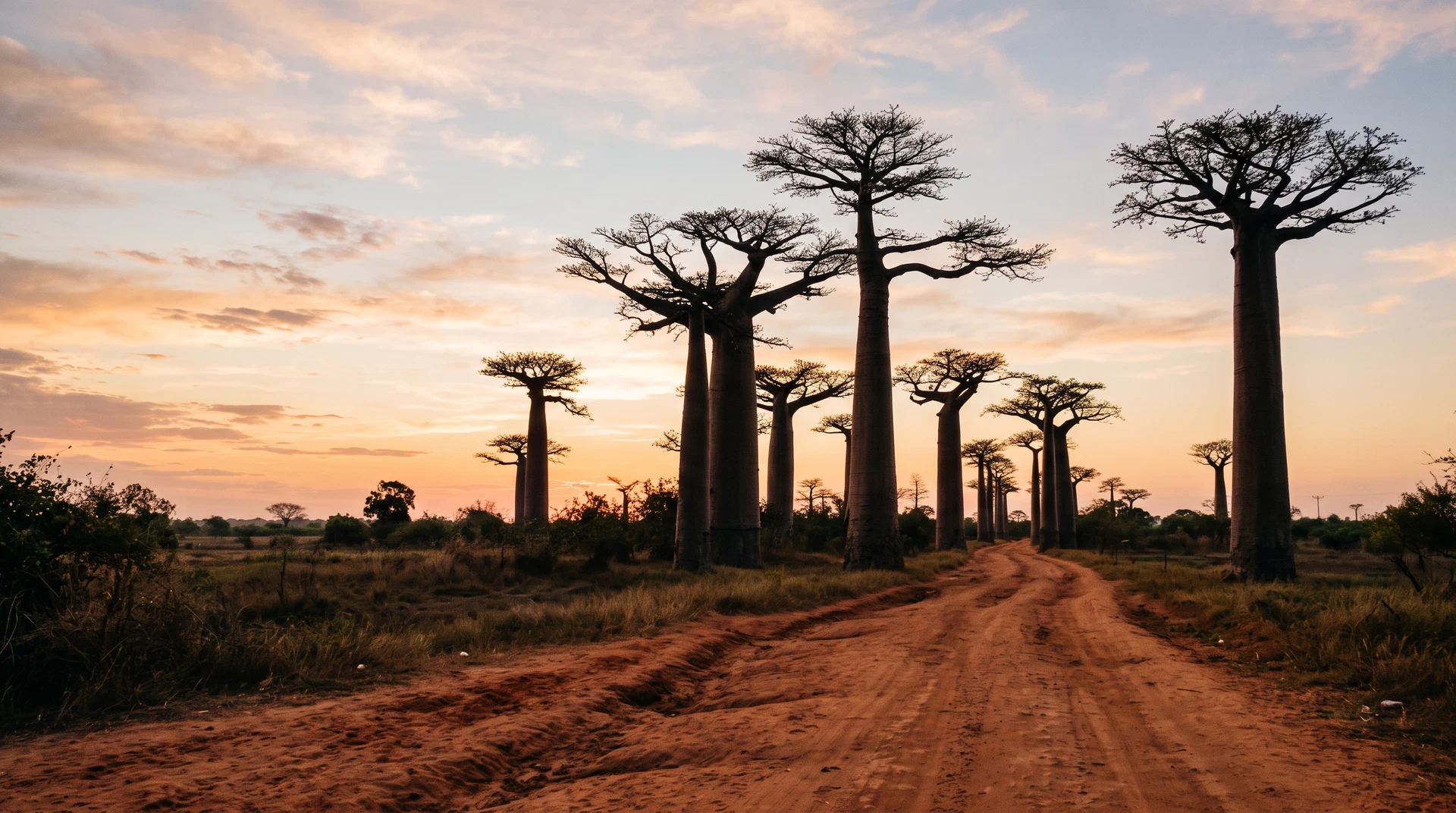
Traveling the dirt road north from Morondava, the horizon suddenly erupts with the impossible architecture of the Avenue of the Baobabs. Here, the flat Menabe plains are punctuated by soaring, smooth-barked cylinders of Adansonia grandidieri, trees that seem less like vegetation and more like prehistoric pillars. The scale is disorienting; what appear from a distance to be modest saplings reveal themselves as behemoths reaching immense heights, their gnarled branches searching for water in the dry air. This kilometer-long stretch contains a concentration of these giants found nowhere else on Earth, creating a majestic and lonely visual rhythm.
The baobab is often called the "upside-down tree," a name from the legend that gods, annoyed by the tree's vanity, replanted it with roots in the air. Botanically, the Adansonia grandidieri is a marvel of adaptation, endemic to Madagascar and suited to the harsh dryness of the western coast. Their massive, swollen trunks are sophisticated water storage vessels, holding thousands of liters to sustain the tree through months of drought. The bark possesses a grey, metallic sheen that reflects the intense sun, while the wood is fibrous and pulpy, favoring flexibility and storage over traditional hardwood density.
What visitors see today as a grand promenade is the ghost of a much denser past. These trees are the sole survivors of a thick tropical forest that once blanketed this region, a canopy so tight that sun rarely touched the red earth. Over decades, the surrounding forest was cleared for agriculture, primarily rice cultivation. The baobabs were spared, partly due to the difficulty of felling such water-heavy trunks and partly out of cultural respect, but their isolation has left them vulnerable. They stand now as architectural relics, providing a stark illustration of how quickly an ecosystem can be reduced.
The Avenue's atmosphere is defined by the peculiar light and the omnipresent red dust coating everything in fine powder. During the day's heat, the landscape feels bleached and static, with trees casting sharp shadows that offer little respite. However, as the afternoon wanes, the Menabe region undergoes a transformation. The air cools, and light softens into amber and gold, causing the grey bark to glow as if lit from within. It is a sensory experience demanding stillness; the sound of wind through sparse leaves and occasional bird calls are the only interruptions to an ancient silence.
In the local cultural context, these baobabs are honored as the "Mother of the Forest." This is not a title given lightly; for the communities of the Menabe, these trees are more than just landmarks. They are considered living links to a time before the current memory of the land, standing as silent witnesses to the island's deep natural history. This cultural connection has played a crucial role in their survival, acting as an informal system of protection long before official government mandates were ever drafted. To stand in their shadow is to feel the weight of this reverence, a quiet understanding that these giants are the true owners of the landscape.
Despite their apparent invincibility, the baobabs face modern threats requiring constant vigilance. The Avenue's popularity has led to significant soil compaction around the trees, as vehicle tires compress the earth and prevent shallow roots from breathing. Furthermore, the encroachment of rice paddies introduces excess water the trees are not adapted to handle, while fire for land clearing poses a lethal risk to seedlings. Without the original forest's protection, the next generation struggles to take root, creating a demographic gap that threatens the long-term survival of the grove and its unique biodiversity.
Recognizing these risks, the government designated the Avenue as the country's first Natural Monument in 2015. This status brought structured conservation, including designated walking paths and rigorous monitoring of land use. Local stewards work to educate visitors on the importance of staying on paths and avoiding fire, which is strictly prohibited. These efforts are not just about preserving a tourist attraction; they are about maintaining the genetic diversity of a species central to Madagascar's identity and ensuring the "Mother of the Forest" does not become a memory. This protection is vital for the region's ecological future.
As the sun dips toward the Mozambique Channel, the Avenue reaches its most iconic state. The sky bleeds into vibrant, crimson hues, and the baobabs are reduced to sharp, black silhouettes against the fire of the horizon. It is at this moment that the drama of their form is most evident—the massive trunks, spindly branches, and the audacity of their survival. The crowds that gather for this spectacle usually fall into a hushed reverence, recognizing they are witnessing one of the natural world's great visual anthems. The transition to evening is a reminder of the cyclical rhythm these trees have followed for a millennium.
For the practical traveler, a visit requires preparation and a willingness to embrace the site's rustic nature. No paved roads lead here; the journey from Morondava is a bumpy, dusty affair best undertaken in a sturdy vehicle. There is little formal infrastructure—no visitor centers or gift shops clutter the immediate vicinity, preserving the raw power of the landscape. Visitors are encouraged to bring water, wear sturdy shoes, and arrive with a mindset of respect. By adhering to designated paths and following ranger guidance, travelers ensure their presence supports rather than detracts from the ongoing conservation efforts.
The Avenue of the Baobabs is ultimately a place of contradiction: a celebration of life and a monument to loss. It stands as a testament to the natural world's resilience, while warning of the fragility of the systems that support it. To walk among these giants is to be reminded of our own brief tenure and the responsibility to protect the ancient wonders that remain. As stars emerge in the clear Malagasy sky, the baobabs remain as they have for centuries—silent, steadfast, and singular—anchoring the red earth of the Menabe to the vastness of the heavens above.