Travel
Navigating the razor-sharp stone forests and ancient river canyons of Tsingy de Bemaraha.
In the remote Melaky Region of western Madagascar, a prehistoric karst landscape of vertical limestone needles challenges the limits of exploration. Here, rare lemurs leap across jagged peaks while the Manambolo River guards the silent burial sites of the island’s first inhabitants.
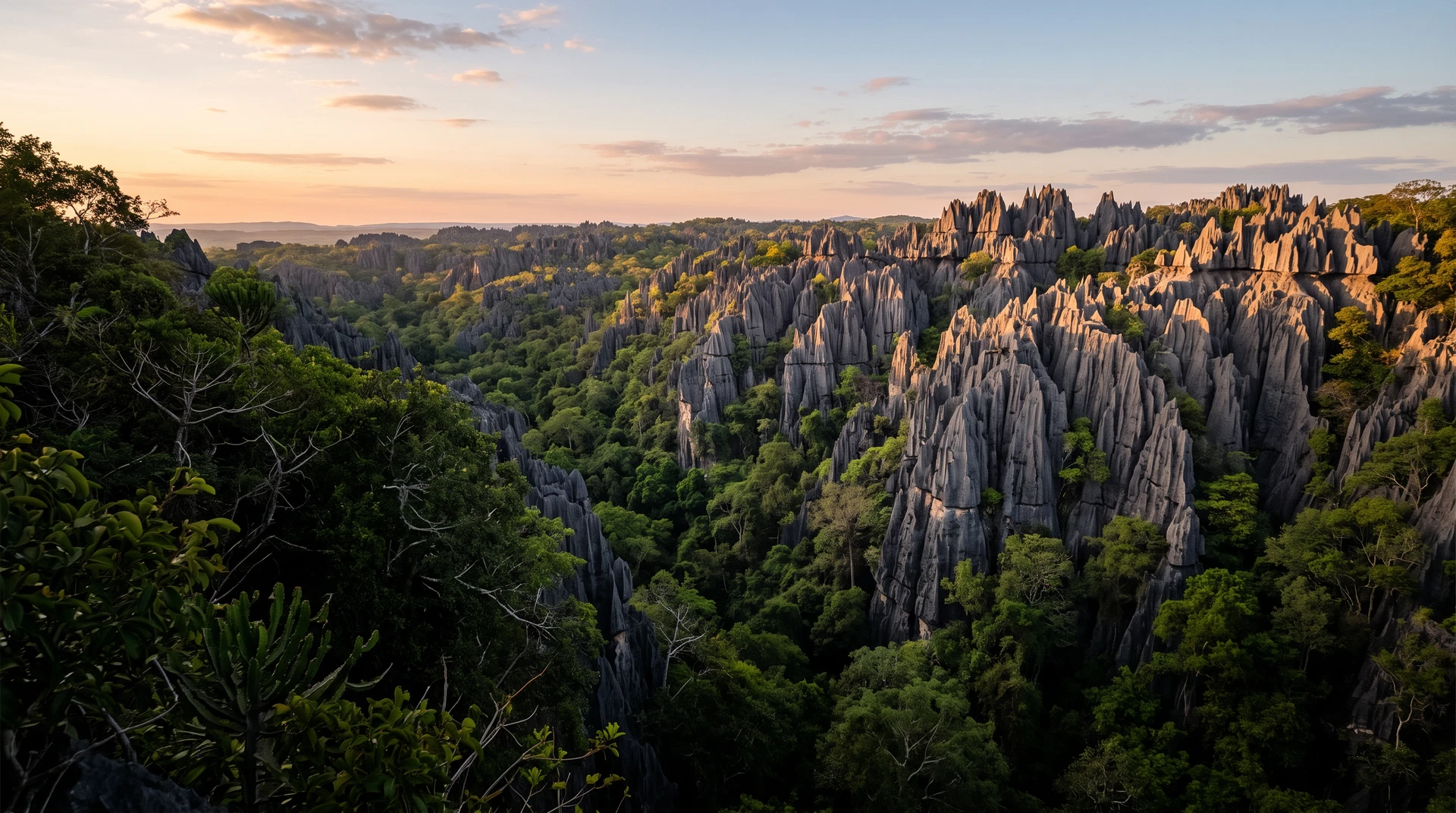
The approach to Tsingy de Bemaraha National Park is a lesson in patience, a journey through the dusty arteries of western Madagascar that leads to a landscape so improbable it feels like a hallucination. Known locally as the "place where one cannot walk barefoot," this UNESCO World Heritage site is a sprawling fortress of karst limestone, where the earth has been sculpted into a vertical maze of razor-sharp needles. To stand at the edge of the Great Tsingy is to look out over a petrified ocean of stone, a monochromatic wilderness that defies the soft curves of the natural world.
The origins of this stone forest date back approximately 200 million years to when the region was submerged. Over eons, the accumulation of coral and shells formed a massive limestone plateau, which was eventually uplifted by tectonic forces. As the waters receded, the relentless work of tropical rainfall began to carve the rock. Acidic water seeped into fissures, dissolving softer minerals and leaving behind the resilient, vertical blades that define the landscape today. This process of karstification has created a subterranean world of caves and sinkholes that mirror the complexity of the surface, forming a dual reality of extremes.
Navigating the Tsingy is not a casual stroll but a full-body engagement with geology. Visitors are required to don climbing harnesses and clip into steel cables that snake across rock faces and bridge narrow chasms. The ascent involves scaling iron ladders bolted into the limestone and squeezing through tight crevices where the stone walls feel close enough to breathe against. From the top of the observation platforms, the scale of the erosion is overwhelming. The needles, some rising over a hundred feet, create a jagged canopy that hides a secret world below, demanding calculated movement and physical focus.
Despite the seemingly inhospitable nature of the stone, the Tsingy is a sanctuary for an extraordinary array of life. In the narrow canyons and pockets of soil between the needles, a dry deciduous forest thrives, providing a green counterpoint to the gray karst. Here, eleven species of lemurs have mastered the art of living on the edge. The Decken’s sifaka, with its cream-colored fur, can be seen leaping with grace from one razor-sharp pinnacle to the next. These primates have adapted to the seasonal extremes of the Melaky Region, finding sustenance in a vertical garden inaccessible to most.
Flowing along the southern boundary, the Manambolo River offers a different perspective on this geological masterpiece. A slow drift in a traditional pirogue reveals the scale of the canyon walls, which rise vertically from the water’s edge. The river is the lifeblood of the region, a winding path of turquoise that cuts through the heart of the limestone. From the water, the silence of the gorge is profound, broken only by the rhythmic splash of the paddle and the cry of a Madagascar fish eagle. The cliffs here are not just geological features but historical archives of the island.
Tucked into the high, inaccessible reaches of the Manambolo cliffs are the ancient burial sites of the Vazimba, the indigenous people believed to be the original inhabitants of Madagascar. These sacred tombs, often marked by simple wooden structures, are a reminder of the deep spiritual connection the Malagasy people maintain with their ancestors. The Vazimba are shrouded in myth, described as forest dwellers who lived in harmony with the land long before later migrations. Their presence transforms the landscape into a cultural monument, where the stone needles serve as silent sentinels over the resting places of the past.
The accessibility of Tsingy de Bemaraha is dictated by the rhythm of the seasons, preserving its sense of remote isolation. From November to April, heavy rains turn the dirt tracks into impassable quagmires, effectively cutting the park off from the outside world. During these months, the stone forest belongs once again to the lemurs and the elements. This enforced solitude allows the ecosystem to recover, ensuring that the fragile karst formations and endemic flora are not overwhelmed. For the traveler, a visit must be carefully timed to the dry heat of the winter months when the journey is possible.
Stewardship of this landscape is a complex task, balancing conservation with the physical demands of exploration. The sharp, brittle nature of the limestone means that even a misplaced foot can cause significant damage to formations that took millions of years to create. Rangers emphasize the importance of following designated routes for the safety of both the visitor and the karst. The park’s UNESCO status brings international attention, but day-to-day protection relies on local communities and rigorous protocols. It is a place that demands respect, offering its beauty only to those willing to move with care.
The sensory experience of the Tsingy is defined by contrast. There is the searing heat of the exposed rock at midday, followed by the cool shadows of deep canyons. There is the abrasive texture of limestone against the skin and the sudden flash of a parrot’s wings against the gray stone. The wind, as it moves through the needles, creates a low, whistling sound, a natural symphony that underscores the prehistoric atmosphere. In the evenings, as the sun dips, the karst takes on a golden hue, the shadows lengthening to create a dramatic, high-contrast landscape that shifts with the light.
Leaving the Tsingy, one carries the memory of a landscape that feels fundamentally different from any other place on earth. It is a reminder of the planet’s capacity for extreme creativity, a testament to the power of water and time. The stone forest remains a bastion of the wild, where the boundaries between geology and biology are blurred, and where the echoes of ancient cultures still resonate. For those who venture into its jagged heart, the Tsingy offers a rare encounter with the sublime, a vertical wilderness that stands as a timeless monument to the mystery of Madagascar.