Travel
The Emerald Abyss: Finding Stillness Within South Africa’s Great Green Canyon
Rising from the mist of the Mpumalanga highlands, the Blyde River Canyon offers a lush, vertical sanctuary where ancient dolomite spirals meet the rushing waters of the Drakensberg Escarpment, revealing the vibrant, subtropical soul of the world’s largest verdant gorge.
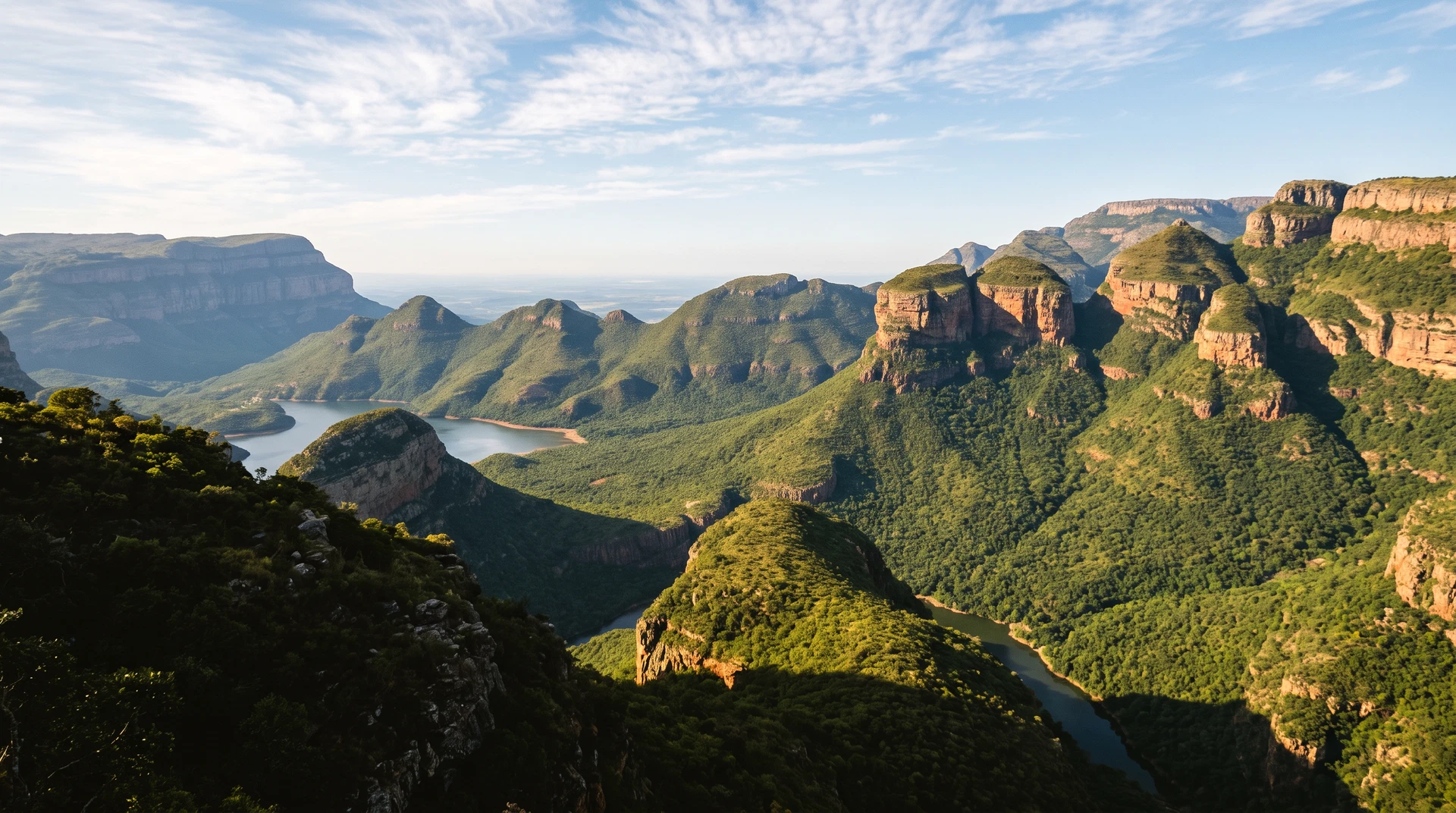
The Great Drakensberg Escarpment does not announce its presence with a gradual incline. Instead, the South African highveld simply ends, falling away in a staggering vertical collapse that separates the interior plateau from the humid Lowveld. At this threshold, the earth has been torn open by the Blyde River, creating a chasm that defies the typical desert-toned expectations of a canyon. This is a place of profound verticality, where the scale is softened by a relentless carpet of subtropical vegetation. To stand on the rim is to witness a geological drama that has resulted in one of the most striking natural wonders of the Southern Hemisphere, a slow-motion collision between ancient stone and the persistent force of water.
Unlike the arid expanses of the Grand Canyon, the Blyde River Canyon is defined by its life. It is recognized as the world’s largest "green canyon," a title earned by the dense forests that cling to every ledge of its 800-meter-deep walls. This emerald mantle is fueled by the moist air that rises from the Lowveld, cooling as it hits the escarpment to form the characteristic mists that frequently swallow the viewpoints. The vegetation is a complex ecosystem providing sanctuary for a staggering array of life, from the rare bald ibis nesting in the cliffs to the samango monkeys moving through the forest floor below.
The most iconic sentinels of this landscape are the Three Rondavels. These massive dolomite spirals rise from the canyon wall like the pointed roofs of traditional African homesteads, their sides striped with layers of ancient sedimentary rock. At sunset, the orange-hued stone catches the dying light, glowing against the deep green shadows of the gorge. The scale is difficult to process; the peaks seem close enough to touch, yet the river winding at their base is a mere silver thread, nearly a kilometer beneath the feet of the observer. There is a stillness here that feels heavy and ancient, a reminder that these stone giants have watched the seasons turn for eons.
Further north, the geological story takes a more turbulent turn at the confluence of the Blyde and Treur rivers. Here, the "River of Joy" and the "River of Sorrow"—named by 19th-century Voortrekkers—meet in a violent swirl of white water. Over centuries, the abrasive silt and pebbles carried by the currents have ground deep, cylindrical basins into the sandstone, creating the surreal landscape of Bourke’s Luck Potholes. Bridges crisscross the churning water, allowing visitors to look directly down into the smooth, water-carved cavities that resemble a giant’s honeycomb. The sound is a constant, low-frequency thrum, the acoustic signature of the river’s tireless work in reshaping the very foundation of the canyon.
Navigating the canyon requires a slow, deliberate pace, dictated by the winding R532 road that traces the lip of the escarpment. Known as the Panorama Route, this drive is as much a part of the experience as the viewpoints themselves. The road curls through pine plantations, occasionally breaking out into open grassland where the wind whips across the plateau. Drivers must contend with sharp curves and the sudden onset of dense mist that can transform a sunny afternoon into a claustrophobic world of gray in minutes. This environmental volatility is a constant reminder of the canyon’s power; the landscape demands respect, offering its most spectacular views only to those patient enough to wait for the clouds to part.
Stewardship of this environment is a delicate balancing act. The canyon is a core component of the UNESCO-designated Kruger to Canyons Biosphere Reserve, a conservation area that seeks to bridge the gap between protected wilderness and human development. Within the canyon’s boundaries, endangered endemic flora, such as the Blyde Protea, find their last strongholds. Visitors are urged to remain strictly on designated paths to protect the micro-habitats that exist in the damp, shaded corners of the rim. The impact of a single footstep can be significant in an environment where soil is thin and growth is dictated by the precise interplay of altitude and moisture, making every cautious step a contribution to the region’s long-term preservation.
The verticality of the canyon creates distinct climatic zones. On the rim, the air is crisp and cool, carrying the scent of mountain fynbos and damp earth. As one descends toward the water, the temperature rises and the air grows heavy with the humidity of the subtropical forest. In the depths of the gorge, the Blyde River flows through a world of giant ferns and towering yellowwood trees, a hidden valley that feels entirely disconnected from the windswept plateau above. This layered existence is what gives the canyon its depth, offering a variety of perspectives that change with every shift in light and elevation, revealing the emerald heart of the great escarpment.
To experience the Blyde River Canyon is to confront the sheer persistence of the natural world. It is a place where the passage of time is measured in the deepening of a pothole or the slow growth of a lichen on a dolomite face. There is a wistfulness in the way the mist clings to the Three Rondavels, a sense of a world that exists on its own terms, indifferent to the passing travelers. It is a landscape that invites contemplation rather than conquest, a verdant abyss that reminds us of the vibrant heart of the African continent. In the quiet moments when the wind drops, the canyon reveals its true self: a lush, vertical sanctuary of enduring emerald beauty.