Travel
The Silence of a Dried Sea: Navigating the Luminous Salt Crusts of Makgadikgadi
Across the parched expanse of Botswana’s Central District, the remains of an ancient super-lake form a landscape of blinding white salt and haunting silence. This vast basin, once home to a prehistoric sea, now hosts one of Africa’s most dramatic seasonal transformations and vital wildlife migrations.
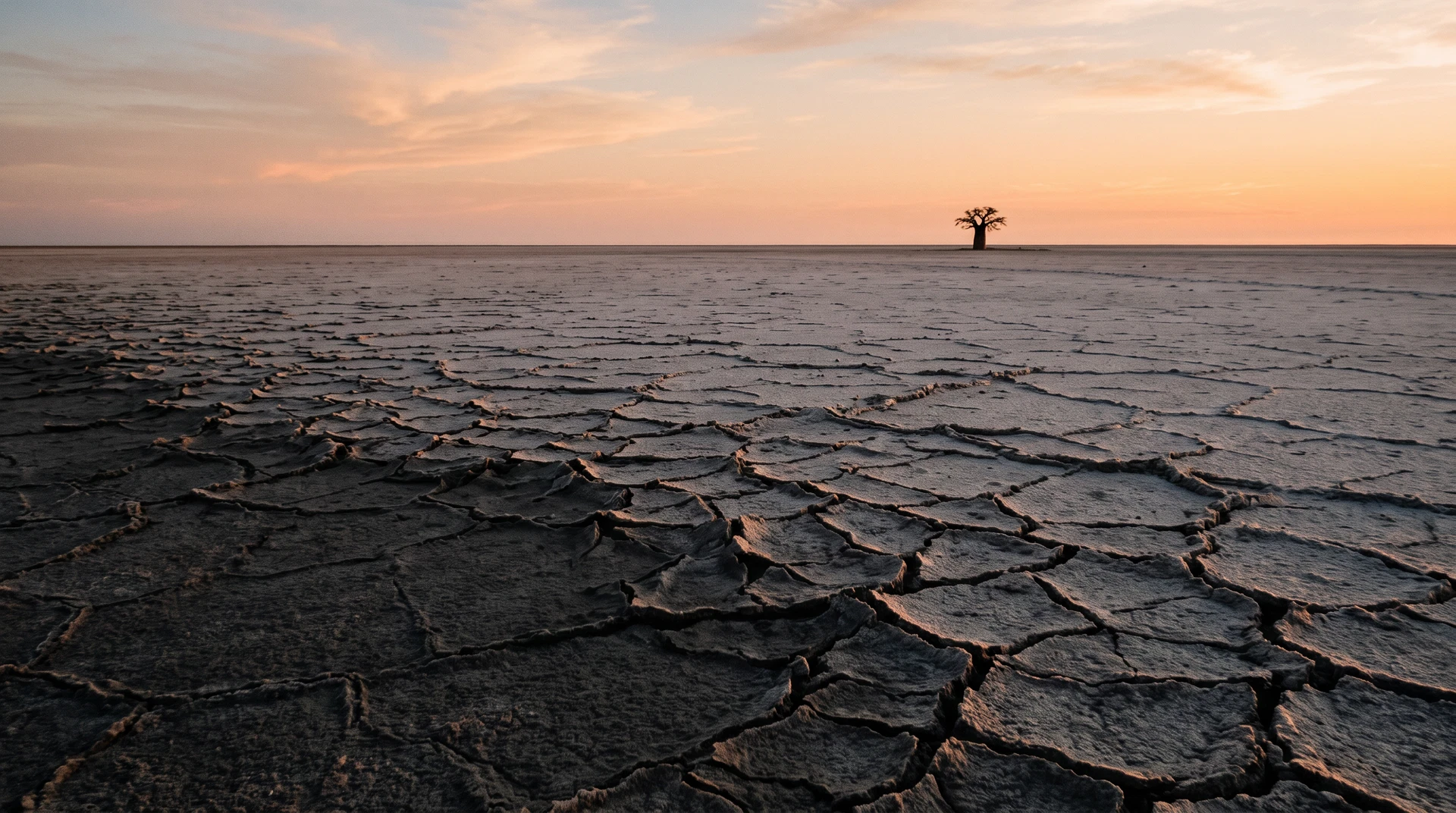
The first thing you notice is the silence, a profound quiet that presses against your eardrums. In the heart of Botswana’s Central District, the Makgadikgadi Pans stretch toward every horizon, a blindingly white expanse that defies the typical imagery of the African bush. This is not the lush labyrinth of the Okavango, but its skeletal remains. Covering over 30,000 square kilometers, it is the world’s largest salt pan complex, where the earth has been stripped to its basic elements. The light here is unfiltered, bouncing off the crystalline surface with such intensity that the line between land and sky often dissolves into a shimmering, heat-distorted haze.
To understand this landscape, one must look back to the era of Lake Makgadikgadi. Once a super-lake spanning more than 275,000 square kilometers, it was fed by the Okavango, Chobe, and Zambezi rivers. Tectonic shifts eventually diverted these lifelines, leaving the lake to evaporate under the Kalahari sun. What remains today is a series of massive basins, primarily the Sua and Ntwetwe pans, which serve as a stark reminder of the planet’s shifting geography. Walking across the crust, you are stepping on the floor of a vanished sea, the salt underfoot a concentrated ghost of the minerals that once sustained a massive prehistoric ecosystem.
The salt crust is a marvel of natural geometry, a mosaic of interlocking polygons formed by the cycle of wetting and drying. It feels solid, yet it is deceptively fragile. A critical rule for any visitor is to strictly follow designated tracks. The crust can be thin, concealing a treacherous layer of mud beneath that can swallow a vehicle in seconds. Furthermore, the scars left by off-road driving are not temporary. In this arid environment, tire marks can remain visible for decades, a permanent blemish on a landscape that otherwise feels untouched. There is a weight to this realization; your presence here must be light.
Rising like a granite fortress from the white sea is Lekhubu Island, a rocky outcrop that feels like an altar to the ancient world. Here, the ground changes from salt to stone, and the vegetation shifts to the surreal. Lekhubu is famous for its ancient baobabs, those "upside-down" trees with bloated trunks that look as though they were planted by a giant. Some of these trees are estimated to be over a thousand years old, their silver bark weathered by centuries of wind. Standing among them at sunset, the contrast is breathtaking: the dark, gnarled silhouettes of the trees against the pink-hued salt pan.
While the dry season presents a world of monochromatic brilliance, the arrival of summer rains triggers a transformation bordering on the miraculous. As the basins fill with a thin layer of water, the pans turn into the world’s largest mirror, reflecting the dramatic African thunderstorms and the vast, unpolluted night sky. The salt becomes a catalyst, as water dissolves minerals and awakens dormant algae and crustaceans. This seasonal pulse is the heartbeat of the Makgadikgadi, a reminder that even in the desert, water is the ultimate arbiter of existence, turning a parched wasteland into a temporary, shimmering paradise for the life that waits.
As the waters rise, the pans become a critical breeding ground for Lesser and Greater Flamingos. They arrive in their thousands to feed on the sudden abundance of algae. From the air, the pans appear brushed with streaks of vivid pink, a living tapestry moving with the wind. The flamingos build mud-mound nests in the shallow water, protected from land-based predators by the very environment that makes human access so difficult. It is a fragile window of opportunity; if the rains are too light, the pans dry up before the chicks can fly, a reminder of the precarious balance maintained in this changing climate.
The birds are not the only ones who respond to the rains. The Makgadikgadi hosts the second-largest zebra and wildebeest migration on the continent. As the surrounding Kalahari grasslands begin to green, tens of thousands of animals move toward the pans for the mineral-rich water and fresh grazing. The sight of a dust cloud on the horizon, slowly resolving into a line of thousands of zebras, is a primal experience. They follow ancient paths etched into their collective memory, moving with a singular purpose that has remained unchanged for millennia. For a few months, the silence of the pans is replaced by the rhythmic thrum of hooves.
Traveling here requires a shift in mindset. Infrastructure is minimal by design, and most visitors experience the pans through rustic campsites on the periphery. You must carry everything: water, fuel, and self-reliance. The heat during the day can be oppressive, and the cold at night biting, yet these extremes are part of the allure. To visit the Makgadikgadi is to accept a degree of vulnerability, acknowledging that you are a guest in a place that does not cater to human comfort. It is a practical lesson in humility, where the lack of modern distractions allows for a deeper, more observant connection with the environment.
As you leave the pans, the white horizon receding in the rearview mirror, a sense of wistfulness takes hold. It is a feeling of having touched something eternal, a landscape operating on a geological timescale far beyond our own. The Makgadikgadi is not a place you "see" so much as a place you "feel"—a space where the clutter of modern life is stripped away, leaving only the essential. Whether it is the ancient baobabs of Lekhubu or the shimmering mirages of the Ntwetwe Pan, the memory of this luminous void stays with you, a quiet reminder that silence is often the most powerful voice of all.