Travel
The Miraculous Pulse of Water Where the Kalahari Desert Meets a Shimmering Inland Sea
In the heart of Botswana, a seasonal flood transforms the parched Kalahari into a vibrant labyrinth of life. This endorheic wonder, where rivers vanish into sand rather than the sea, offers a profound encounter with nature’s most delicate and dramatic hydrological masterpiece.
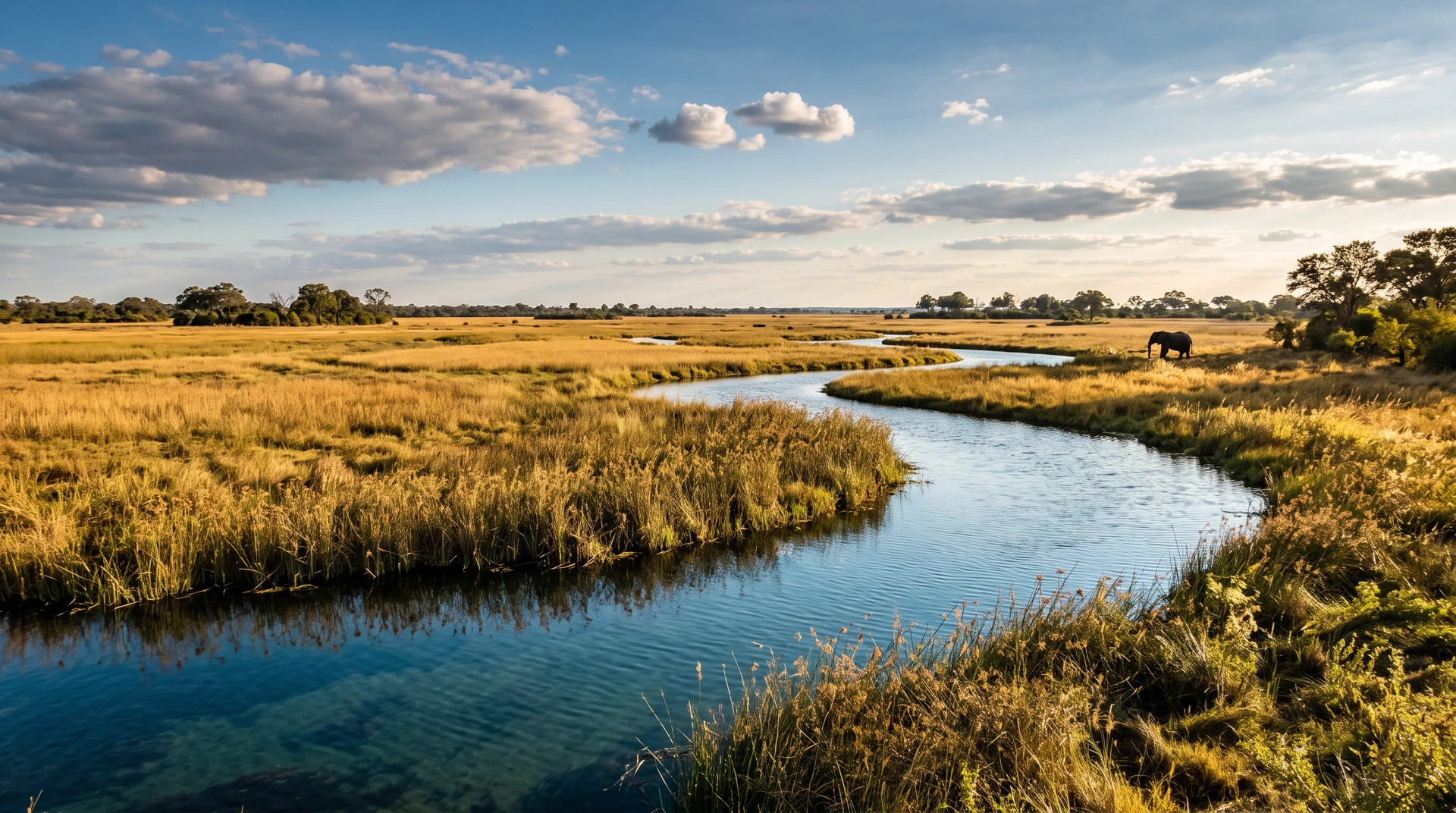
The descent into the Okavango Delta begins with a revelation. From the window of a small Cessna, the arid, terracotta expanse of the Kalahari Desert suddenly fractures into a thousand silver veins. This is the world’s largest intact endorheic delta, a geological anomaly where the Okavango River, having journeyed from the highlands of Angola, surrenders its strength to the thirst of the desert sands rather than the salt of the sea. Below, the landscape is a mosaic of emerald islands and sapphire channels, a place where the map changes every season as the water pulses through the earth.
The timing of this transformation is the delta’s most poetic secret. While the rest of Southern Africa enters the dry winter months, the Okavango begins its peak flood. The rains that fell months ago and hundreds of miles away finally arrive, trickling through a labyrinth of papyrus and reeds. This seasonal pulse is the lifeblood of the region, forcing every living creature to adapt to a landscape that is constantly in flux. It is a slow-motion miracle, a creeping inundation that turns dusty plains into lush floodplains, inviting a migration of life as ancient as the sands themselves.
Navigating this watery maze is best done in a mokoro, the traditional dugout canoe that has defined life here for generations. As the poler stands at the stern, guiding the craft through lily-choked channels, the silence is profound. There no engine noise to startle the jacanas trotting across floating pads, only the soft drip of the pole and the rustle of wind through the reeds. In the mokoro, you are at eye level with the delta’s smaller wonders—the iridescent dragonflies, the tiny reed frogs, and the delicate white water lilies that open their petals to the morning sun.
Yet, the delta is also a realm of giants. Botswana sustains the greatest concentration of elephants left on Earth, and nowhere is their presence more felt than in the Okavango. During the flood, these massive pachyderms become semi-aquatic, wading through chest-deep water to reach the succulent grasses of the islands. Watching a herd cross a channel is a masterclass in quiet power; their trunks act as snorkels, and their calves swim in the wake of their mothers. These journeys are not merely for sustenance but are deeply etched into the collective memory of the herd, passing through generations.
For those who seek the more elusive residents, the delta serves as one of the final strongholds for the endangered African wild dog. These "painted wolves" thrive in the complex terrain of the Okavango, using the mosaic of land and water to their advantage during the hunt. Unlike the solitary leopard or the pride-bound lion, the wild dogs are a whirlwind of social energy, their high-pitched chirps echoing through the mopane woodlands as they coordinate their movements. Their cooperative hunting strategy is a marvel of biological coordination, ensuring the pack's survival in a landscape that rewards the swift and the social.
The human presence here is intentionally fleeting. Stewardship in the Okavango is defined by a "high-value, low-volume" tourism model, where accommodation is restricted to temporary tented camps. These lodges are often accessible only by air, perched on wooden decks that leave no permanent scar on the earth. There is a specific kind of luxury in this minimalism; it is the luxury of being a guest in a place that does not belong to you. The camps are designed to be dismantled, reflecting a commitment to preserving the near-pristine state of the wetland.
As the sun dips below the horizon, the delta undergoes a sonic shift. The daytime chorus of birds is replaced by the deep, resonant grunts of hippos and the distant, sawing call of a leopard. The stars above the Kalahari are impossibly bright, reflected in the still waters of the lagoons until the world feels like it is suspended between two heavens. In this isolation, the scale of the delta becomes truly apparent. It is a vast, self-sustaining machine of water and light, operating on a clock that ignores the frantic pace of the modern world.
Leaving the Okavango is a process of returning to a world that feels suddenly too solid and too predictable. The lessons of the delta—of the importance of water, the necessity of flux, and the beauty of a light footprint—linger long after the plane has cleared the floodplains. This is not just a destination; it is a reminder of what the earth can achieve when left to its own rhythms. In an era of increasing scarcity, the Okavango Delta stands as a testament to the power of preservation, a shimmering inland sea that continues to defy the desert, one seasonal pulse at a time.