Travel
The Silent Rift: Navigating the Billion-Year Echoes of Namibia’s Fish River Canyon
Stretching across the parched plains of the ǁKaras Region, Africa’s largest canyon offers a raw encounter with deep time. From its metamorphic basement to the healing waters of ǀAi-ǀAis, this self-supported trek challenges the spirit while revealing a billion years of geological drama.
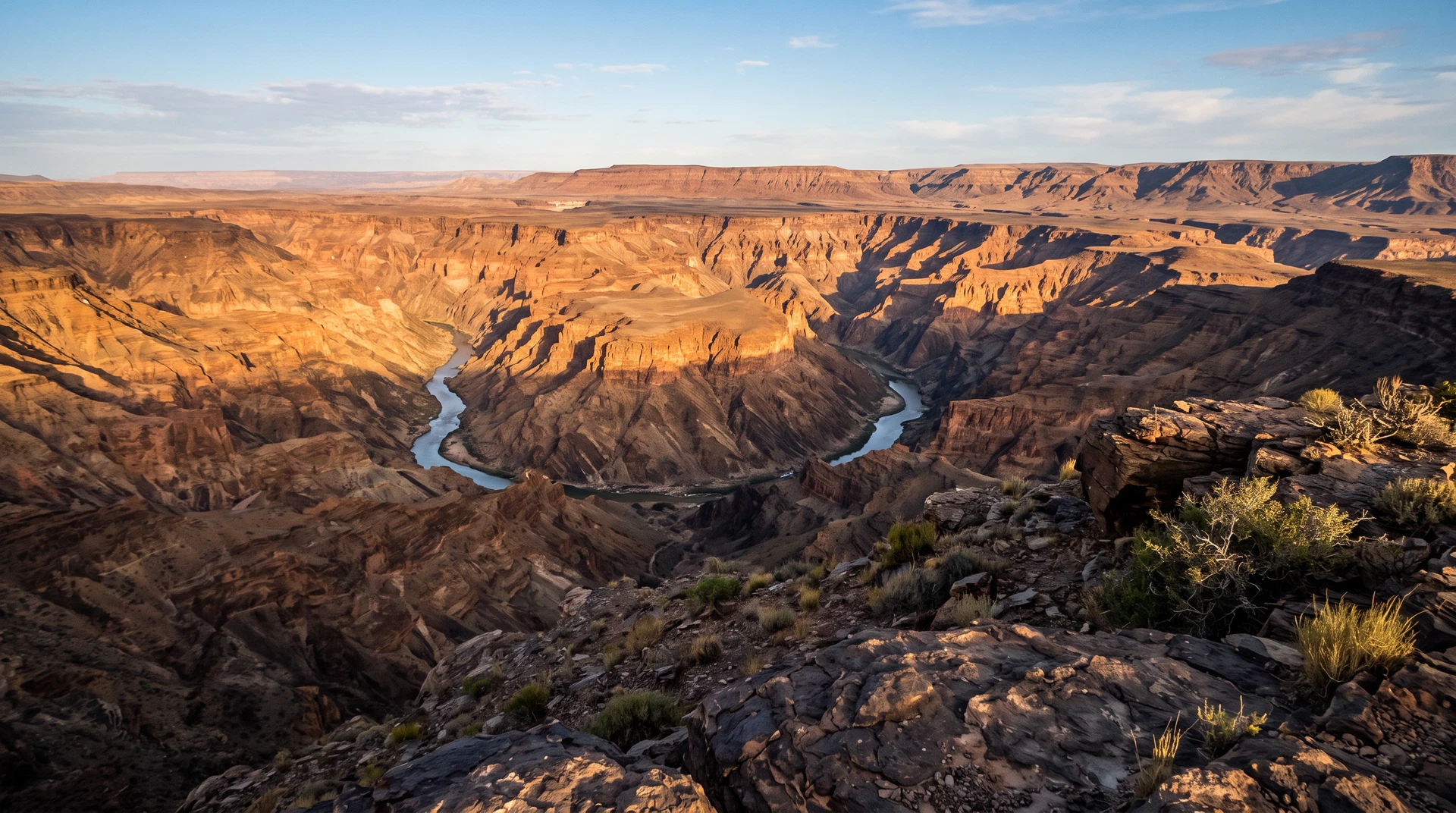
Standing at the rim of the Fish River Canyon, the scale of the earth’s fracture feels less like a landscape and more like a confrontation. Located in Namibia’s southern ǁKaras Region, this is Africa’s largest canyon, a jagged scar that stretches roughly 161 kilometers through the desert. The air at the viewpoint is often still, carrying the scent of dry stone and sun-baked earth. Below, the ground falls away in a series of dramatic terraces, revealing a chasm that reaches up to 27 kilometers in width. It is a place where the horizon feels secondary to the depth, a vertical wilderness that demands a complete recalibration of one's sense of scale.
The story written in these walls is one of immense patience and violent shifts. Geologically, the canyon is a masterclass in deep time, exposing a metamorphic basement that dates back over a billion years. These ancient rocks are overlain by younger sedimentary layers, creating a visual timeline of the planet’s history. The canyon’s current form was not sculpted by water alone; it is the result of tectonic rifting that occurred millions of years ago, followed by the persistent, seasonal erosion of the Fish River. Walking through the canyon is essentially a descent into the basement of the world, where every step carries you across millions of years of compressed history.
For those who choose to descend, the journey is a self-supported trek that is as much a mental challenge as a physical one. The path is not a groomed trail but a rugged navigation through boulders and sand, requiring hikers to carry everything they need for the multi-day expedition. Because of the extreme summer temperatures, which can soar to dangerous levels, the canyon is only open to trekkers during the cooler window from May to September. Even then, the environment is unforgiving. A medical clearance certificate is a mandatory prerequisite, and the park requires groups of at least three to ensure that no one faces the canyon’s isolation entirely alone.
The silence within the canyon is profound, a heavy, resonant quiet that seems to absorb the sound of your own footsteps. Away from the rim’s viewpoints, the modern world disappears entirely. There are no cell signals, no roads, and no easy exits. This isolation fosters a unique camaraderie among those on the trail, as the shared responsibility of navigation and resource management becomes the primary focus. The days are governed by the sun, starting in the crisp, cold air of dawn and ending under a canopy of stars so bright they seem to vibrate against the black Namibian sky. It is a rare, unmediated experience of the wild.
The Fish River itself is a seasonal presence, often reduced to a series of stagnant, turquoise pools during the trekking months. These pools are vital lifelines for the canyon’s desert-adapted inhabitants. You might spot the agile Hartmann’s mountain zebra picking its way across the scree slopes or hear the sharp call of a fish eagle echoing between the cliffs. The vegetation is sparse but resilient; quiver trees stand like sentinels on the upper slopes, their waxy leaves and thick trunks designed to store every drop of moisture. In the canyon floor, hardy shrubs and tamarisks cling to the riverbanks, providing small patches of shade in an otherwise exposed landscape.
Navigation requires a keen eye for the terrain, as the river’s path is winding and often deceptive. Short-cuts across the bends can save kilometers, but they involve grueling climbs over steep ridges of loose rock. The physical toll of the trek is significant; the constant impact of sand and stone can wear down even the best-prepared gear. However, the reward is a perspective that cannot be found from the rim. From the canyon floor, the towering walls of gneiss and schist feel like the pillars of a cathedral, their colors shifting from deep ochre to pale violet as the light moves across the sky.
As the trek nears its conclusion at the southern end, the landscape begins to soften. The rugged metamorphic rocks give way to the promise of the ǀAi-ǀAis hot springs. Here, groundwater that has traveled deep through fault lines emerges at a steaming 60°C, rich with minerals and heat. For hikers who have spent days straining their muscles against the canyon’s floor, these springs are a near-miraculous relief. The transition from the harsh, dry interior of the canyon to the soothing warmth of the thermal pools marks the end of the journey, providing a physical and metaphorical washing away of the desert’s dust.
Leaving the Fish River Canyon often feels like emerging from a dream of another era. The sheer antiquity of the landscape leaves a lasting impression, a reminder of the fleeting nature of human presence compared to the billion-year endurance of the stone. It is not a destination for the casual tourist, but for those who seek to test their limits and witness the raw power of geological forces, it is unparalleled. The canyon does not offer comfort, but it offers something far more valuable: a sense of profound connection to the earth’s most ancient rhythms. In the silence of the rift, one finds a clarity that only the desert can provide, a stillness that remains long after the trek has ended.