Travel
The Liquid Rainbow: Witnessing the Ephemeral Bloom of Colombia’s Most Radiant Jungle River
In the heart of the Serranía de la Macarena, the endemic Macarenia clavigera plant transforms a jungle stream into a vibrant spectrum of reds and pinks. This ephemeral masterpiece, visible only during the rainy season, offers a rare glimpse into a biological bridge where three worlds meet.
Deep within the Meta Department of Colombia, where the rugged foothills of the Andes begin their slow descent toward the vast expanses of the Amazon and the Orinoco, lies a landscape that feels like a secret kept by the earth itself. Reaching La Macarena requires a transition from the urban bustle of Bogotá to a small, propeller-driven plane that skims over a canopy of unbroken green. As the aircraft descends, the Serranía de la Macarena rises like an ancient island of sandstone. The air here is thick with the scent of damp earth and the distant promise of rain, a humidity that clings to the skin like a second garment. It is a place defined by its isolation, a frontier where the wild remains truly wild, and where the rhythm of life is dictated by the rising and falling of the rivers that carve through the prehistoric rock.
The Serranía de la Macarena is not merely a mountain range; it is a biological bridge of unparalleled significance. Here, the distinct ecosystems of three major South American biomes—the Andes, the Amazon, and the Orinoco—converge in a vibrant collision of life. The geology of the region is equally unique, characterized by the ancient formations of the Guyana Shield. These hard, nutrient-poor sandstone beds provide the perfect stage for the region’s most famous inhabitant, a delicate aquatic plant that has adapted to thrive in conditions that would stifle most other life forms.
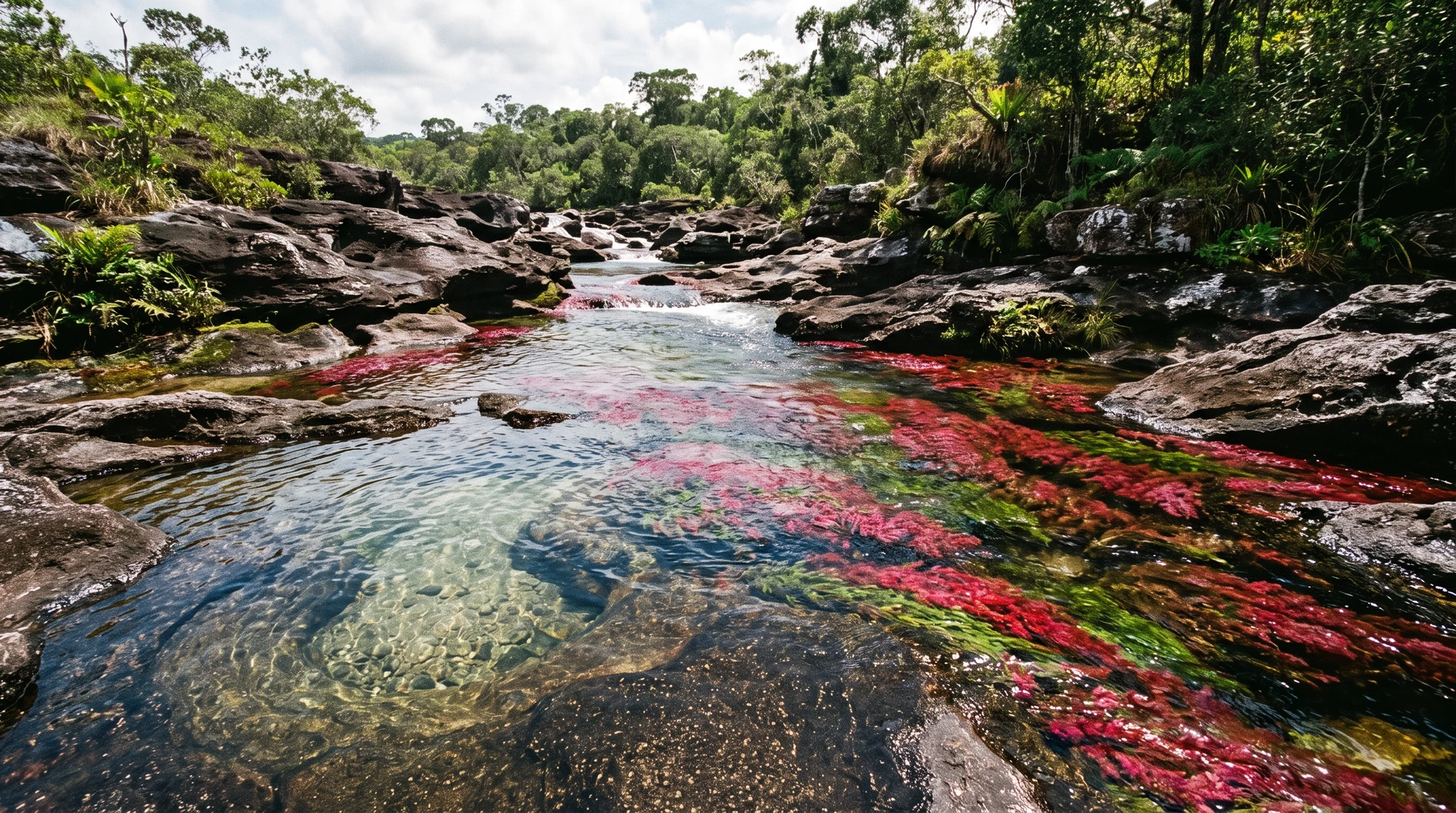
To the casual observer, Caño Cristales might look like an ordinary jungle stream for much of the year. But as the rainy season takes hold between June and November, a miraculous transformation occurs. The riverbed, composed of dark, weathered rock and crystalline quartz sand, begins to blush. This is the work of Macarenia clavigera, an endemic aquatic plant that is neither moss nor algae, but a specialized vascular species. During the high-water months, when the sun strikes the shallow rapids with just the right intensity, these plants erupt in a spectrum of colors ranging from pale pink to a deep, bruised purple and a brilliant, blood-red crimson. They cling to the rocks with a tenacity that defies the current, their feathery fronds swaying in the clear water like the tresses of a submerged forest.
Walking along the banks of Caño Cristales is an exercise in sensory overload. The water is so transparent that it seems to disappear, leaving the vibrant plants to appear as though they are floating in mid-air. In the deeper pools, known as "marmitas de gigante" or giant’s kettles, the water takes on a teal or emerald hue, contrasting sharply with the red carpets below. The light here is a fickle companion; a passing cloud can turn the river from a glowing neon pink to a somber burgundy in a matter of seconds. When the sun breaks through, the entire river seems to ignite, reflecting the blue of the sky and the deep green of the overhanging jungle. It is a visual symphony that feels almost too vivid to be natural, a masterpiece painted by biology and physics.
The beauty of Caño Cristales is matched only by its extreme fragility. Because the Macarenia clavigera plants are highly sensitive to changes in water chemistry and physical disturbance, the Colombian National Parks system enforces some of the strictest environmental regulations in the world. Visitors are prohibited from wearing sunblock or insect repellent, as the oils and chemicals in these products can be fatal to the delicate flora. This requirement forces a more intimate, raw connection with the environment; one must endure the tropical sun and the persistent buzz of insects without the usual chemical barriers. It is a small price to pay for the privilege of witnessing such a rare phenomenon.
Access to the river is strictly controlled, and every visitor must be accompanied by an authorized local guide. These guides are often residents of La Macarena who have transitioned from lives of subsistence farming to become the stewards of their own natural heritage. Their knowledge is not just academic; it is lived. They point out the subtle differences in the plant’s color depending on the depth of the water and the speed of the current, and they share stories of the river’s history that are woven into the fabric of the community. Through their eyes, the river is not just a tourist destination, but a vital organ of the ecosystem.
The experience of Caño Cristales is inherently tied to the weather. The rainy season is not a time of constant downpours, but rather a cycle of dramatic storms followed by bursts of intense, clarifying sunlight. It is this cycle that feeds the river and provides the necessary conditions for the Macarenia to bloom. Without the rain, the water levels drop, the sun scorches the exposed plants, and the colors fade into a dormant brown. To visit during these months is to embrace the unpredictability of the tropics. You might start a hike under a clear blue sky, only to be drenched by a sudden deluge that turns the trails into small streams. But when the clouds part and the light hits the saturated river, the brilliance of the colors is only heightened.
As the season draws to a close in late November, the "Liquid Rainbow" begins to fade. The plants complete their life cycle, releasing seeds into the cooling water before retreating into a state of dormancy. The river returns to its quiet, clear state, and the park closes its gates to allow the ecosystem to recover in solitude. This ephemerality is what makes Caño Cristales so poignant. It is a reminder that the most beautiful things in nature are often the most fleeting, requiring us to be present and attentive in the moment. Standing on the ancient rocks of the Macarena, watching the crimson plants dance in the current, one feels the weight of geological time and the lightness of a single, vibrant season.