Travel
The Sentinels of the Sky: Searching for Stillness in Colombia’s Cocora Valley
In the high-altitude reaches of the Quindío department, the world’s tallest palms rise like impossibly slender masts through the Andean mist. This verdant cradle, a vital sanctuary for the endangered yellow-eared parrot, offers a profound encounter with the quiet majesty of Colombia’s cloud forest.
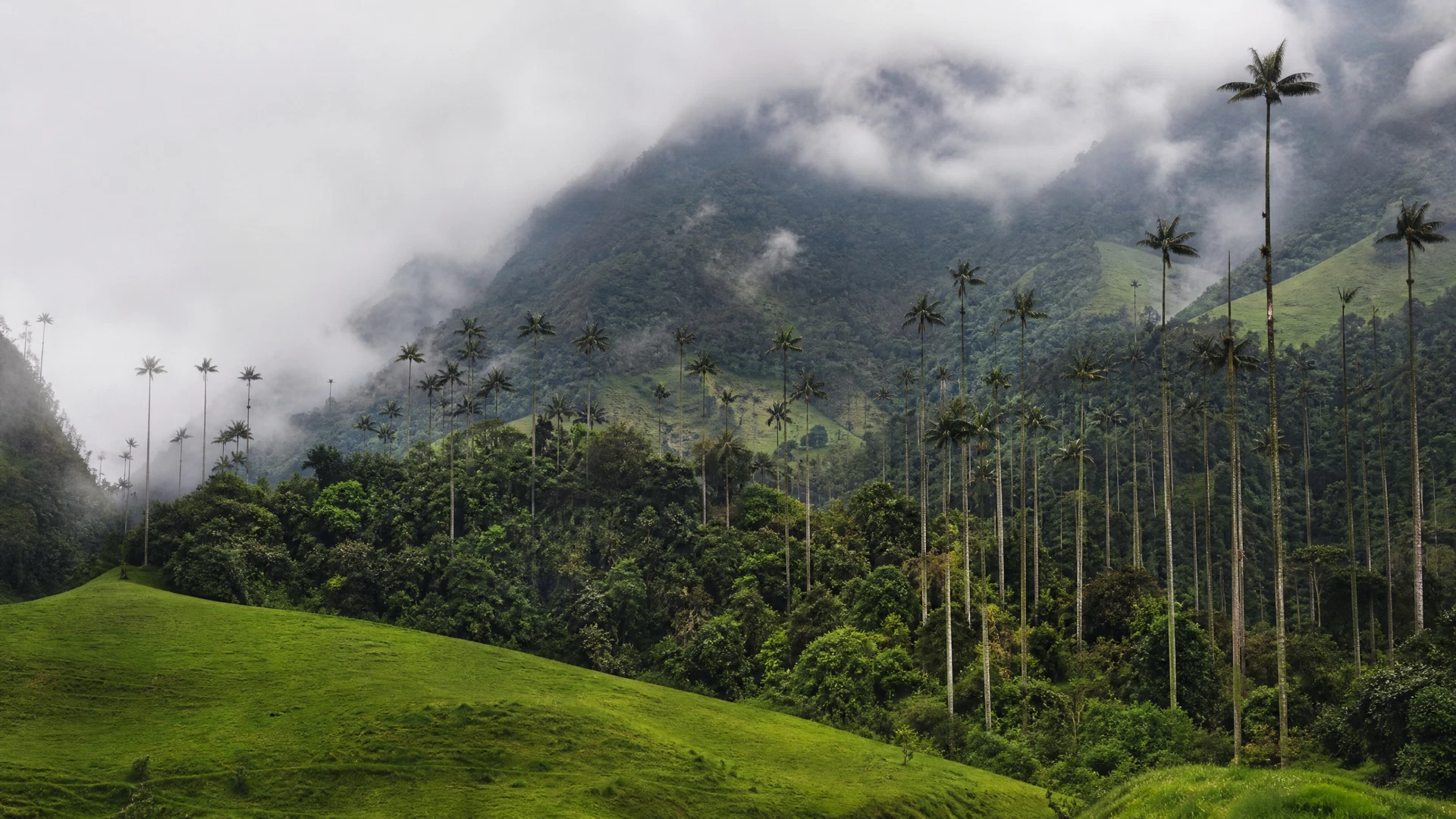
The mist does not merely descend upon the Cocora Valley; it breathes. In the early hours, before the Willys jeeps rattle from Salento, the valley belongs to the clouds. They roll over the ridges of the Central Cordillera, snagging on the dark green canopy. As the light shifts, the silhouettes emerge—slender, impossibly tall, and hauntingly graceful. These are the Quindío wax palms, *Ceroxylon quindiuense*, standing as vertical interruptions in a landscape of rolling emerald curves. To stand at their base is to feel a humbling shift in scale. They do not resemble trees so much as the masts of a sunken fleet, rising from a sea of grass to touch a sky that is rarely ever completely clear.
Located in the heart of Colombia’s Quindío department, the valley serves as a vital high-altitude corridor into the rugged wilderness of Los Nevados National Natural Park. The air here is thin and cool, carrying the scent of damp earth and bromeliads. The geography is defined by the steep slopes of the Andes, which funnel moisture-laden winds into a persistent shroud of fog. This constant humidity is the lifeblood of the cloud forest, sustaining a complex web of life that clings to every branch. It is a place where the boundaries between earth and atmosphere are perpetually blurred, creating an environment that feels both ancient and ephemeral.
The wax palm is the undisputed protagonist of this landscape. As Colombia’s national tree, it carries a weight of significance that belies its delicate appearance. These giants can reach heights of 60 meters, making them the tallest monocots in the world. Their trunks, smooth and light gray, are ringed with the scars of fallen leaves and coated in a thin layer of natural wax. Unlike the stout pines of the north, the wax palm is a study in verticality. It spends decades climbing toward the light, eventually erupting into a tufted crown of fronds that shivers in the mountain breeze. They are survivors of a prehistoric era, standing firm against the Andean winds.
The wax palms are essential components of a specialized habitat. They provide the primary nesting sites and food sources for the endangered yellow-eared parrot. The relationship is symbiotic and fragile; without the palms, the parrots lose their homes, and without the parrots to disperse seeds, the forest’s future is uncertain. This biological drama unfolds quietly amidst the ferns and mosses. Conservationists work to protect these areas, emphasizing that the palms we see today are often centuries old, living relics in a landscape that is slowly being reclaimed by the forest or altered by human hands.
Walking the designated trails is a lesson in sensory immersion. The path begins in open pastures where palms stand in isolated clusters, remnants of forests cleared for grazing. As you ascend, the terrain becomes more intimate. The open air gives way to the dense architecture of the cloud forest. Here, the sound of the Rio Quindío provides a constant soundtrack, punctuated by the sharp calls of hidden birds. The ground is often slick with mud, a reminder of the relentless rainfall. Every step reveals a new detail: a burst of orange from a wild orchid or the silver underside of a tree fern. It is a world that demands slow, deliberate movement.
The local community has long been the stewards of this land, and their presence is felt in the small farms that dot the valley floor. However, the surge in global interest has brought new challenges. The stewardship cautions are clear: staying on the marked paths is a necessity for the survival of wax palm seedlings that struggle in trampled soil. The fragile cloud forest cannot withstand the impact of wandering feet. Respecting these boundaries ensures that the valley remains a sanctuary rather than a spectacle, preserving the quietude that makes a visit here so profound.
As the afternoon progresses, the sun is frequently swallowed by a new surge of clouds. The temperature drops, and the valley retreats back into its silver-gray mystery. This is when the wistful nature of the landscape is most apparent. There is a certain melancholy in the sight of these lone giants standing in the mist, survivors of a changing world. They remind us of the persistence of nature, but also of its vulnerability. To witness the Cocora Valley is to witness a living monument, a place where the earth reaches upward with a grace that is both defiant and serene.
Leaving the valley, one carries the image of those vertical lines etched against the fog. It is a landscape that stays with you, a reminder of the diversity of the Colombian Andes. Beyond the coffee fincas of Salento lies this cathedral of palms, a place where the air is thick with life and the trees touch the clouds. It is not just a destination for a photograph, but a space for reflection on the scale of time. The Cocora Valley stands as a testament to the wonders that occur when a unique geography meets a singular species, creating a world that is, quite literally, like no other.