Travel
The Emerald Eye of the Andes Rests Within a Sun-Drenched Volcanic Caldera
Perched high in the Ecuadorian Andes, the Quilotoa Lagoon offers a mesmerizing encounter with the raw power of geological history. Within its three-kilometer-wide rim, mineral-rich waters shimmer in shifting shades of turquoise, reflecting a landscape shaped by ancient fire and the enduring spirit of the Kichwa people.
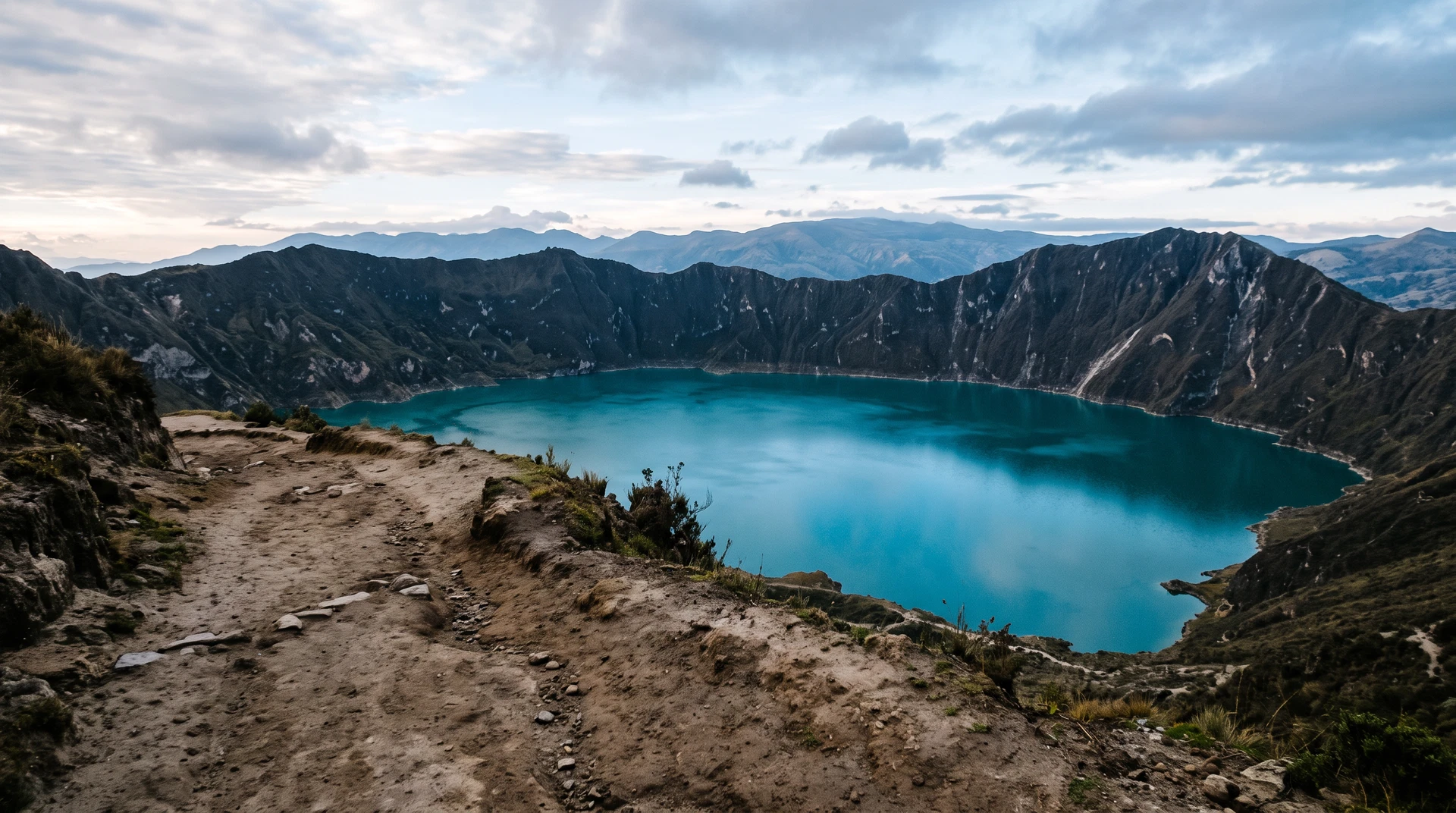
The air at 3,900 meters is a thin, crystalline veil that demands a slower pace and a deeper breath. Traveling through the Cotopaxi Province of Ecuador, the landscape is one of rolling paramo, where hardy grasses sway in the biting wind and the sky feels close enough to touch. This is a world of high-altitude extremes, where the sun burns with a sharp intensity and the shadows hold a lingering chill. The journey toward Quilotoa is a gradual ascent through a rugged terrain of deep ravines and small, wind-swept villages, each step bringing you closer to the rim of one of the most dramatic geological features in the Northern Andes.
Nothing quite prepares you for the suddenness of the reveal. As you reach the jagged edge of the caldera, the ground simply falls away, opening into a vast, three-kilometer-wide bowl that feels like the world’s most spectacular amphitheater. Below, the lagoon sits like a polished gemstone, its surface a startling, opaque turquoise that seems to defy the natural palette of the surrounding earth. The scale is immense, a reminder of the colossal forces that once tore this mountain apart. From the rim, the 250-meter depth of the lake is hidden beneath a tranquil surface, yet the sheer verticality of the inner walls speaks of a violent and transformative past.
This spectacular void was created approximately 800 years ago during a massive dacitic eruption, a volcanic event so powerful it caused the entire summit to collapse inward. The resulting caldera became a permanent vessel for the elements, slowly filling with water and minerals over the centuries. Unlike the jagged, snow-capped peaks of nearby Cotopaxi or Chimborazo, Quilotoa is a landscape of negative space—a monument to what is no longer there. The geological history is etched into the stratified layers of the caldera walls, where streaks of ash and pumice tell the story of the mountain’s final, cataclysmic breath before it settled into its current, silent state.
The lagoon’s most arresting feature is undoubtedly its color, a vibrant, shifting hue that ranges from a deep, bruised peacock blue to a brilliant, neon turquoise. This is not the clear, reflective blue of a mountain tarn, but a dense, alkaline soup rich in dissolved volcanic minerals. Sulfur and iron are the primary architects of this visual alchemy, reacting with the sunlight to create a glow that seems to emanate from the depths themselves. As clouds drift across the sun, the water transforms, flickering between shades of jade and emerald, a constant reminder that the volcano, though dormant, continues to influence the chemistry of the landscape.
Situated within the Ilinizas Ecological Reserve, Quilotoa is part of a delicate high-altitude ecosystem that requires careful stewardship. The paramo surrounding the caldera is a vital watershed, acting as a giant sponge that captures moisture from the mist and feeds the valleys below. The vegetation here is low-slung and resilient, from the silvery leaves of the frailejones to the tough bunchgrasses that anchor the volcanic soil. Every footstep off the designated trails can contribute to erosion in this fragile environment, where the thin soil takes decades to recover from disturbance. Protecting this balance is essential for the continued health of the reserve and the communities that depend on it.
The management of this natural wonder rests in the hands of the local Kichwa community, whose relationship with the land is one of both survival and deep-seated respect. In the small settlement of Quilotoa, the rhythm of life is dictated by the altitude and the seasonal shifts of the Andean climate. The community has developed a sustainable model of stewardship that emphasizes local agency, ensuring that the trails are maintained and that the impact of visitors is carefully monitored. Their presence is a vital thread in the cultural fabric of the region, ensuring that the lagoon remains a living landscape where ancient traditions are respected alongside the modern influx of global travelers.
For many, the lagoon is the crowning jewel of the Quilotoa Loop, a multi-day trek that winds through the remote backcountry of the Andes. The trail is a physical challenge that tests the endurance of even seasoned hikers, not because of its technicality, but because of the relentless thinness of the air. Walking the circumference of the rim offers a panoramic perspective that changes with every turn, revealing the distant, jagged silhouettes of the Ilinizas peaks to the north. It is a journey of introspection, where the silence of the high mountains is broken only by the whistling wind and the occasional cry of a mountain bird.
Descending into the heart of the caldera is an exercise in shifting perspective. The path down to the water’s edge is steep and sandy, a zig-zagging descent that brings the scale of the inner walls into sharp focus. As you approach the shore, the smell of sulfur becomes more pronounced, a faint but unmistakable reminder of the geothermal heat that still lingers deep underground. Standing at the water’s edge, the turquoise expanse feels intimate yet impenetrable. The return climb, however, is a grueling reminder of the 3,900-meter elevation, a slow and steady slog that emphasizes the importance of proper acclimatization before attempting any significant physical exertion in this region.
Ultimately, Quilotoa is a place that demands presence. It is not a site to be rushed or ticked off a list, but one to be absorbed in the quiet moments between the gusts of wind. The intersection of raw geology, unique mineral chemistry, and the enduring Kichwa culture creates an experience that is as much about the spirit of the Andes as it is about the visual spectacle. As the sun begins to dip towards the horizon, casting long, dramatic shadows across the crater, the lagoon glows with a final, intense radiance, a shimmering eye in the earth that has watched the centuries pass in cold, turquoise silence.