Travel
The Restless Giant of the Andes: Finding Stillness in the Shadow of Cotopaxi's Peak
High in the Ecuadorian paramo, the symmetrical cone of Cotopaxi stands as a silent sentinel over a fragile ecosystem. From the roaming wild horses to the soaring Andean condor, this first mainland national park offers a raw, high-altitude encounter with the Earth’s inner fire and outer beauty.
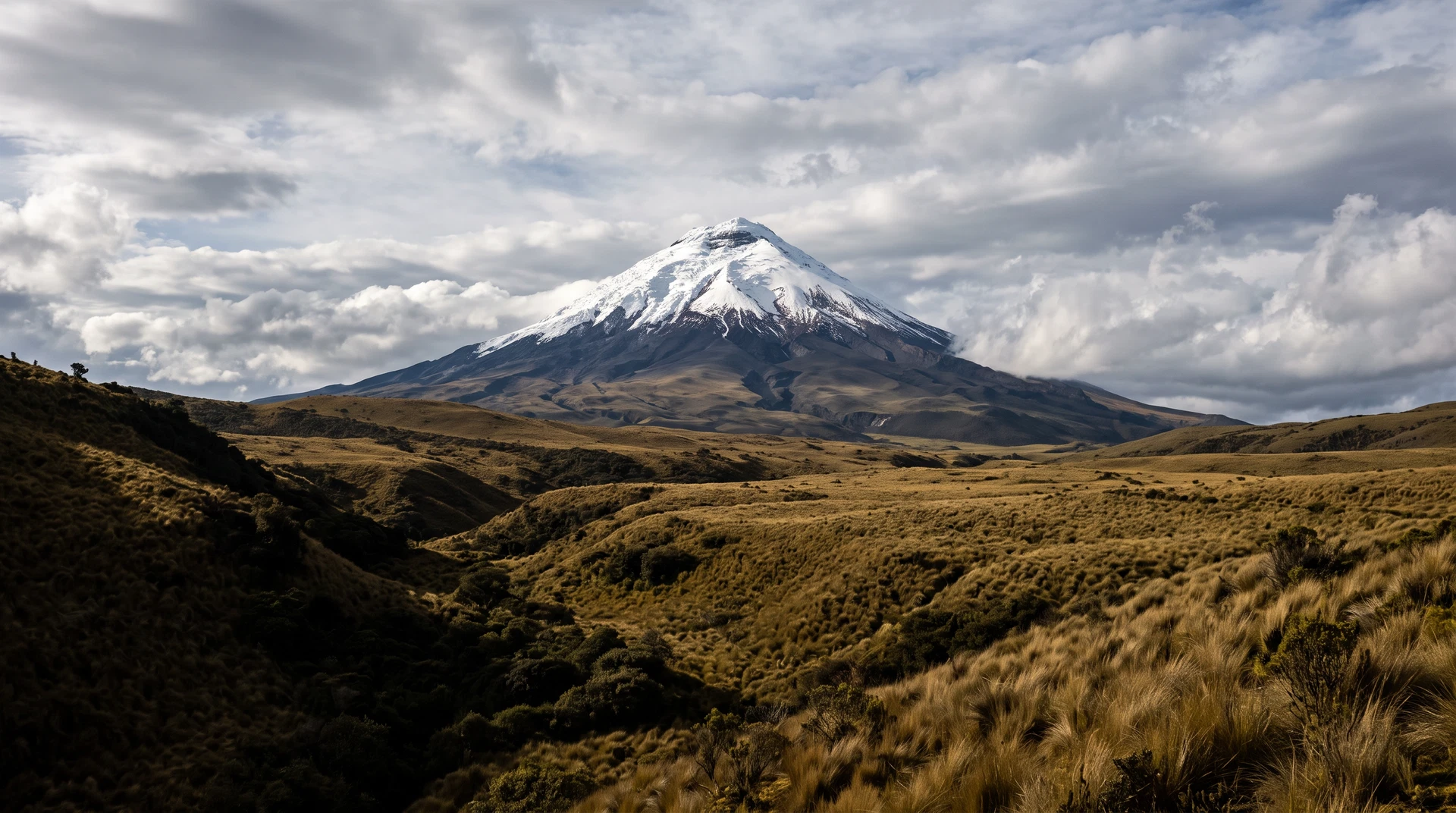
The air at 3,800 meters feels sharp, a cold crystalline presence that demands your full attention with every measured breath. Before you, the symmetry of Cotopaxi rises with a geometric perfection, a white-capped cone piercing the equatorial sky. Known to the indigenous Quechua as the "Moon's Throne," this stratovolcano is the monarch of the Ecuadorian Andes. It is not merely a mountain but a living entity whose restless spirit is felt in the sulfurous whispers of its vents and the shifting glaciers that cling to its flanks. To stand in its shadow is to acknowledge the profound scale of the natural world, where human presence feels fleeting against the backdrop of geological time.
Beneath the volcano’s gaze lies the paramo, a high-altitude tundra that serves as the park’s ecological heart. This is a landscape of subtle beauty, where the ground is a sponge of mosses, lichens, and chuquiragua—the "flower of the Andes" with its hardy orange blossoms. The paramo is a critical water source for the lowlands, acting as a natural reservoir that captures the mist and rain, filtering it through deep layers of volcanic soil. Walking through these grasslands, one notices the absence of tall trees, replaced by low-lying shrubs and the silver-leaved frailejones that stand like fuzzy sentinels in the fog. It is a quiet, contemplative space, where the wind whipping through the ichu grass is the only constant.
Movement in the distance reveals the park’s most evocative residents: the wild horses. These descendants of Spanish steeds, known as parameros, have adapted to the harsh conditions over centuries, their thick coats a testament to the endurance required to survive at this elevation. Seeing them gallop across the vast, open plains of the Limpiopungo valley provides a sense of untamed freedom that is increasingly rare. They move with a quiet dignity, grazing on the tough grasses and navigating the marshy edges of the lagoons with practiced ease. Their presence adds a layer of romanticism to the park, a reminder of the historical layers that have shaped this land, from ancient volcanic eruptions to colonial influences.
Cotopaxi is one of the highest active volcanoes on the planet, reaching a staggering 5,897 meters above sea level. Its activity is not a matter of ancient history but a contemporary reality that shapes every aspect of life within the national park. Since its first recorded eruption in 1534, it has periodically reminded the surrounding valleys of its destructive potential. The most recent period of unrest, beginning in 2015, led to temporary closures and a heightened sense of vigilance among scientists and locals alike. This constant threat creates a unique tension—a beauty that is inseparable from danger. The glaciers that cap the peak are not just scenic features; they are potential sources of massive mudflows.
Established in 1975, Cotopaxi was mainland Ecuador’s first national park, a milestone in the country’s conservation history. Spanning over 33,000 hectares, it provides a vital sanctuary for species that are increasingly threatened by habitat loss elsewhere. The Andean condor, with its massive wingspan, can often be seen riding the thermals above the volcanic peaks, a symbol of the high-altitude wilderness. More elusive is the spectacled bear, South America’s only native bear species, which finds refuge in the more remote, forested fringes of the park. The protection of this habitat is not just about preserving individual species but about maintaining the integrity of the entire Andean water cycle and the unique biodiversity of the highlands.
For the visitor, the experience of Cotopaxi is defined by the physical challenge of the altitude. Even a simple walk around the Limpiopungo Lagoon, situated at roughly 3,800 meters, can leave the unacclimatized gasping for air. The light here has a peculiar quality—intense and direct, yet often softened by the rapid movement of clouds that can shroud the volcano in seconds. One moment, the peak is visible in all its sun-drenched glory; the next, it is gone, replaced by a wall of gray mist and a sudden drop in temperature. This volatility is part of the park’s character, a reminder that at these heights, the weather is something to be endured as an integral part of the mountain’s personality.
Ascending the volcano itself is a serious undertaking that requires more than just physical fitness. It demands a deep respect for the mountain’s moods and a commitment to safety that begins long before reaching the trailhead. The Ecuadorian government mandates that all climbers be accompanied by certified mountain guides, a policy designed to protect both the visitors and the fragile alpine environment. Acclimatization is the most critical factor; spending several days at intermediate altitudes is essential to avoid the debilitating effects of altitude sickness. The climb typically begins in the dark of night, with headlamps illuminating the crunching snow as climbers push toward the crater rim for a sunrise that illuminates the "Avenue of the Volcanoes."
As the sun begins to set, casting long, purple shadows across the paramo, the weight of the landscape becomes almost palpable. The volcano, now silhouetted against a bruised sky, seems to grow even larger, its presence filling the horizon. There is a profound stillness here, a silence that is not an absence of sound but a presence of something ancient and vast. Cotopaxi National Park is a place that challenges our perceptions of scale and power, offering a glimpse into the raw forces that continue to build and reshape our world. To leave this place is to carry a piece of that stillness with you, a memory of the thin air and the restless giant of the Andes.