Travel
Where the Currents Collide: Witnessing the Living Laboratory of Evolution in the Galápagos Islands
In the heart of the Pacific, where three mighty ocean currents converge, the Galápagos Islands remain a testament to nature's resilience. This volcanic archipelago offers a rare glimpse into a world where fearless wildlife and prehistoric landscapes continue to rewrite the rules of survival and adaptation.
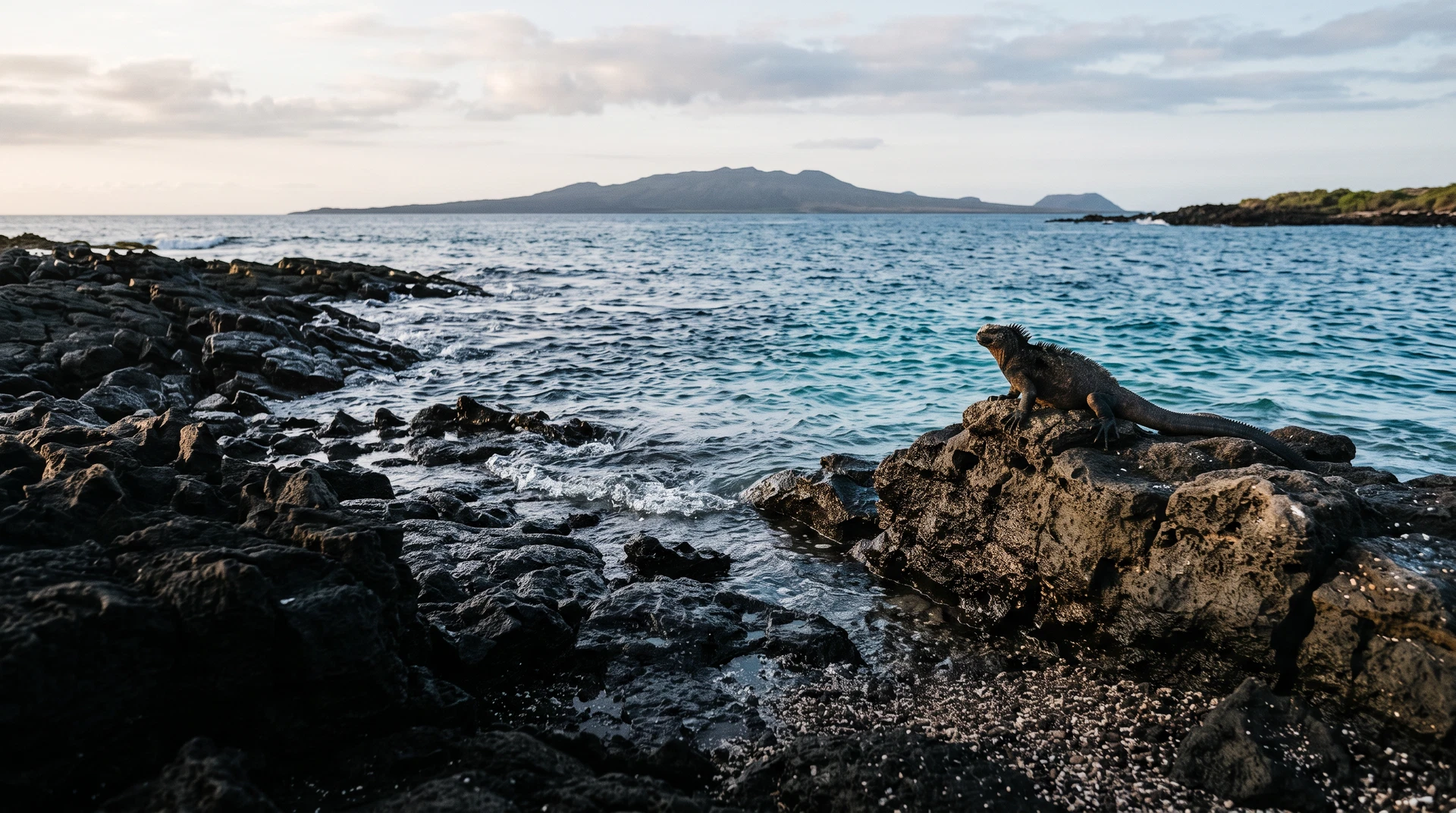
The approach to the Galápagos is a study in primordial beauty. From the air, the archipelago appears as jagged, coal-colored silhouettes rising from the deep cobalt Pacific. These are the summits of massive underwater volcanoes, born from a tectonic hotspot that continues to pulse beneath the ocean floor. Stepping onto Baltra, the air is thick with equatorial heat, and the landscape is dominated by resilient scrub and volcanic rubble. It is a world still in the throes of creation, where the thin veneer of civilization is dwarfed by geological forces. Here, the silence is filled with the rhythmic wash of the sea.
What defines this archipelago is its location at the intersection of a trio of powerful oceanic streams. The cold Humboldt Current sweeps from the south, the warm Panama Current from the north, and the nutrient-rich Cromwell Current surges from the west. This convergence creates an oceanic crucible unlike any other. In these waters, tropical corals thrive alongside cold-water penguins, and massive whale sharks glide past hammerheads. The sea temperature shifts dramatically within miles, dictating the life clinging to each shore. This hydrographic complexity is the engine of the islands’ biodiversity, providing the sustenance required for such a concentrated and varied array of life.
To walk among the wildlife here is to experience a profound reversal of the natural order. Elsewhere, humans signal a retreat, but here, animals are famously indifferent. Blue-footed boobies continue mating dances inches from the trail, and marine iguanas remain motionless on black lava rocks as visitors step carefully around them. This lack of fear, a result of millions of years of isolation without major predators, creates an intimacy that is both startling and humbling. It forces a realization of our place within the ecosystem—not as masters, but as observers in a sanctuary where the inhabitants have never learned to be afraid.
The archipelago comprises 19 main islands and over 100 islets, each with a distinct ecological niche. On Santa Cruz, the highlands are a misty realm of scalesia forests and giant tortoises moving with prehistoric deliberation. In contrast, Fernandina is a raw volcanic wasteland, home to massive colonies of marine iguanas huddling for warmth against dark basalt. The geological age of the islands varies; western islands are younger and volcanically active, while eastern ones are eroded into softer forms. To travel between them is to witness different stages of a continuous geological narrative, one that has spanned millions of years of isolation and adaptation.
This diversity sparked the revolutionary ideas of Charles Darwin during his 1835 visit. Observing subtle variations in finch beaks and tortoise shells, he began to piece together the mechanics of natural selection. Today, the Galápagos is a living laboratory of evolution, a status solidified in 1978 as the first-ever UNESCO World Heritage site. This designation acknowledged the islands’ irreplaceable value to science. The 97% of land protected as a national park serves as a fortress for these processes, ensuring that the evolutionary experiments begun eons ago can continue without the catastrophic interference of the modern world, preserving the archipelago's unique biological heritage.
While terrestrial wonders are world-renowned, the true scale of the islands' richness is found beneath the waves. Snorkeling in these waters is an immersion into a beautiful theater of survival. Sea lions, the playful acrobats of the shallows, dart around swimmers with dizzying speed and boundless curiosity. Deeper down, the shadows of Galapagos sharks and the silhouettes of eagle rays provide a somber reminder of the ocean’s power. The visibility changes in an instant as currents shift, bringing clouds of plankton that attract massive schools of fish. It is a high-energy environment where the struggle for life is visible in every shimmering scale.
Preserving this biological crossroads requires a level of vigilance that is as rigorous as it is necessary. The greatest threat is not volcanic activity, but the accidental introduction of invasive species. A single seed or insect hitching a ride could devastate an ecosystem evolved in total isolation. Consequently, visitors must adhere to strict biosecurity protocols, including inspections and specialized cleaning stations. Furthermore, the National Park mandates that all visitors remain with certified guides. These guardians are the frontline of conservation, ensuring that the delicate balance between tourism and protection is never tipped, maintaining the integrity of this fragile and isolated volcanic ecosystem.
While the vast majority of the archipelago is a wild sanctuary, a small percentage supports a permanent human population. In towns like Puerto Ayora, the rhythm of life is a blend of island pragmatism and conservation-minded living. Here, the challenges of sustainability are tangible, from managing fresh water to balancing community needs with the strictures of the National Park. The relationship between residents and their environment is one of deep interdependence. The economy is inextricably linked to the health of the ecosystem, fostering a local culture focused on stewardship. It is a reminder that the human story is now a permanent chapter in the islands’ evolution.
Visiting the Galápagos is not a passive experience; it demands physical effort and a disciplined mindset. The terrain is rugged, the sun relentless, and the rules of engagement with wildlife are non-negotiable. Yet, this structure makes the experience profound. By stripping away modern distractions, the islands force a focus on the immediate and essential. Whether it is the sight of a flightless cormorant drying its wings or the sound of a giant tortoise exhaling a weary breath, the moments that resonate are those of pure existence. As the boat pulls away, the islands recede into the mist, remaining a defiant outpost of life and a beacon of hope.