Travel
The sacred dust of the Andes rises where ancient rivers carve through the Incan heartland.
Beyond the stone gates of Cusco lies a high-altitude sanctuary where the Urubamba River snakes through emerald peaks. Here, pre-Incan salt ponds shimmer under the equatorial sun, and concentric agricultural terraces reveal a civilization that spoke to the stars through the very soil they tilled for survival.
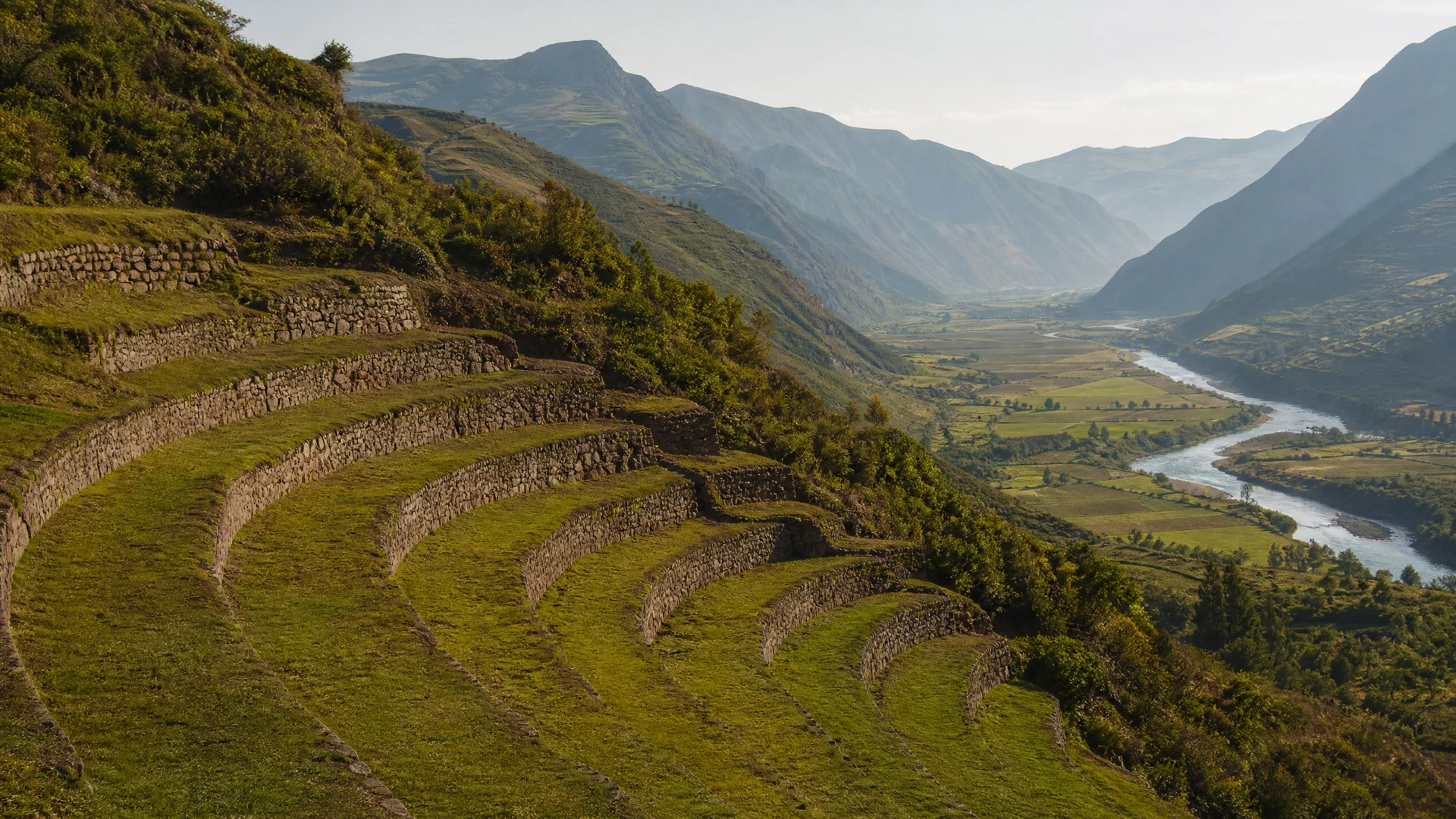
Descending from the thin air of Cusco into the Sacred Valley feels like shifting from urban history to elemental power. The Urubamba River, or Willka Mayu, is the lifeblood of this corridor, rushing through a landscape that is a continuous conversation between earth and sky. Here, the Andean peaks are the apus, mountain spirits watching over the valley for millennia. The air, scented with eucalyptus and damp earth, reminds travelers that in this high heartland, every breath is a participation in a world operating on a deliberate clock.
The Urubamba River dictates the valley's agricultural rhythm, its glacial waters nourishing the fertile floor where the world’s largest kernels of white corn are grown. Farmers still use the chaquitaclla, a traditional foot-plow, to prepare the soil just as their ancestors did. This cycle of planting and harvesting is tied to the celestial movements, a legacy of the Incan understanding of the stars. The river is not just a source of water but a sacred entity that connects the high glaciers to the low jungles, carrying the prayers and the lifeblood of the Andes through every bend and rapid.
The valley’s legacy is etched into the Maras salt mines, a pre-Incan geometric marvel. More than 3,000 evaporation ponds, in shades of white and ochre, cling to a steep canyon like a crystalline mosaic. Fed by a single hypersaline spring channeled through ancient masonry, these ponds remain a communal effort. Harvesting the mineral-rich crust follows a generational rhythm, dictated by the sun and slow evaporation. Standing above Maras, one witnesses a landscape transformed by human patience, where the blinding white salt contrasts sharply against the deep green Andean slopes.
Nearby, Moray offers an architectural wonder reflecting Incan environmental mastery. Massive concentric circular terraces descend into the earth like a natural amphitheater, likely serving as a sophisticated agricultural laboratory. Temperature differences between the levels create microclimates, allowing the Incas to experiment with crops from across their vast empire. It is a place of profound quiet, where the geometry of stone walls pulls the gaze inward. Visitors are invited to contemplate how these ancient people engineered their survival with such aesthetic grace, turning a functional necessity into a work of landscape art.
The valley is a vibrant tapestry of living culture, most evident on market days in towns like Pisac and Chinchero. Plazas erupt in color as indigenous traders from high-altitude communities display intricate textiles that tell stories of lineage and cosmology. Mounds of native potatoes and purple corn sit alongside hand-woven alpaca wools. The air is thick with Quechua, a language that has survived the centuries, and the scent of chicha, traditional fermented corn beer. These markets are essential nodes of social life, where ancient traditions of bartering and communal gathering remain as relevant today as ever.
Designated as Cultural Heritage of the Nation in 2006, the Sacred Valley is a unique intersection of natural beauty and historical significance. This recognition emphasizes that the entire landscape—the rivers, fields, and cultural practices—is a monument requiring careful stewardship. It is a delicate balance to maintain the integrity of these sites while keeping them functional for the local economy. For the traveler, this means moving with reverence, recognizing that every step on an ancient path is a journey through a protected sanctuary that belongs to the people who still call this Andean heartland home.
Physicality defines the experience here, as the altitude rarely dips below 2,800 meters. The body must move at a different pace, respecting the thin oxygen and intense mountain sun. Acclimatization is a rite of passage that forces a slower, more observant way of traveling. Rushing through the valley means missing the subtle shifts in light across the peaks or the changing roar of the river through rocky gorges. By slowing down, travelers notice the small details—a farmer leaning against his spade, the specific blue of a weaver’s thread, or the sharp scent of crushed mountain herbs.
The sensory experience is deeply grounded in the earth and the tactile quality of Incan stonework. Massive boulders are joined so precisely that not even a blade of grass fits between them, reflecting a civilization that prioritized harmony with the land. At night, the valley transforms under a canopy of stars that feel close enough to touch, the Milky Way mirroring the Urubamba below. The silence of the Andean night is profound, broken only by the wind through the maize fields, a reminder of the isolation and peace that this high-altitude refuge provides to all who enter.
As the sun sets, casting long shadows across terraced hillsides, the Sacred Valley’s true nature as a living museum is revealed. The exhibits are not behind glass; they are underfoot. Irrigation channels carved by the Incas still carry water, and the same varieties of corn are harvested by their descendants. This continuity is the valley’s greatest strength, a resilience that has weathered centuries of change without losing its essential soul. To visit is to enter a narrative written in stone and water, a story that continues to unfold with every new season and every enduring spirit.