Travel
The thunder of the Atlantic Forest resonates within the mist of Iguaçu's falling waters.
Beneath the dense canopy of Brazil’s Atlantic Forest, a colossal amphitheater of water redefines the scale of the natural world. Here, the Iguaçu River fractures into hundreds of cascades, creating a sensory immersion into the raw power and delicate biodiversity of a protected sanctuary.
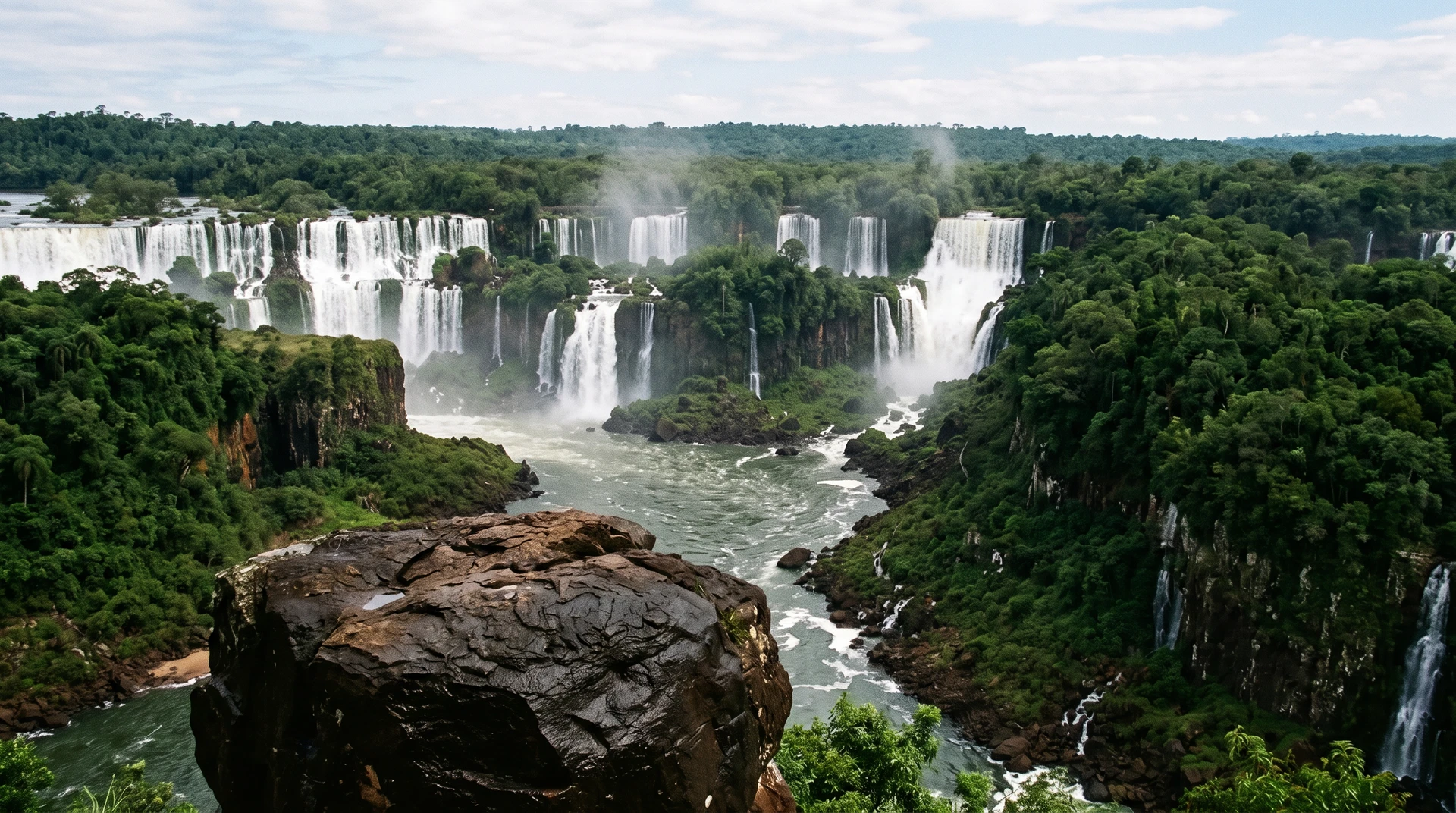
The air in Paraná carries a weight, a saturated humidity that clings to the skin long before the first glimpse of white water breaks through the emerald curtain of the Atlantic Forest. It begins as a low-frequency vibration, felt in the soles of the feet, a rhythmic pulsing that signals the presence of something vast. As you move deeper into the 169,000-hectare sanctuary of Iguaçu National Park, the forest canopy tightens its grip, a dense weave of lianas and bromeliads that muffles the outside world until only the river remains. This is not the polite trickling of a woodland stream, but the gathered momentum of a continent’s interior, preparing for its most dramatic transformation.
When the curtain finally parts, the scale of the Iguaçu River’s descent is almost impossible to reconcile with the human eye. Spanning a staggering 2.7 kilometers in width, the falls are a chaotic, beautiful sequence of over 270 individual cascades. They tumble over basalt cliffs that have stood for millennia, carving a horseshoe-shaped amphitheater that seems to swallow the horizon. The water does not just fall; it shatters against the rocks below, sending plumes of mist hundreds of feet into the air, creating a permanent microclimate where rainbows are constant companions, arcing through the spray with a vivid, fleeting brilliance that mocks the static nature of a photograph.
At the heart of this aquatic upheaval lies the Garganta do Diabo, or the Devil’s Throat. This U-shaped chasm, plunging 80 meters into a roiling abyss, channels the majority of the river’s volume into a concentrated display of kinetic energy. Standing on the designated walkways that extend over the precipice, one is suspended in a world of white noise and blinding spray. The sheer force of the water creates a wind that tugs at your clothes, a reminder of the raw power contained within this geological fracture. It is a place where the boundaries between liquid and air dissolve, leaving the observer drenched and humbled by the realization that this process has continued, uninterrupted, for eons.
Yet, to focus solely on the thunder of the falls is to miss the intricate life that thrives in their shadow. Iguaçu National Park is one of the last great strongholds of the Atlantic Forest, a biome that now exists in precious, fragmented pockets. Within these 169,000 hectares, the ecosystem maintains a fragile equilibrium. It is a sanctuary for the elusive jaguar, whose silent pawprints occasionally mark the muddy banks of the upper river, and for the giant otter, which navigates the quieter tributaries. The forest is a layered world of specialists, from the giant anteater rooting through termite mounds to the thousands of butterfly species congregating in the sun-dappled clearings.
The experience of navigating the park is one of constant transition between the grand and the granular. The boardwalks, engineered to withstand the river’s surges, lead you through thickets of bamboo and past ancient trees draped in moss. Along these paths, the coatis—ring-tailed members of the raccoon family—are a ubiquitous presence. While their inquisitive nature and masked faces are undeniably charming, they serve as a practical reminder of the park’s stewardship challenges. Conditioned by years of human presence, they have become bold opportunists. Respecting the strict prohibition against feeding them is not just a rule for visitor safety; it is an act of preservation for these wild residents.
There is a specific cadence to the day here, dictated by the movement of light and the shifting intensity of the mist. In the early morning, before the heat of the Brazilian sun burns through the haze, the falls possess a ghostly quality, the water appearing like heavy silk against the dark basalt. As midday approaches, the colors sharpen—the saturated greens of the foliage, the ochre of the silt-laden river, and the brilliant white of the foam. It is during these hours that the park’s biodiversity is most visible; toucans with their oversized, brightly colored beaks hop between branches, and vultures circle high above the Devil’s Throat, riding the rising thermals.
The stewardship of such a site requires a delicate hand. The park’s status as a UNESCO World Heritage site is a commitment to protecting the vulnerable Atlantic Forest biodiversity. The designated walkways are designed to minimize human impact, keeping visitors on a controlled path that prevents the trampling of delicate undergrowth and the erosion of the riverbanks. To walk these paths is to participate in a managed encounter with wilderness, a necessary compromise that allows millions to witness the falls without destroying the environment that sustains them. It is a reminder that the beauty of Iguaçu is inseparable from its ecological health and its preservation for future generations.
Leaving Iguaçu is a slow process of sensory recalibration. As you move away from the river, the thunder fades into a hum, and the mist dries from your skin, leaving behind a fine layer of river minerals. The forest closes in once more, returning you to the world of shadows and birdsong. But the memory of the Garganta do Diabo lingers—a mental image of water so powerful it seems to defy gravity, and a forest so vast it feels like the beginning of time. In an age of diminishing wild spaces, Iguaçu stands as a defiant testament to the endurance of the natural world, where the earth still speaks in thunder.