Travel
The White Sheets of Maranhão: Where the Rain Rests Among the Shifting Sands
In the remote corners of northeastern Brazil, the sky descends into the desert, filling the hollows of a vast dune field with crystalline rainwater. Lençóis Maranhenses is a landscape of impossible contradictions, where the arid pulse of the wind meets the cooling embrace of a thousand seasonal lagoons.
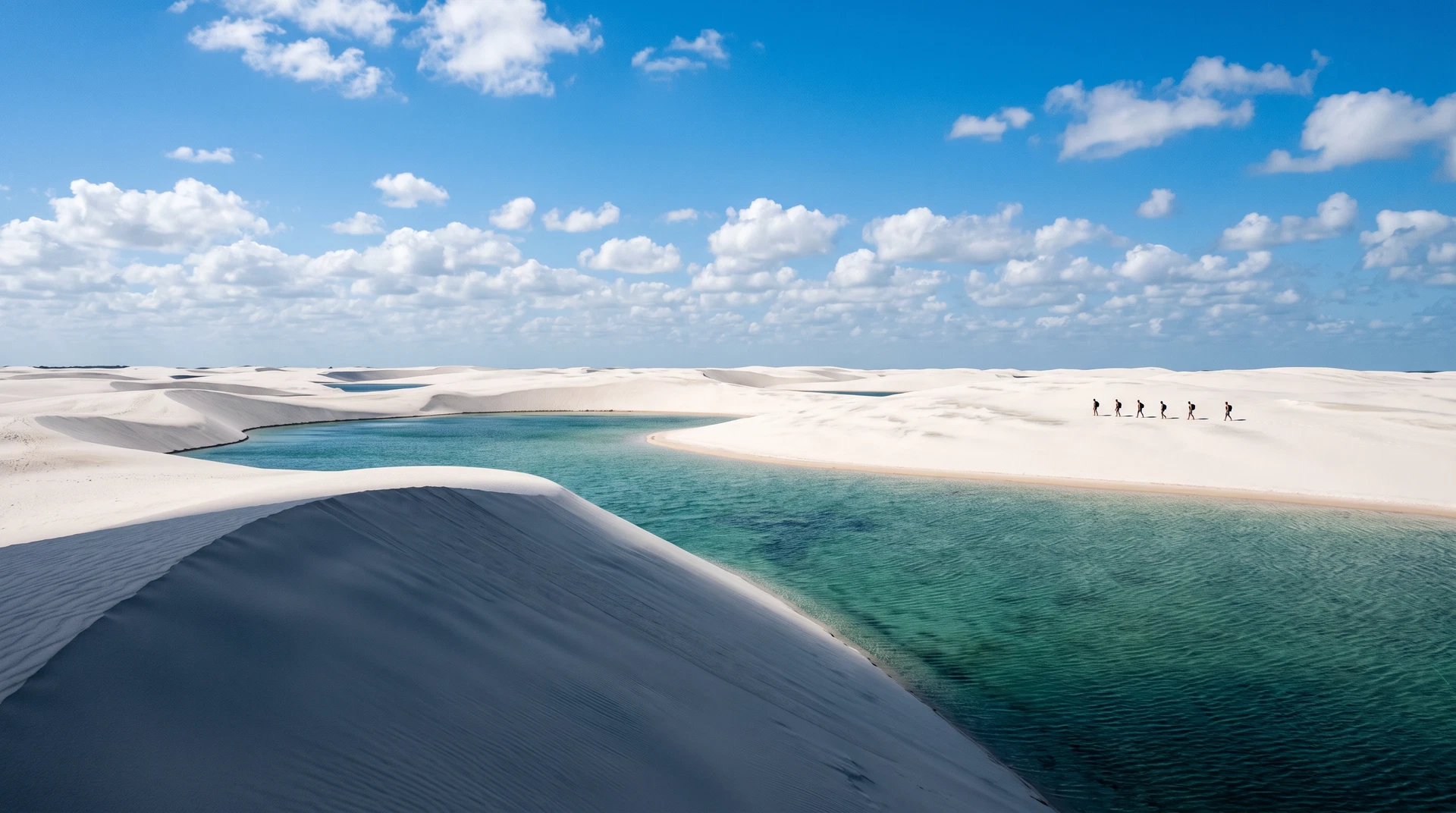
The journey to the edge of Lençóis Maranhenses National Park begins where the paved roads of Maranhão surrender to the wild. From the gateway town of Barreirinhas, the landscape undergoes a startling transformation, shedding the dense greens of the Brazilian interior for a monochromatic brilliance. As authorized 4x4 vehicles navigate the sandy tracks, the horizon fractures into immense, ivory waves. These are the "lençóis"—the bedsheets—a 156,562-hectare expanse of white sand tossed across the coastline. The first sight of this wilderness is a sensory shock, a place where geography appears suspended and the earth mimics the fluidity of the ocean.
At the heart of this environment lies South America's largest field of migrating barchan dunes, shaped by Atlantic trade winds. Unlike static deserts, these dunes are in perpetual motion, creeping across the landscape at up to twenty meters per year. The wind sculpts the sand into perfect crescents, their crests smoking with fine dust as the breeze carries the continent’s edge inland. It is a landscape defined by transit, where the ground is never the same from one season to the next. This migration creates a rhythmic, undulating topography that stretches for miles, a white labyrinth made hospitable only by the arrival of equatorial rains.
Between May and September, torrential rains collect in the interdunal basins. Because the underlying rock is impermeable, rainwater pools into thousands of crystal-clear freshwater lagoons. The result is a mosaic of deep turquoises and emeralds framed by the sterile brilliance of the dunes. To crest a ridge and find a cool, still pool in the middle of what looks like a parched desert is a moment of profound cognitive dissonance. These lagoons are pure, life-sustaining reservoirs that transform the dunes into a temporary Eden, providing a sanctuary for specialized life forms that call this transition zone home.
Lençóis Maranhenses occupies a unique ecological crossroads where three distinct Brazilian biomes converge. To the west lies the Amazon rainforest; to the south, the scrubby plains of the Cerrado; and to the east, the arid Caatinga. This biological intersection grants the park a surprising complexity, as species from each realm venture into the sandy margins. While the dunes may appear barren, the fringes teem with life, from resilient mangroves to migratory birds using the lagoons as a vital waypoint. It is a place where the lushness of the tropics meets the austerity of the desert in an ongoing negotiation for survival.
Navigating this roadless, 80-kilometer coastline requires authorized transport and local guides who understand the shifting sand. The park’s recent recognition as a UNESCO World Heritage site underscores the importance of its preservation and strict stewardship protocols. Walking barefoot across the cool, fine-grained quartz sand—which does not retain the sun’s heat—one feels a sense of profound isolation. The guides act as keepers of the park’s stories, pointing out subtle signs of life, like the tracks of a crab or the sudden emergence of seasonal fish from the drying mud, ensuring that visitors navigate this fragile ecosystem safely and responsibly.
The sensory experience is one of overwhelming silence, punctuated only by the hiss of the wind and the splash of a swimmer. There is a peculiar quality to the light, a brilliance that emanates from the ground as much as the sky, turning the landscape into a high-key photograph. The water in the lagoons is a silk-like embrace that offers immediate relief from the equatorial sun. As one floats in a turquoise pool, surrounded by white slopes and the vast sky, the modern world feels infinitely distant. It is a landscape that refuses to be hurried, where the only relevant clock is the slow arc of the sun.
There is a distinct wistfulness to the beauty of the Lençóis, rooted in the knowledge that this paradise is ephemeral. By October, intense heat reclaims the lagoons, evaporating the water and leaving behind only cracked mud. The fish that flourished in the pools either bury themselves in the damp sand to await the next rains or perish, their life cycles tied to the rhythm of the clouds. To visit during the peak season is to witness a fleeting masterpiece that will be dismantled and rearranged by the time the next traveler arrives. This transience lends gravity to every footprint, a reminder of a cycle that continues without us.
As the sun descends toward the Atlantic, casting violet shadows across the dunes, the scale of the park becomes apparent. The white sand turns to gold, then to a soft purple, and the lagoons darken into mirrors reflecting the first stars. There is a deep peace in this transition, a feeling of being small in the face of a landscape both ancient and new. Leaving the Lençóis is a slow process, a retracing of tracks through the sand as the 4x4s head back toward civilization. One carries away a fine dusting of quartz and a lingering sense of wonder for a place that can never be truly possessed.
The legacy of Lençóis Maranhenses lies in its ability to remind us of the earth’s capacity for renewal. It is a testament to the power of the wind and the grace of the rain, a sanctuary where the elements conspire to produce a vision of purity. In a world of permanent structures, the shifting sands and seasonal waters of Maranhão offer a necessary alternative—a reminder that the most profound experiences are often the most fleeting. To stand among the white sheets is to be reminded that the world is still capable of surprising us, and that the most beautiful things are those the wind will eventually carry away.