Travel
The Infinite Horizon: Finding Stillness and Scale Upon the Great Bolivian Salt Flats
Stretching across the high Altiplano, the Salar de Uyuni offers a profound encounter with geological time and elemental beauty. This vast expanse of crystalline white transforms with the seasons, challenging our perception of space and revealing a landscape as fragile as it is immense.
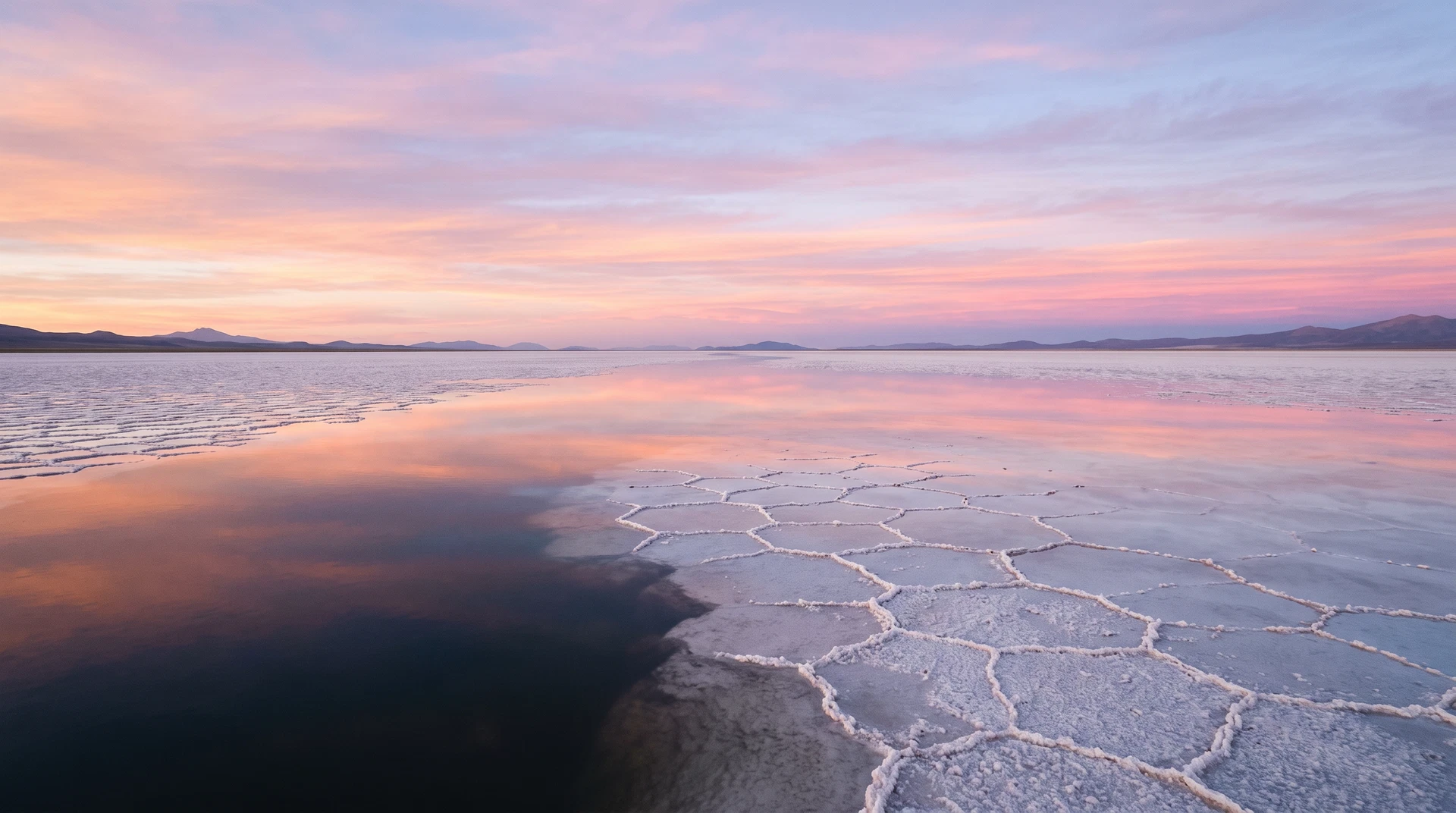
The first sensation upon entering the Salar de Uyuni is one of profound disorientation, a sudden shedding of visual anchors. Here, at nearly 3,700 meters above sea level, the world is stripped back to its most basic elements: a blindingly white floor and a sky of such intense, saturated blue that it feels heavy. The salt crust, a hexagonal mosaic of dried minerals, stretches for over ten thousand square kilometers, creating a horizon so flat and distant that the curvature of the Earth seems to be the only thing limiting the view. It is a place where perspective fails, where a distant mountain might be a mile away or twenty, and where the silence is so absolute it rings in the ears.
This crystalline desert is a ghost of a much wetter past, a relic of prehistoric lakes that once filled the Altiplano basin. Millions of years ago, the Minchin and Tauca lakes covered this high plateau, but as the climate shifted and the water evaporated under the fierce Andean sun, they left behind a legacy of minerals. The Salar is not merely a surface; it is a massive, layered crust of salt several meters thick, resting upon a pool of brine rich in lithium, potassium, and magnesium. To stand here is to stand upon an ancient sea, a geological memory frozen in white.
During the austral summer, when the rains finally descend from the mountains, the Salar undergoes a metamorphosis that borders on the supernatural. A thin layer of water, often only a few centimeters deep, accumulates across the level surface, transforming the salt flats into the largest natural mirror on the planet. The boundary between earth and sky dissolves entirely; clouds float beneath one’s feet, and the sunset is doubled, bleeding crimson and gold across both the heavens and the ground. For the traveler, walking across this flooded expanse feels like a suspension of gravity, a glide through a void where the only constant is the reflection of the infinite.
However, the beauty of the Salar is inseparable from its harshness, a reality that every visitor must respect. The high altitude of the Bolivian plateau thins the air, making every step a deliberate effort and demanding a period of acclimatization before one can truly appreciate the landscape. The sun is relentless, its rays bouncing off the white salt with a ferocity that can burn unprotected skin in minutes, while the nights bring a biting cold that seeps through even the heaviest layers. It is a landscape that requires a practical approach to gear and a humble recognition of one's physical limits in such a specialized environment.
Beneath the serene white surface lies a resource that has placed this remote corner of Bolivia at the center of global industrial interest. The Salar de Uyuni contains a staggering portion of the world’s known lithium reserves, the "white gold" essential for the batteries that power our modern lives. This economic potential creates a quiet tension in the air, a reminder that this wilderness is not isolated from global demands. While the salt flats remain a sanctuary of silence for now, the presence of extraction facilities on the periphery serves as a reminder of the delicate balance between preserving a unique geological wonder and the global hunger for transition energy.
Stewardship of this fragile ecosystem is a collective responsibility, as the salt crust is more vulnerable than its vastness might suggest. The patterns of the salt—the natural ridges and polygons that form as the surface dries—are easily damaged by careless navigation. Responsible travel here means adhering strictly to established vehicle tracks, ensuring that the heavy 4x4s necessary for crossing the flats do not scar the landscape for decades to come. Every tire mark off the path is a permanent wound in the crust.
Rising like a stranded ship from the white sea is Incahuasi Island, a rocky outcrop that provides a necessary visual counterpoint to the surrounding void. Covered in giant trichocereus cacti, some of which have stood for centuries, the island is a reminder of the life that persists even in this saline wilderness. From its summit, the scale of the Salar becomes even more overwhelming, a 360-degree panorama of white that makes the island feel like a tiny, precarious refuge. The contrast between volcanic rock and crystalline salt highlights the unique geological diversity of the Altiplano.
As the sun begins its descent, the light on the Salar changes with a speed that catches the breath. The blinding white softens into a palette of pastels—lavender, rose, and pale blue—before the shadows stretch long and thin across the hexagonal ridges. The temperature drops precipitously, the wind picks up, and the stars begin to emerge with a clarity only possible at such high elevations. In these final moments of daylight, the Salar feels less like a place on Earth and more like a celestial body, a moonscape brought down to our level, where the quiet is so profound it seems to vibrate against the skin.
To leave the Salar de Uyuni is to carry away a new understanding of scale and a lingering sense of the sublime. It is a destination that demands little of the traveler but their presence and their respect, offering in return a glimpse of the planet in its most elemental form. Long after the salt has been brushed from one’s boots, the memory of that infinite horizon remains, a mental sanctuary of white space and silence. In a world that often feels crowded and loud, the Salar stands as a necessary reminder of the vast, indifferent beauty of the natural world, a place where the sky and the earth meet in a perfect, crystalline embrace.