Travel
The Mist and the Masterpiece: Seeking the Sacred Wooden Spires of Chiloé
Beyond the rugged Chilean coastline lies a mist-shrouded archipelago where centuries of isolation have forged a singular culture. From the technicolor stilt houses of Castro to the hand-carved wooden cathedrals rising above the rain-swept hills, Chiloé offers a profound encounter with South America’s most resilient maritime traditions.
To cross the Chacao Channel is to leave behind the familiar spine of the Chilean Andes for a realm where the map dissolves into a thousand shades of gray. The ferry ride from the mainland is a brief but definitive passage, often accompanied by the playful wake of Peale’s dolphins and the persistent, fine drizzle known locally as puelche. As the Isla Grande de Chiloé emerges from the mist, it reveals a landscape that feels less like a province of Chile and more like a sovereign dream of the sea. Here, the hills are a saturated, impossible green, and the air carries the scent of woodsmoke and salt, a sensory introduction to an archipelago that has spent centuries perfecting the art of isolation.
The defining silhouette of this landscape is not a mountain peak, but the spire of a wooden church. Scattered across the islands like sacred sentinels, these structures represent one of the most remarkable architectural fusions in the Southern Hemisphere. In the 17th and 18th centuries, Jesuit missionaries arrived with European blueprints, but they found no stone and few masons. Instead, they found the Chilote people—master shipbuilders who understood the language of timber and the temper of the Pacific. Together, they constructed cathedrals using the same techniques used to build hulls, joining massive logs with wooden pegs instead of iron nails to allow the buildings to flex against the coastal winds.
Sixteen of these churches now stand under UNESCO protection, each a testament to a craftsmanship that is as much about survival as it is about faith. At the Church of Santa María de Loreto in Achao, the oldest in the archipelago, the interior feels like the upturned belly of a great wooden ship. The ceiling is a ribbed vault of alerce and cypress, hand-carved with a precision that defies the primitive tools of the era. Outside, the walls are clad in tejuelas—shingles cut from the rot-resistant alerce tree, shaped into scales or diamonds that have weathered to a soft, silvery patina over three centuries of rain.
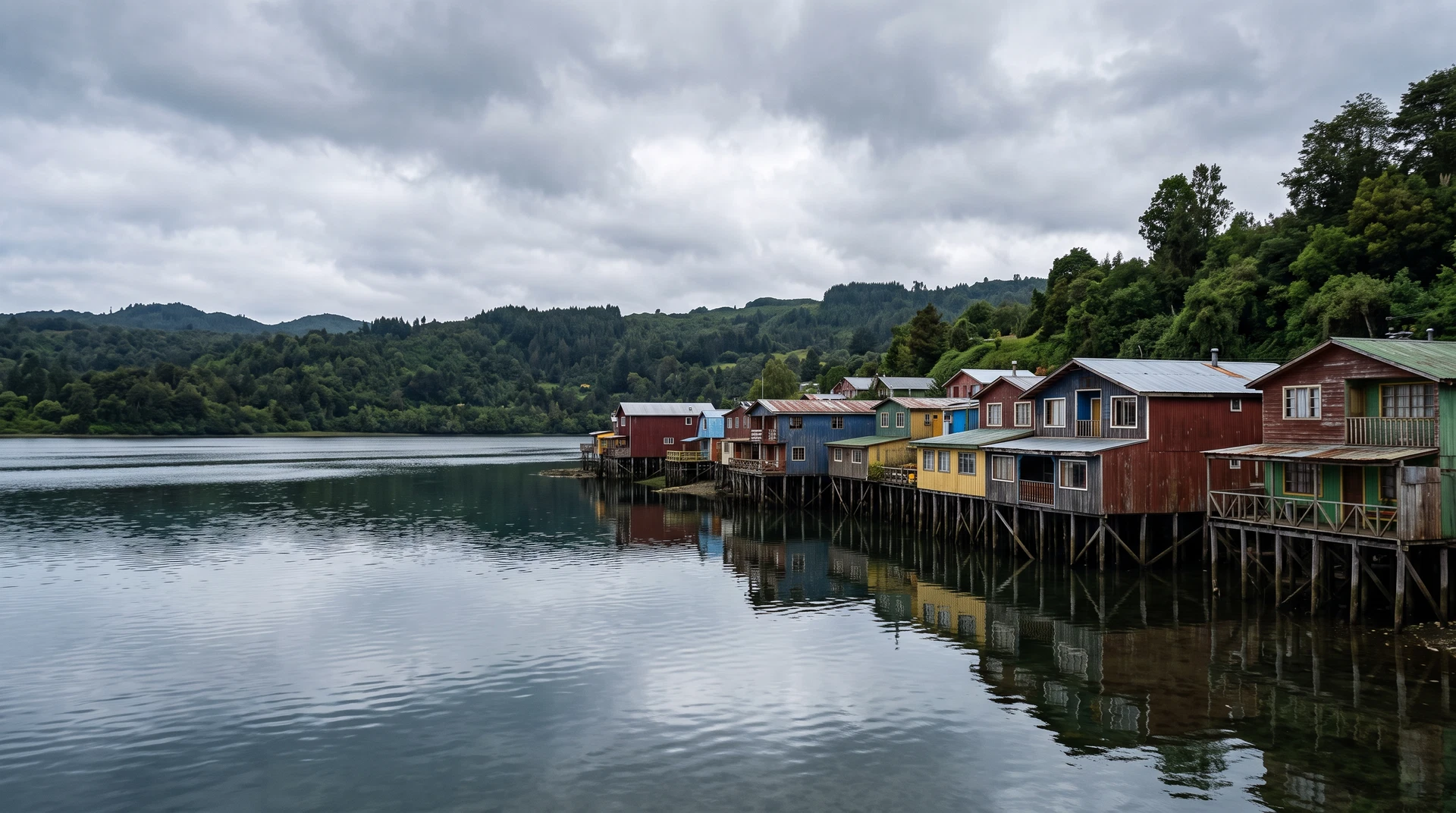
Descending from the hills into the capital of Castro, the architectural ingenuity takes a more secular, but no less vibrant, form. Along the Gamboa wharf, rows of palafitos—stilt houses—lean over the water in a riot of canary yellow, cobalt blue, and deep crimson. These houses are a direct response to the archipelago’s dramatic tidal shifts, which can see the sea retreat and advance by nearly seven meters in a single day. At low tide, the houses stand exposed on their spindly wooden legs, overlooking a floor of dark, glistening mud and beached fishing boats; at high tide, they appear to float, their colors shimmering in the rising waters.
This constant dialogue with the sea has birthed a mythology as thick as the island’s morning fog. In Chiloé, the forest and the waves are populated by a pantheon of spirits that remain a vital part of the local consciousness. There is the Caleuche, a ghost ship that sails the channels at night, manned by those who have drowned at sea, and the Pincoya, a sea goddess whose dance determines the abundance of the shellfish harvest. These are not merely stories for tourists but the cultural fabric that binds the seafaring communities together, explaining the whims of an environment that can be as treacherous as it is beautiful.
While the eastern coast is a sheltered labyrinth of channels and inlets, the western shore of the Isla Grande faces the full, unrestrained fury of the Pacific. Here, Chiloé National Park protects a vast expanse of Valdivian temperate rainforest, a prehistoric ecosystem where ancient arrayán trees with cinnamon-colored bark grow alongside giant ferns. The trails lead through dense, dripping thickets where the rare Darwin’s fox—a diminutive, cinnamon-eared canine endemic to the island—still roams. The forest eventually gives way to massive coastal dunes and rugged cliffs, where the wind-sculpted landscape feels like the very edge of the habitable world.
To travel here is to accept the rain as a constant companion. It is the lifeblood of the islands, feeding the peat bogs and the lush pastures where sheep graze, providing the wool for the heavy, hand-knitted sweaters sold in the Dalcahue markets. The dampness is countered by the profound warmth of the Chilote home, centered around the fogón or the wood-burning stove. This is where the curanto is shared—a traditional feast of shellfish, meat, and potatoes cooked over hot stones in a hole in the ground, covered with giant nalca leaves. It is a communal ritual of slow cooking that reflects the unhurried pace of island life.
Yet, this heritage is as fragile as the wood from which it is built. The UNESCO churches face a constant battle against the humidity, wood-boring insects, and the sheer passage of time. Preservation is a delicate task, requiring specialized knowledge of traditional joinery and the sourcing of rare timber. Visitors are welcomed into these sacred spaces, but with a request for silence and respect; these are not museums, but active centers of community life where the rhythmic tolling of a wooden bell still marks the passage of the day and the arrival of the fishing fleet.
Leaving Chiloé feels like waking from a long, vivid dream. As the ferry pulls away from the pier at Chacao, the wooden spires and the colorful palafitos recede into the mist, returning to the silver solitude they have occupied for generations. The archipelago does not yield its secrets easily, nor does it cater to those in a hurry. It is a place that demands a slower heartbeat, rewarding the observant traveler with a glimpse of a world where the hand of man and the force of nature have reached a rare, weathered, and beautiful equilibrium.