Travel
A journey through the celestial silence of the Atacama Desert’s ancient and arid plains
Deep within the world’s driest non-polar desert, Chile’s Atacama offers a profound encounter with a landscape defined by centuries of drought and cosmic clarity. From high-altitude geyser fields to salt-crusted horizons, this is a realm where the Earth’s geological history and the stars above converge.
The approach to San Pedro de Atacama is a transition into a realm where the familiar rules of the biosphere seem to dissolve. As the road climbs from the Pacific coast into the high plateau, the air thins and the humidity vanishes, replaced by a dryness so profound it can be felt in every breath. This is the threshold of the world’s driest non-polar desert, a place where the landscape is stripped back to its geological bones. The town of San Pedro, with its adobe buildings and dusty streets, serves as a humble anchor in a sea of red earth. Here, the light has a piercing quality, unencumbered by the haze of moisture that softens the world elsewhere. It is a place that demands a slow pace, not just for the sake of the lungs adjusting to the altitude, but to allow the mind to catch up with the sheer scale of the surrounding void.
The defining characteristic of the Atacama is its legendary aridity, a condition that has persisted for millions of years. In certain pockets of this vast expanse, there is no record of rainfall ever having occurred in human history, and scientists estimate that some areas have remained dry for centuries. This lack of water has created a unique laboratory of preservation; without the erosive force of rain or the decompositional power of moisture, the earth remains remarkably static. Ancient tracks and delicate biological soil crusts remain frozen in time. To walk across these plains is to move through a landscape that is both incredibly fragile and seemingly eternal, where a single footstep off the designated path can leave a mark that will last for decades.
High above the desert floor, at an elevation of 4,320 meters, lies the Tatio Geyser field, the highest of its kind on the planet. To witness this geothermal spectacle, one must arrive in the pre-dawn chill, when the air temperature often drops well below freezing. As the first light of the sun touches the peaks of the Andes, the field erupts into a forest of steam. Hundreds of vents hiss and gurgle, sending columns of white vapor spiraling into the indigo sky. As the largest geyser field in the Southern Hemisphere, it is where Earth’s internal heat meets the thin, cold atmosphere. The experience is visceral—the smell of sulfur, the sound of boiling water, and the sight of the rising sun catching the mist—creating a scene that feels like the very morning of the world’s creation.
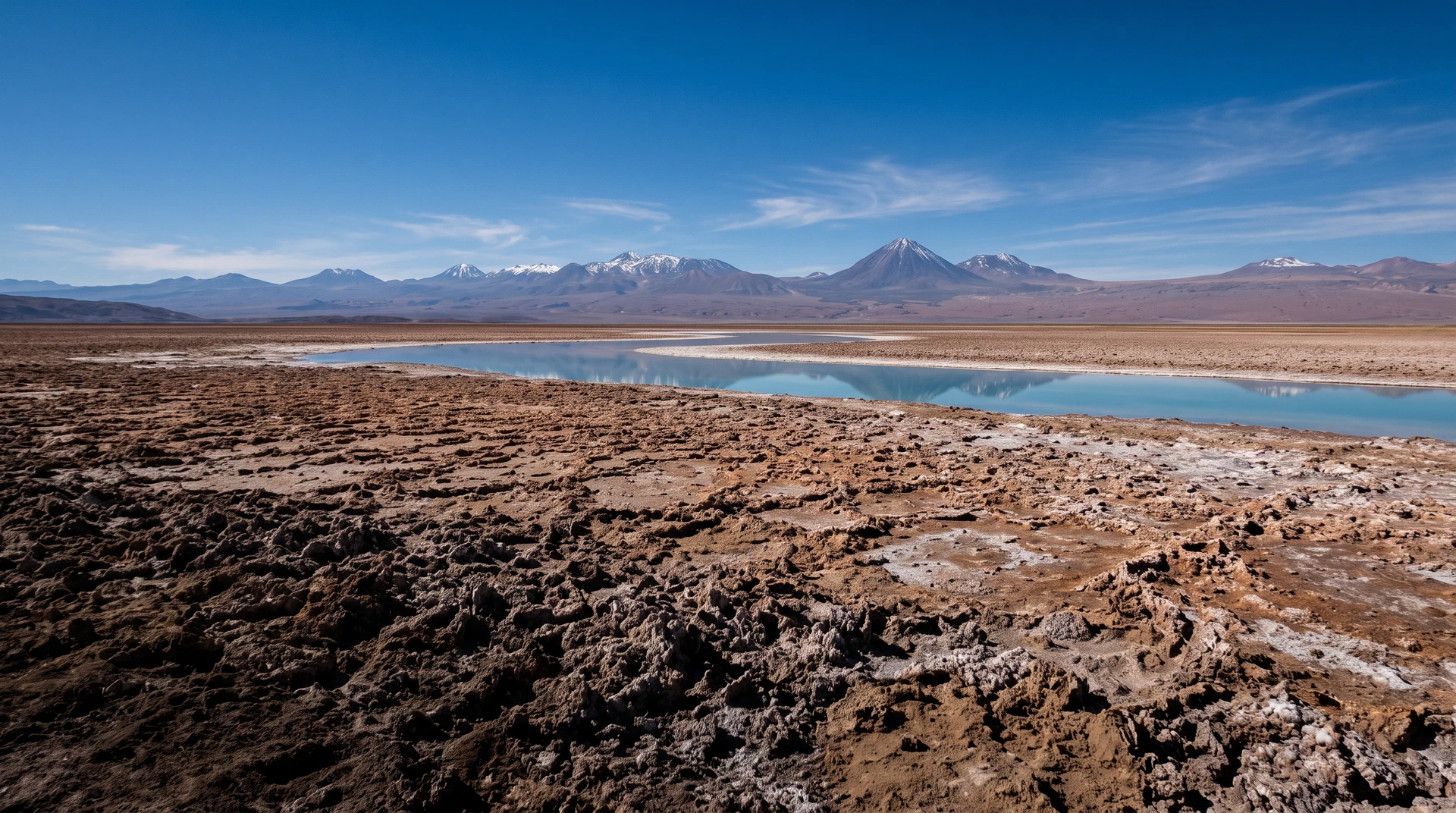
Descending from the heights, the landscape shifts into the blinding white expanse of the Salar de Atacama. This massive salt flat is a mosaic of crystalline crusts and shallow, mineral-rich lagoons. The salt here is not the smooth, snowy surface of other famous flats, but a rugged, jagged terrain of uplifted plates and sharp ridges, colored by the minerals of the surrounding mountains. It is a place of stark contrasts, where the white of the salt meets the deep blue of the sky and the reddish-brown of the distant volcanoes. The silence here is absolute, broken only by the occasional crunch of salt underfoot. This landscape challenges the eyes' ability to judge distance, where the horizon stretches into infinity and mountains appear both close and far.
The Atacama is not merely a geological curiosity; it is a landscape deeply etched with human history. The region is home to ancient Andean cultures that have survived in these extreme conditions for millennia. Scattered throughout the desert are pre-Columbian archaeological remains—fortified villages and irrigation systems—that speak to a sophisticated understanding of this challenging environment. These sites are protected with reverence, representing the enduring spirit of people who found life where it should not exist. Travelers are reminded to tread lightly, respecting the stewardship of these ancestral lands. The desert’s fragile biological soil crusts, which are essential to the ecosystem, are as much a part of this heritage as the stone walls of the ancient ruins.
When the sun finally dips below the horizon, the Atacama reveals its most profound treasure: the sky. Because of the region’s extreme dryness and high altitude, the atmosphere is exceptionally clear, making it the premier location for astronomical observation. This is the home of the ALMA Observatory, the largest and most sensitive radio telescope on Earth, which peers into the farthest reaches of the universe from the Chajnantor Plateau. For the casual observer, the night sky is a revelation. The Milky Way appears not as a faint smudge, but as a brilliant, textured river of light, so bright it casts shadows on the desert floor. In the Atacama, the boundary between Earth and the cosmos feels thin, a launching pad for the imagination to drift among the stars.
Visiting the Atacama requires a practical mindset and a respect for the desert’s power. The combination of high altitude and intense solar radiation means that acclimatization and protection are not just suggestions, but necessities. Travelers must spend their first days moving slowly, drinking ample water, and allowing their bodies to adjust to the thin air before venturing to the higher geyser fields. The sun here is relentless, its heat felt immediately and intensely due to the lack of atmospheric moisture. Yet, for those who prepare, the rewards are immense. The desert offers a form of clarity that is rare in the modern world—a chance to disconnect from the noise of the everyday and reconnect with the fundamental elements of stone, sky, and time.
As one leaves the Atacama, the sense of its vastness lingers. It is a place that stays with you, not just as a collection of photographs, but as a feeling of profound stillness. The desert does not yield its secrets easily; it requires patience, a tolerance for dust, and a willingness to be humbled by the environment. In return, it offers a glimpse into a world where centuries pass without rain and stars are as familiar as the ground. To journey through the Atacama is to participate in an otherworldly odyssey, a reminder of the Earth’s capacity for extreme beauty and the enduring mystery of its most silent corners.