Travel
The autonomous rhythm of the San Blas islands defines life in Guna Yala.
Across 365 coral-fringed islands in the Panamanian Caribbean, the Guna people maintain a sovereign sanctuary of ancient traditions and vibrant textile arts. This autonomous territory offers a rare encounter with a culture that has successfully protected its heritage and pristine waters from the pressures of modern tourism.
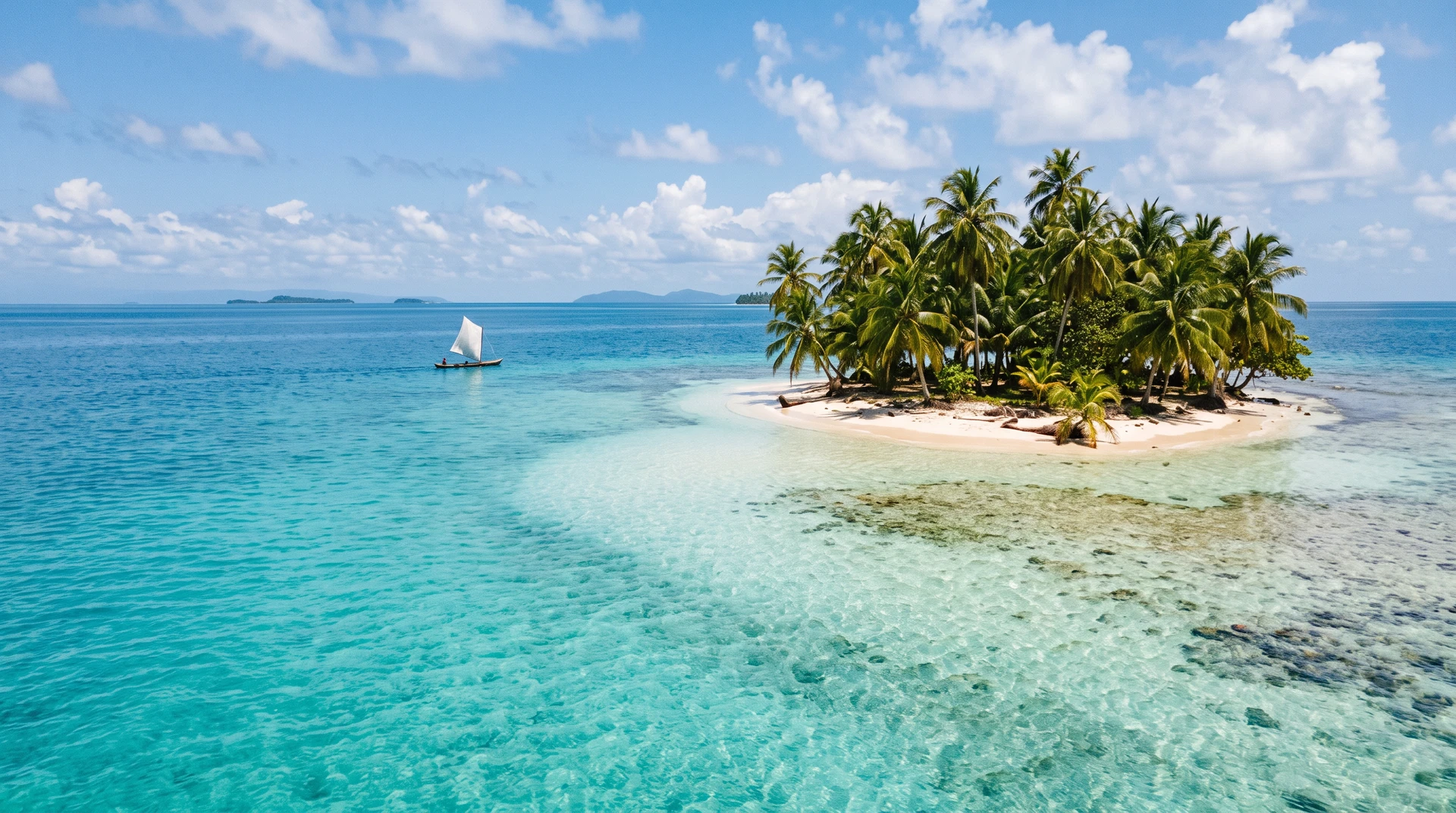
The transition from the skyscraper-shadowed bustle of Panama City to the sun-drenched silence of Guna Yala is a profound shift in time and governance. As the small plane banks over the Caribbean coast, the mainland’s dense emerald jungle gives way to a shimmering mosaic of turquoise and sapphire. Below, the San Blas archipelago emerges as a scattering of white-sand specks, some no larger than a city block, anchored in the translucent sea. Stepping onto the packed-earth landing strip, the air changes, losing the metallic tang of the city and taking on the scent of salt spray and woodsmoke. Here, the maps of the Republic of Panama feel secondary to the lived reality of an indigenous sovereignty that has endured for centuries, guarded by the Guna people with a quiet, unyielding ferocity.
There are, the locals say, 365 islands in the archipelago—one for every day of the year—though the shifting tides make that number a poetic approximation rather than a fixed geographic fact. Only about fifty of these islands are inhabited, densely packed with thatched-roof dwellings that seem to grow directly out of the coral sand. The rest are lonely outposts of coconut palms and low-lying scrub, surrounded by reefs that break the Atlantic swells into gentle ripples. In Guna Yala, the horizon is never far away, and the sea is not merely a backdrop but the very floor of existence. Life is measured by the arrival of supply boats and the departure of fishermen in their hand-carved cayucos, wooden canoes that glide across the shallows with a grace that belies their solid construction.
This is not a typical Caribbean resort destination, and the Guna General Congress ensures it stays that way. As a legally recognized autonomous territory, Guna Yala operates under its own laws, and the Guna people have famously resisted the construction of large-scale hotels or foreign-owned businesses. This political independence is palpable in every interaction. Visitors are guests in a sovereign home, and the rules are clear: respect the land, the sea, and above all, the people. There is a refreshing lack of the transactional desperation often found in tourism hubs; instead, there is a dignified hospitality that requires a reciprocal level of mindfulness from the traveler. To walk through a Guna village is to witness a community that has chosen its own path, prioritizing cultural integrity over the promises of rapid development.
The most visible expression of this cultural integrity is the mola. These complex, hand-stitched textiles are worn as panels on the blouses of Guna women and have become the defining symbol of their heritage. A mola is not merely fabric; it is a narrative rendered in cloth. Using a reverse-appliqué technique, artisans layer multiple colors of fabric and painstakingly cut away the top layers to reveal the hues beneath, creating intricate geometric patterns and stylized representations of the natural world. A single mola might depict the jagged teeth of a shark, the delicate wings of a butterfly, or the abstract spirits that inhabit Guna mythology. To watch a woman’s needle move with rhythmic precision is to see the preservation of a visual language that predates the arrival of Europeans, a vibrant testament to a history that refused to be erased.
Morning in the islands begins with the sound of the sea and the smell of coffee brewing over open fires. The Guna people have a relationship with their environment that is both utilitarian and deeply spiritual. The coconut trade was long the backbone of the local economy, and even today, the palms are treated with a respect that borders on the familial. Nothing is wasted; the husks provide fuel, the leaves provide thatch, and the fruit provides sustenance. In the village squares, men gather to discuss the affairs of the day under the guidance of the sailas, or traditional leaders, who chant the history and laws of the Guna people in a melodic cadence. This oral tradition serves as the glue that holds the archipelago together, ensuring that even as the younger generation looks toward the mainland, they remain anchored to ancestral wisdom.
The environmental stewardship practiced here is born of necessity as much as tradition. The Guna are acutely aware that their islands are among the most vulnerable in the world to the effects of climate change. With the highest point on many islands sitting only a few feet above sea level, the rising tides are a constant, encroaching reality. Yet, this has not led to defeatism; rather, it has reinforced the community’s commitment to protecting their reefs and mangroves. The waters of Guna Yala remain some of the most pristine in the Caribbean, teeming with lobster, snapper, and vibrant coral gardens that have been spared the destruction of industrial fishing and anchor damage. There is a profound lesson here in the value of local management, where those who depend most on the ecosystem are given the power to protect it.
For the traveler, Guna Yala offers a stripping away of the superfluous. There are no luxury spas or high-speed internet connections to buffer the experience of the elements. Accommodations are typically simple bamboo huts with sand floors, where the lullaby of the waves is the only entertainment. Dining is a communal affair, often centered on the catch of the day served with coconut rice and plantains. This simplicity is the ultimate luxury, providing a rare opportunity to disconnect from digital noise and reconnect with the basic rhythms of the natural world. It requires a willingness to slow down, to wait for the boat that may or may not arrive on time, and to find beauty in the play of light on the water or the intricate stitching of a half-finished mola.
Leaving the archipelago is a bittersweet experience, a slow return to a world that feels increasingly fragmented. As the cayuco pulls away from the dock and the thatched roofs recede, there is a lingering sense of gratitude for the Guna people’s resilience. They have managed to hold onto something that much of the world has lost: a sense of place that is inseparable from identity. Guna Yala is not just a collection of islands; it is a living proof that another way of life is possible, one where sovereignty, tradition, and environmental care are woven together as tightly as the threads of a mola. To visit is to be reminded that the most beautiful places on earth are not those that have been conquered, but those that have been cherished and kept whole.