Travel
The green intensity of Costa Rica's Osa Peninsula remains the world's most concentrated sanctuary of life.
Deep within the southwestern reaches of Costa Rica, the Osa Peninsula serves as a final, rugged frontier where primary rainforests collide with the Pacific. Here, the rhythm of existence is dictated by the canopy’s breath and the ocean’s untamed pulse.
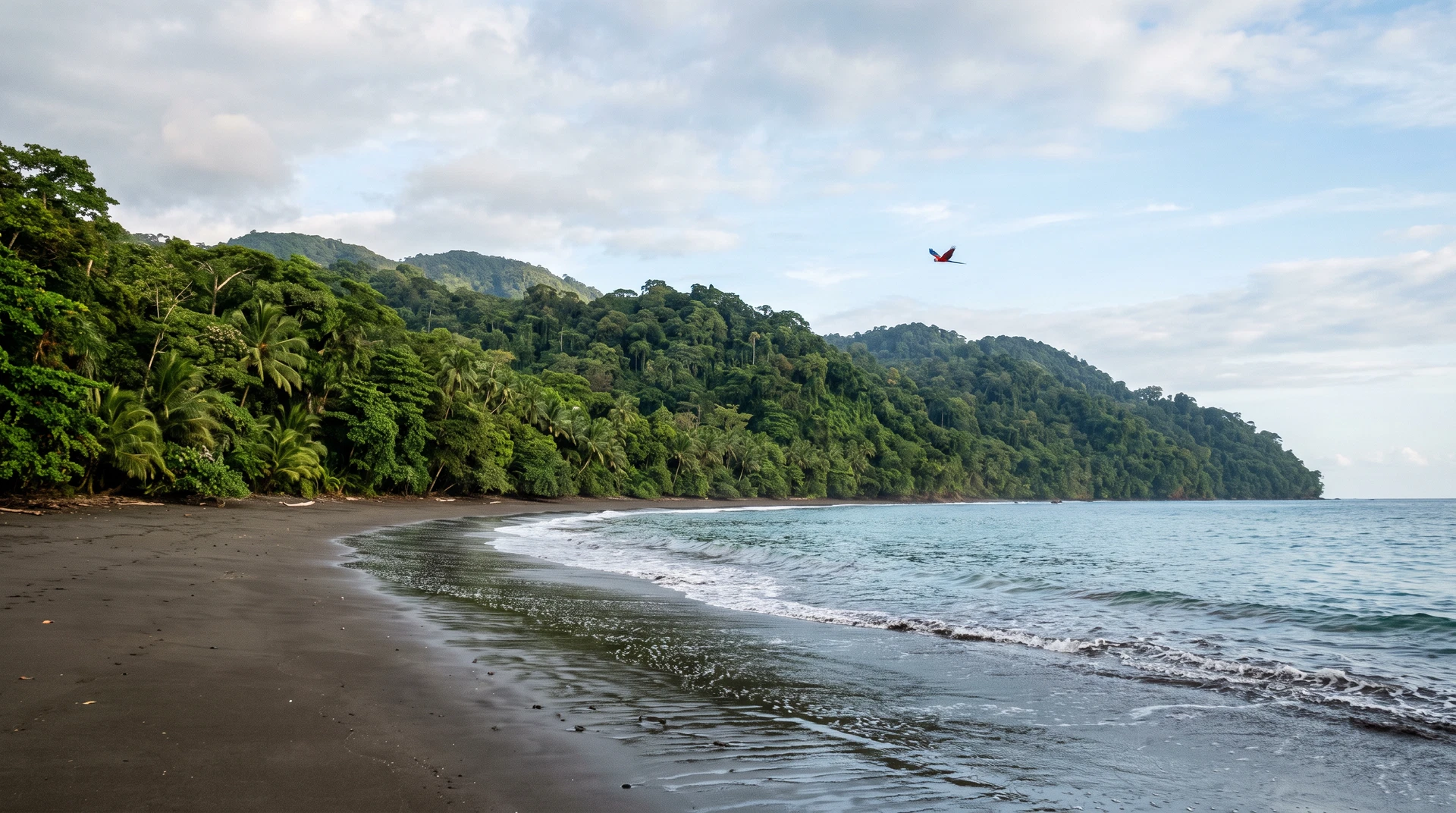
The transition from the modern world to the Osa Peninsula is not merely a change in geography, but a fundamental shift in sensory reality. As the small prop plane descends toward the dirt strip at Puerto Jiménez or Drake Bay, the landscape below transforms into a dense, vibrating carpet of emerald. This is the largest remaining tract of primary rainforest on the American Pacific slope, a place so biologically dense that it feels as though the air itself is alive. The humidity clings to the skin like a second garment, carrying the heavy scent of damp earth, crushed leaves, and the saline tang of the nearby sea. It is an immediate introduction to a region harboring two and a half percent of the planet’s biodiversity within a fraction of its surface area.
Navigating the Osa requires a surrender to the elements. There are few paved roads, and the ones that exist are often surrendered to seasonal rains or the slow, steady encroachment of the jungle. Travel here is measured in tides and river crossings rather than miles or minutes. To enter Corcovado National Park, the peninsula’s crown jewel, is to step into a realm where humans are strictly observers. The park’s regulations are a testament to its fragility; every visitor must be accompanied by a certified guide, and the policies regarding waste and food are uncompromising. These rules are a necessary shield for an ecosystem that remains one of the last places on Earth where the wild is not yet domesticated.
The canopy above is a multi-layered theater of constant motion. All four of Costa Rica’s native monkey species—the vocal mantled howler, the agile spider monkey, the inquisitive white-faced capuchin, and the diminutive, endangered squirrel monkey—swing through the branches in a perpetual search for fruit and shade. To see all four in a single afternoon is not an anomaly here, but a standard expectation. Above them, the sky is frequently punctuated by the flash of scarlet macaws. These birds, often seen in pairs that mate for life, announce their presence with raucous, prehistoric cries that echo across the forest floor. Their vibrant red, yellow, and blue plumage stands in stark contrast to the deep greens of the Ceiba and Almendro trees that dominate the skyline.
On the forest floor, the experience is more intimate and often more mysterious. The leaf litter is a world of its own, home to everything from the iconic red-eyed tree frog to the intricate trails of leaf-cutter ants. If one is quiet and exceptionally fortunate, the shadows might reveal a Baird’s tapir. These gentle, trunk-nosed giants are the largest land mammals in Central America, and the Osa is one of their few remaining strongholds. Seeing a tapir emerge from the undergrowth to drink at a stream is a humbling encounter, a glimpse of a creature that looks as though it has wandered out of a different geological epoch. It is a reminder that the Osa is a living museum, preserving lineages vanished elsewhere.
The coastline of the Osa is equally dramatic, where the primary forest grows right down to the high-tide mark. Dark, volcanic sands meet the crashing swells of the Pacific, creating a landscape that feels ancient and unyielding. Unlike the manicured beaches of the northern provinces, the shores here are littered with driftwood and sea-almonds, providing a habitat for hermit crabs and nesting sea turtles. The water is a deep, brooding blue, hiding its own wealth of life, from humpback whales that migrate through these waters to the hammerhead sharks that patrol the deeper channels. The meeting of the forest and the sea is seamless, a continuous corridor of life that spans from the highest ridge to the ocean floor.
Life in the Osa is defined by a practical, quiet resilience. The lodges and outposts scattered along the peninsula operate with a deep respect for their surroundings, often relying on solar power and spring water. There is a palpable sense of community among those who choose to live here, bound by a shared commitment to stewardship. Conversations often revolve around recent sightings—a harpy eagle on a distant ridge or a puma tracks near a trailhead—and the ongoing efforts to protect the peninsula’s corridors from the pressures of development. Here, "luxury" is redefined not by thread counts, but by the privilege of drinking from a mountain stream and waking to howler monkeys.
Walking through the primary forest, one is struck by the sheer scale of the vegetation. Buttress roots as tall as a man anchor massive trees that have stood for centuries, their trunks draped in a chaotic tapestry of lianas and epiphytes. The air is thick with the sound of insects, a constant white noise that underscores the intensity of the life cycles playing out in every square inch of space. It is a place of brutal beauty and indifferent survival, where the cycle of growth and decay is accelerated by the tropical heat. Every fallen tree becomes a nursery for a thousand new plants, and every clearing is a battleground for sunlight. To witness this process is to understand the true meaning of a "biologically intense" wilderness.
As the sun sets over the Golfo Dulce, the sky turns a bruised purple and gold, and the jungle undergoes a shift in personnel. The diurnal creatures retreat to the safety of the canopy, replaced by the nocturnal chorus of frogs, owls, and bats. The darkness here is absolute, unmarred by the light pollution of distant cities, allowing the stars to appear with startling clarity. It is in these quiet moments that the Osa’s true character is most evident. It is a place that demands patience and respect, offering in return a profound connection to the natural world. To visit the Osa is to be reminded that we are part of a much larger, more complex story—one that began long before us and, with careful stewardship, will continue long after.