Travel
The Architecture of Air: Navigating the Ethereal Heights of the Monteverde Cloud Forest
Perched atop Costa Rica’s continental divide, the Monteverde Cloud Forest Biological Reserve offers a rare encounter with one of Earth’s most fragile ecosystems. Here, horizontal rain sustains a staggering density of life, from rare orchids to ancient epiphytes, within a sanctuary defined by its ethereal, mist-shrouded silence.
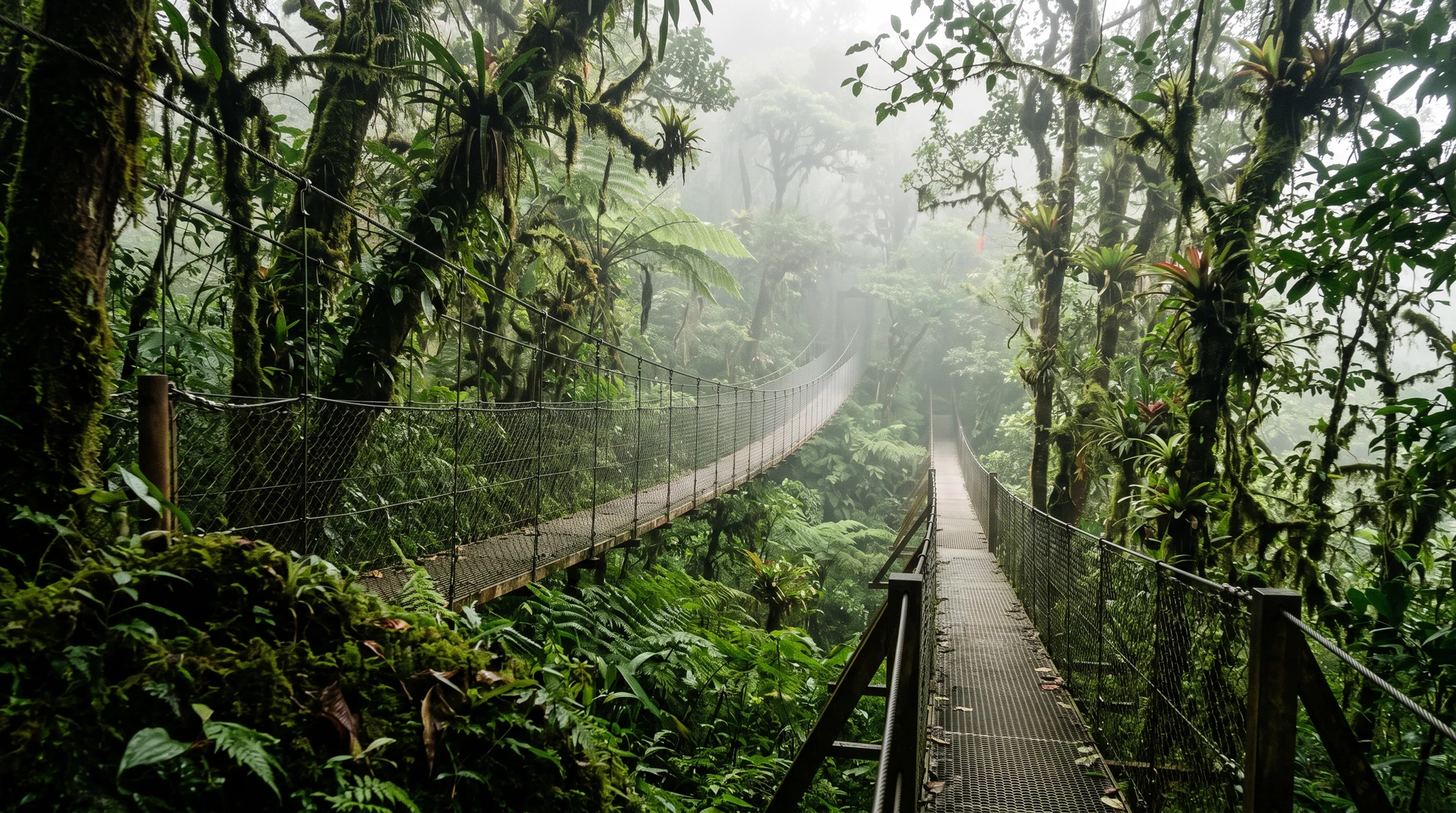
To reach the Monteverde Cloud Forest Biological Reserve is to undertake a vertical pilgrimage into a realm where the boundary between earth and sky dissolves. As the winding roads of the Tilarán Mountains climb higher, the sun-drenched pastures of the lowlands fade, replaced by a saturated green. The air grows cooler, carrying a heavy scent of damp earth and crushed leaves. Suddenly, the landscape softens into a pervasive, milky white. You have entered the cloud forest, a high-altitude sanctuary where the atmosphere itself is a source of life. This is not merely a place of trees, but a complex, breathing organism existing in a delicate state of suspension between the Pacific and Caribbean slopes.
The rarity of this ecosystem is profound, as tropical cloud forests encompass less than 0.26 percent of the Earth’s land surface. Within this minuscule fraction, Monteverde protects approximately 10,193 acres of primary and secondary growth. The reserve exists at the perfect intersection of altitude and moisture-laden trade winds. As these winds are forced upward, they cool and condense, forming the persistent mist that gives the forest its name. Unlike a typical rainforest, Monteverde thrives on "horizontal rain." This is the process by which the dense canopy literally combs water from the passing clouds, capturing microscopic droplets that sustain a landscape perpetually bathed in moisture.
This unique hydrological cycle creates a vertical world of unparalleled botanical complexity. In Monteverde, trees are the scaffolding for a vast, multi-layered community of life. The reserve hosts over 3,000 plant species, a number that challenges the imagination given its small area. Among these, the epiphytes—plants that grow upon others without being parasitic—are the true architects of the interior. With over 800 species of epiphytes, including ferns and bromeliads, the branches of great oaks are often hidden beneath thick, verdant blankets. These aerial gardens act as sponges, absorbing horizontal rain and creating miniature ecosystems high above the forest floor for countless specialized organisms.
For the orchid enthusiast, Monteverde is a holy site. The reserve is home to a staggering 450 varieties of orchids, ranging from flamboyant blooms to miniature species with flowers no larger than a pinhead. To walk the trails is to engage in a constant search for these hidden gems, often tucked into the crooks of mossy branches. The sheer density of these plants is a primary reason why Monteverde harbors an estimated 2.5 percent of the world’s total biodiversity. Every square meter is occupied, every niche filled by an organism evolved to thrive in this high-humidity environment. The result is an impossibly full forest, a dense tapestry where life occupies every corner of the canopy.
The preservation of this landscape is the result of a visionary effort that began over half a century ago. Established in 1972 by the Tropical Science Center, the reserve was born from a realization that this unique environment was under threat from encroaching agriculture. The Center’s stewardship has transformed the area into one of the most important private reserves globally, serving as a model for how scientific research and conservation can coexist with sustainable tourism. It is an active laboratory where biologists study the complex interactions of the cloud forest. Its history is one of foresight, recognizing the value of a forest that many once saw only as an obstacle to progress.
Beyond its role as a sanctuary, Monteverde serves a critical function in Costa Rica’s broader geography. The reserve sits on the continental divide, acting as a vital headwater for watersheds flowing toward both the Pacific and the Caribbean. The water captured by the canopy feeds the rivers that sustain life in the valleys below, providing irrigation, drinking water, and the necessary flow for hydroelectric power. The forest is, in effect, a massive water tower, regulating the flow of moisture and ensuring the stability of the regional climate. This hydrological connection underscores the fact that the health of the cloud forest is inextricably linked to the health of the entire country.
Navigating the reserve’s trail system is an exercise in sensory immersion. The paths wind through deep ravines and across high ridges, often crossing suspension bridges that offer a bird’s-eye view of the canopy. From these vantage points, the scale of the forest becomes apparent; you look down upon a sea of green where the tops of trees disappear into swirling mist. The soundscape is equally distinctive. The dense vegetation and moisture-laden air act as a natural acoustic dampener, creating a profound sense of quiet. This silence is occasionally broken by the haunting call of the resplendent quetzal, a sound that seems to emerge from the mist and vanish just as quickly.
However, the very beauty that draws visitors to Monteverde also places it at risk. The reserve operates under a strict management plan to mitigate the impact of human presence. Advance online booking is now mandatory, a necessary measure to respect daily visitor caps that prevent the trails from becoming overcrowded. These limits are essential for safeguarding the delicate balance of the high-altitude ecosystem against environmental degradation. Soil erosion and the disturbance of wildlife are constant concerns that the reserve’s staff must manage. As a visitor, there is a responsibility to adhere to these rules, recognizing that one’s presence is a privilege granted by a forest that is as fragile as it is magnificent.
The experience of Monteverde lingers long after one has descended back into the sunlit lowlands. There is a specific kind of stillness found only in the clouds, a sense of being part of something ancient yet terrifyingly vulnerable. The reserve serves as a poignant reminder of the Earth’s hidden wonders and the urgent need to protect the few remaining wild places that sustain such a high concentration of life. To visit Monteverde is to witness the architecture of air and water, a masterpiece of natural engineering that continues to capture the clouds, one droplet at a time. It is a place that reminds us that the most valuable things on this planet are often the most ethereal.