Travel
The Turquoise Tiered Sanctuary Where a Roaring Guatemalan River Hides Underground
Deep in the Alta Verapaz jungle, a natural limestone bridge cradles six crystalline pools. Here, the Cahabón River disappears beneath the earth, leaving behind a serene oasis of tiered turquoise basins that invite quiet contemplation amidst the humid, emerald canopy of the Guatemalan highlands.
The journey to Semuc Champey begins long before the first glimpse of turquoise water. It starts in the back of a rugged 4x4, bouncing along narrow, unpaved tracks that wind through the steep hills of Alta Verapaz. The air is thick with the scent of damp earth, a humid weight signaling the depth of the Guatemalan jungle. As the vehicle lurches over limestone outcrops, the modern world recedes, replaced by the rhythmic swaying of coffee plants and the dense canopy. Every jolt of the suspension reminds you of the isolation required to reach this sanctuary, a monument carved by time in the heart of the Maya highlands.
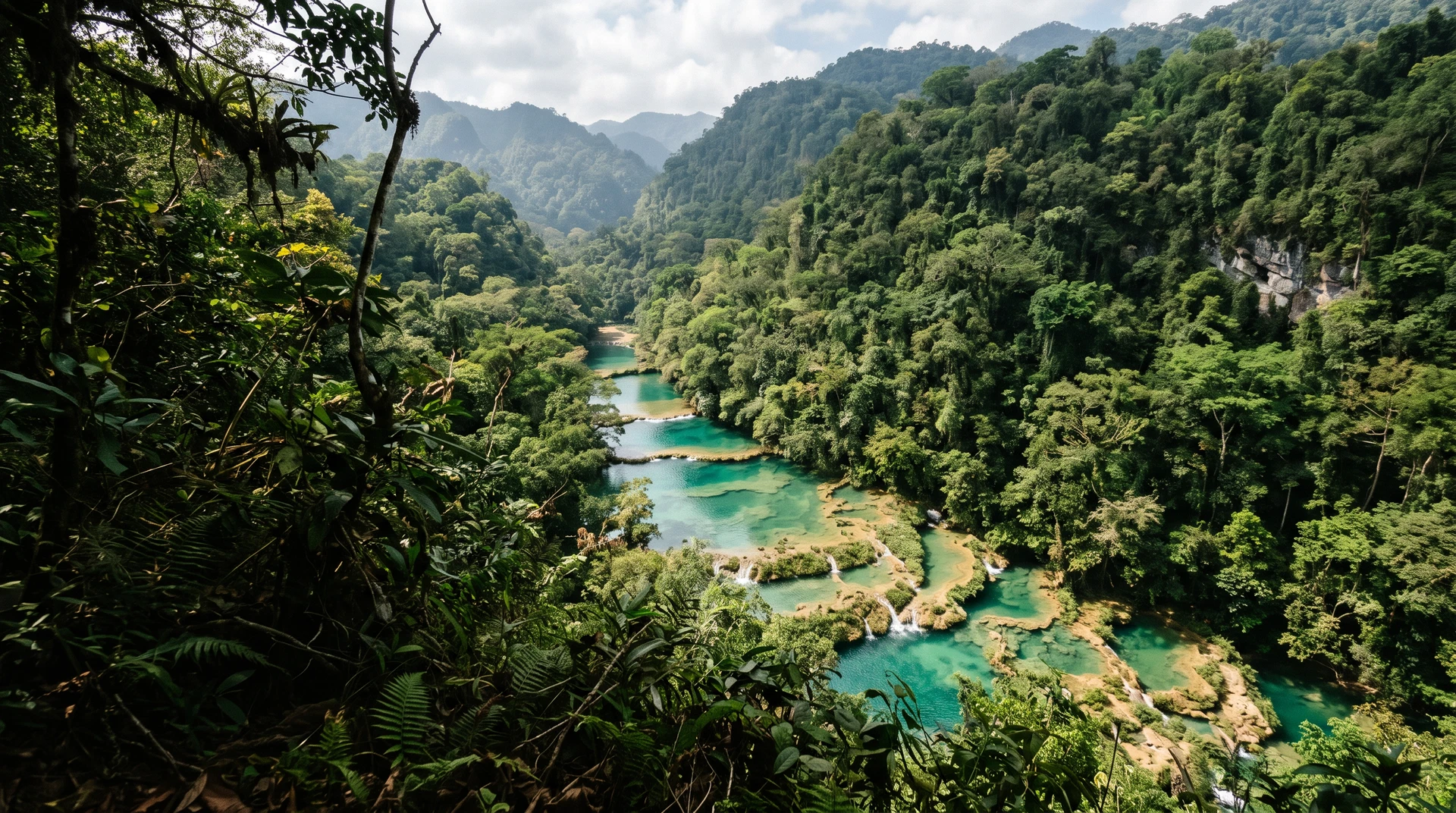
Upon arrival, the sound of the Cahabón River dominates. It is a low, guttural roar that vibrates through the soles of your boots, a testament to the volume of water carving through the karst landscape. Yet, as you descend the wooden stairs, a strange silence intermingles with the thunder. You reach a point where the river seems to vanish, swallowed by the earth. This is the 300-meter natural limestone bridge, a geological marvel spanning the canyon. Above this bridge, the world transforms from a raging torrent into a series of six tranquil pools, their surfaces smooth as glass and their colors shifting from jade to luminous turquoise.
The Q'eqchi' Maya, who have inhabited these lands for generations, named this place Semuc Champey, meaning "where the river hides." The name is a precise description of the hydrological mystery occurring beneath your feet. The Cahabón River plunges into a dark cavern at the upstream end of the bridge, rushing through a subterranean tunnel before re-emerging several hundred meters downstream in a spectacular explosion of white water. Standing on the limestone bridge, you are suspended between two worlds: the violent, hidden power of the river below and the serene, spring-fed basins that rest atop the stone floor of the canyon.
These pools are not fed by the muddy river roaring beneath them. Instead, they are filled by delicate mountain springs that trickle down the canyon walls, filtered through limestone until the water reaches a clarity that seems impossible. The limestone itself is a living participant in the landscape. Over millennia, mineral-rich water has deposited calcium carbonate, building the natural dams that separate the pools. These travertine barriers are slick with moss and smoothed by the constant flow, creating a sequence of basins that step down the canyon like a giant’s staircase, each offering a different depth and a slightly different hue of blue.
Stepping into the water is an exercise in sensory realignment. The temperature is mild, a gentle relief from the sweltering jungle heat. The limestone floor is textured, providing a steady grip for bare feet, though the edges where water spills between levels can be deceptively smooth. Small, curious fish often dart around your ankles, their silver bodies flashing in the sunlight that filters through overhanging ferns. There is a profound sense of stillness here, even with the knowledge of the subterranean river surging just a few meters below. It is a rare moment of peace found in the middle of a roaring jungle.
The visual impact of Semuc Champey is heightened by the sheer verticality of the surrounding canyon. The walls of the gorge rise hundreds of feet, draped in a chaotic tapestry of tropical vegetation. Bromeliads cling to the rock faces, and giant tree ferns unfurl their fronds like prehistoric umbrellas. The humidity creates a perpetual haze that softens the light, giving the scene an ethereal quality. From the "El Mirador" viewpoint, the pools look like a string of jewels dropped into a sea of green, a narrow ribbon of vibrant color that seems entirely out of place in the rugged, untamed wilderness.
Beyond beauty, Semuc Champey is a site of deep cultural significance. The Q'eqchi' community maintains an ancestral connection to this land, viewing the water and the limestone bridge as sacred. Their stewardship is evident in the careful management of the site, designated a Natural Monument under Legislative Decree 25-2005. Visitors must move with respect, following designated boardwalks constructed to protect the fragile karst formations from erosion. This balance between tourism and preservation is delicate, requiring a constant awareness of the impact that human footsteps have on a landscape that took millions of years to form in the Guatemalan interior.
As the afternoon sun dips behind the canyon walls, the colors of the pools deepen, turning from turquoise to a rich emerald. The birds of the canopy—toucans and the occasional flash of a motmot—become more active, their calls echoing off the limestone cliffs. The roar of the Cahabón River re-emerging at the end of the bridge serves as a natural clock, signaling the time to begin the ascent back to the world above. Leaving Semuc Champey feels like waking from a vision, a transition from a hidden sanctuary of water and stone back into the dense, unrelenting green of the tropical highlands.
The experience stays with you as a feeling of geological wonder. It is a place that demands a slower pace, a willingness to observe the way light changes on the water’s surface or a single leaf floats down from the canopy. In a world that often feels paved, this limestone bridge remains a stubborn anomaly, a place where nature still plays hide-and-seek with its most powerful forces. The journey back through the jungle, though just as rugged as the arrival, feels different, as if the stillness of the pools has settled into your bones, providing a quiet center amidst the heat.
Ultimately, Semuc Champey is a reminder of the Earth's capacity for architectural genius. Without human intervention, the landscape has constructed a bridge, a series of reservoirs, and a subterranean bypass, all while maintaining a lush ecosystem. It is a testament to the resilience of the karst environment and the importance of protecting these rare geological features. To visit is to witness a fleeting moment in the life of a river, a place where the Cahabón takes a breath, hides beneath the stone, and allows a moment of crystalline peace to exist in the middle of its long, turbulent journey.