Travel
The Iron Veins and Crimson Depths of Chihuahua’s Ancient Copper Canyons
Beyond the arid plateaus of northern Mexico lies a vertical labyrinth of six river-carved gorges. Here, the legendary Chepe Express climbs into the Sierra Madre Occidental, revealing a landscape where Rarámuri traditions endure amidst geological scales that dwarf the Grand Canyon’s famous horizons.
The journey begins not with a view, but with a sound—the rhythmic, metallic heartbeat of the Ferrocarril Chihuahua al Pacífico, known as El Chepe. As the train pulls away from the sun-bleached plains of Chihuahua City, the horizon begins to buckle and rise. The air, once thick with desert heat, cools as the tracks bite into the foothills of the Sierra Madre Occidental. This is an ascent into a different Mexico, one of high-altitude forests and vertical precipices, where the landscape is defined by the sheer, dizzying depth of the earth itself.
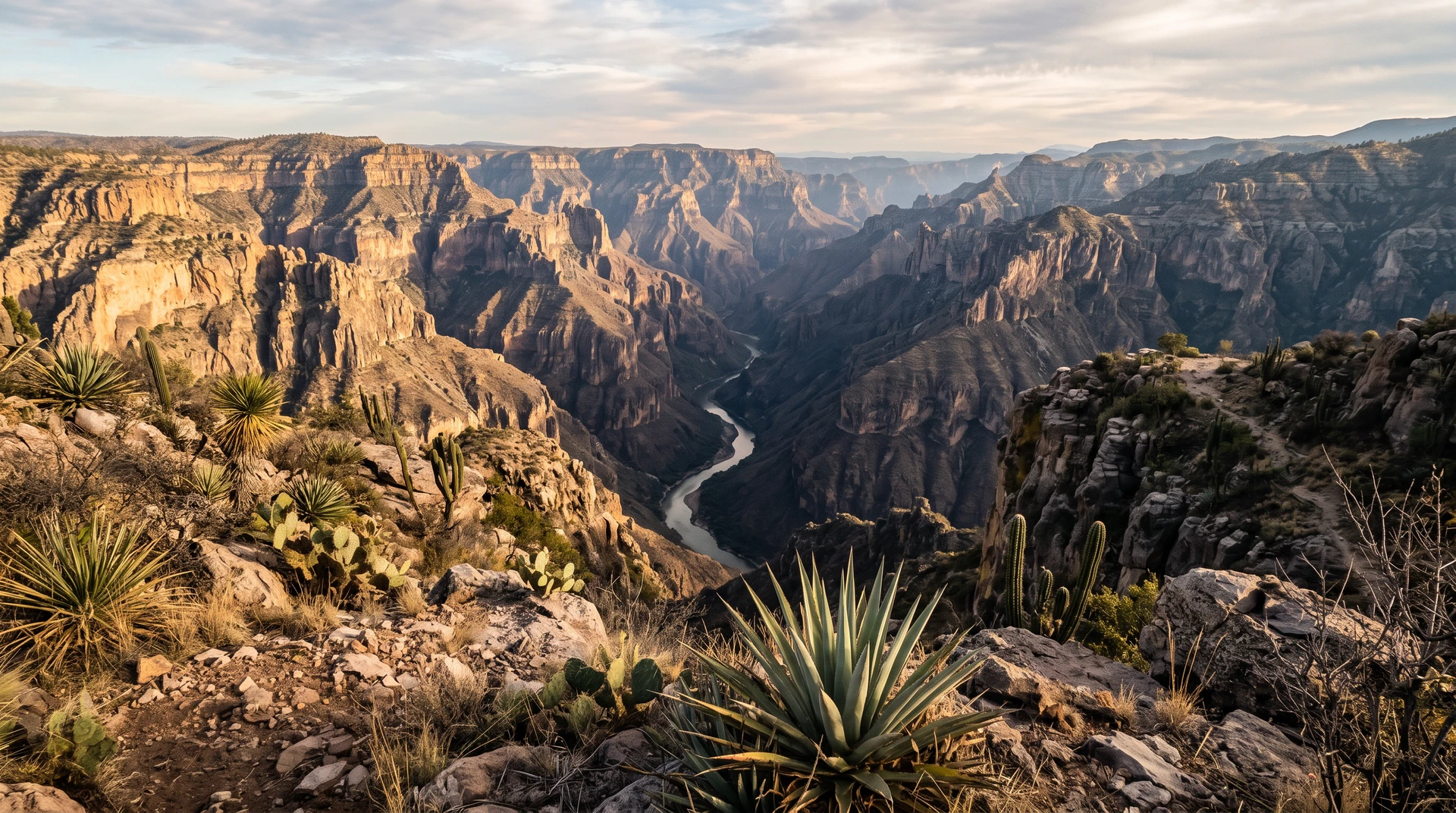
To call the Barrancas del Cobre a canyon is a modest understatement; it is a sprawling network of six distinct gorges, carved over millennia by six major rivers. Covering roughly 65,000 square kilometers, the system is four times the size of the Grand Canyon and, in several places, significantly deeper. The name "Copper Canyon" refers not to the metal, but to the greenish-copper hue of the lichen clinging to the volcanic rock walls. It is a place of monumental scale, where the geology is so vast that it seems to swallow the very concept of distance.
The engineering required to navigate this terrain is heroic. Completed in 1961, the railway traverses 37 bridges and plunges through 86 tunnels, some of which spiral within the mountains to gain elevation. From the open-air vestibules, travelers watch the world transform. Stunted oaks give way to towering Ponderosa pines, and the dry scrub of the lowlands is replaced by the lush, mossy dampness of the high sierra. Each turn reveals a new vista, a fresh perspective on the jagged, rust-colored cliffs that define this rugged corner of North America.
At the heart of the system lies the Urique Canyon, the deepest of the six, plunging approximately 1,879 meters from rim to floor. Standing at the overlook in Divisadero, one is struck by the dramatic verticality. The climate shifts as rapidly as the elevation; while the rim may be dusted with snow, the canyon floor remains a tropical sanctuary where citrus trees thrive in the humid warmth. It is a vertical world where the seasons exist simultaneously, stacked one on top of the other like the layers of rock that form the canyon walls.
This rugged terrain is the ancestral home of the Rarámuri people, who have inhabited these canyons for centuries. Renowned for their extraordinary long-distance running abilities, the Rarámuri have maintained a culture of profound resilience and quiet dignity. Their presence is felt in the small settlements tucked into the folds of the mountains and the intricate, hand-woven baskets sold at train stops. To travel here is to enter a territory where time is measured not by the clock, but by the slow movement of shadows across the canyon floor and the enduring traditions of its people.
Stewardship of this fragile environment is a paramount concern. The alpine forests and tropical riverbeds are susceptible to soil erosion, and the cultural integrity of the Rarámuri communities requires a high degree of sensitivity. Travelers are encouraged to remain on designated trails and to approach local customs with respect. The beauty of the Barrancas del Cobre is not just in its physical scale, but in its delicate balance of nature and culture—a balance that has been maintained through isolation but is now increasingly touched by the outside world.
The sensory experience is one of constant, subtle shifts. There is the scent of pine needles warming in the sun, the sharp smell of fractured stone, and the sudden, cool dampness of a tunnel. The silence here is heavy and absolute, broken only by the cry of a hawk or the distant, rushing sound of a river far below. As the sun sets, the red rock walls seem to glow from within, turning shades of violet and deep ochre before the stars emerge, brighter and more numerous than they ever appear in the cities of the plains.
Practicality in the Sierra Madre means embracing a slower pace. The stops along the Chepe route, such as the town of Creel, offer a chance to step off the iron tracks and into the local rhythm. Here, the air is thin and crisp, and the food is simple and restorative—thick tortillas, local cheeses, and warming stews. The markets are a riot of color, with Rarámuri women in vibrant skirts selling crafts that reflect the geometry of the landscape. It is a place that rewards the patient observer who looks beyond the grand vistas.
Ultimately, a journey through the Copper Canyon is a meditation on scale and endurance. It is a reminder of the earth’s capacity for both monumental violence and quiet beauty. As the train begins its descent toward the Pacific coast, leaving the high sierra behind, the memory of the crimson depths remains. One leaves the Barrancas del Cobre feeling strangely diminished yet spiritually enlarged, having witnessed a landscape that refuses to be hurried and a culture that has found a way to thrive in the most challenging of terrains.