Travel
Where the High Desert Peaks Meet the Sky: A Journey Through Colorado’s Great Sand Dunes
Rising against the jagged, snow-dusted Sangre de Cristo Mountains, North America’s tallest dunes create a surreal, shifting landscape. This high-altitude sanctuary invites travelers to explore a unique hydrological wonder where wind and water conspire to keep the massive sands anchored in a constant, ancient cycle.
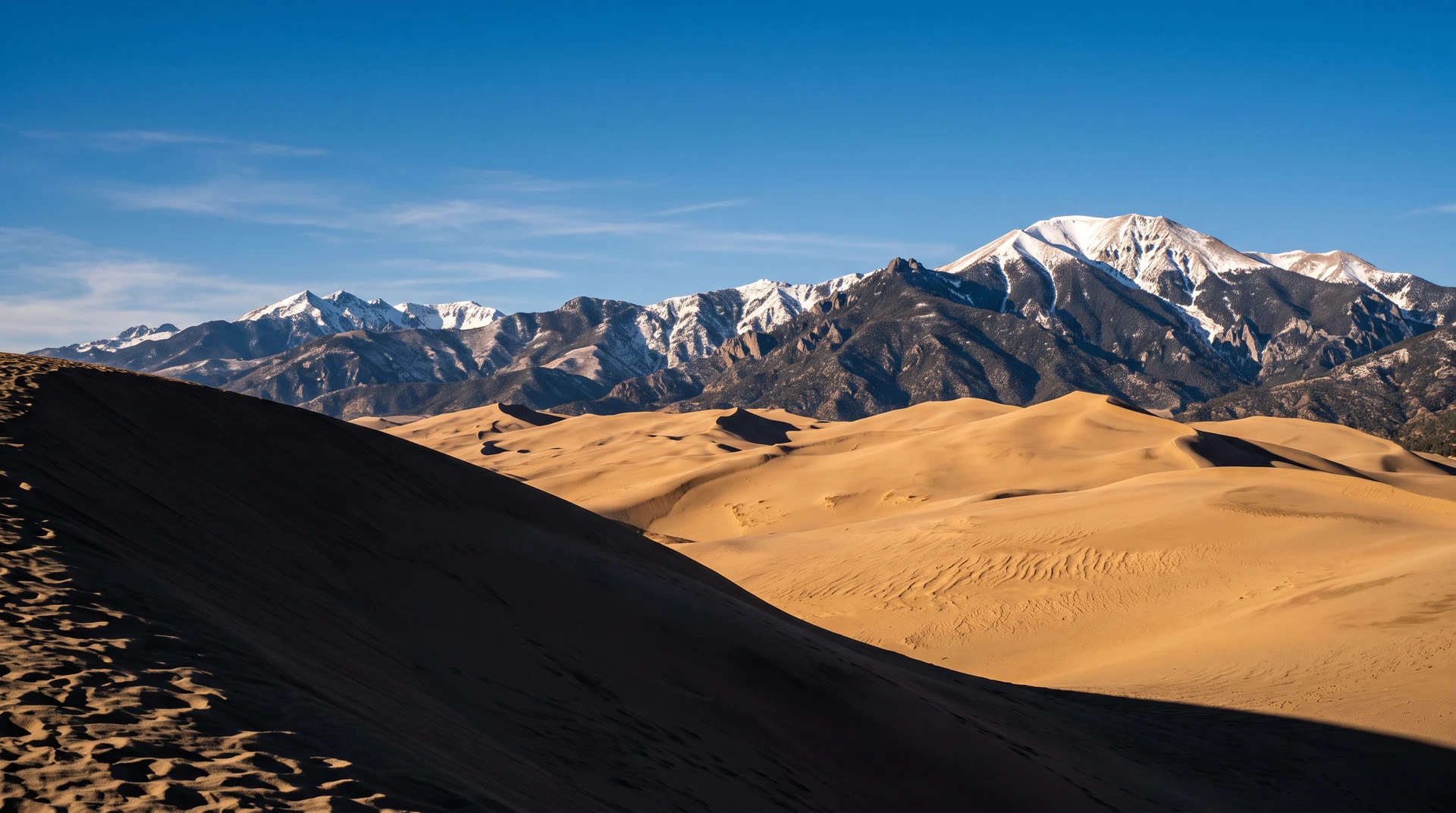
The first glimpse of Great Sand Dunes National Park and Preserve is a visual paradox that defies the logic of the American West. Driving through the vast, flat San Luis Valley, the horizon is dominated by the formidable, jagged peaks of the Sangre de Cristo Mountains. Then, as if a giant has emptied a bucket of gold at their feet, the dunes appear. They are not the rolling hills of a typical desert, but massive, sculptural waves of sand that reach heights of over 700 feet. The contrast between the soft curves of the sand and the sharp granite of the mountains creates a landscape that feels less like Colorado.
Stepping onto the sand, the scale of the dunes becomes immediate and humbling. What looked like smooth slopes from a distance are revealed to be complex ridges and deep valleys, carved by the relentless winds that sweep across the valley floor. The climb is a test of endurance; for every two steps forward, the shifting grains pull you one step back. The air at 8,000 feet is thin and crisp. As you ascend, the sounds of the valley floor fade, replaced by the rhythmic hiss of wind-blown sand. The crest of a high dune offers a sea of sand stretching toward the mountains, a sight both ancient and perpetually new.
The existence of these dunes is a geological marvel, born from a unique set of circumstances that have persisted for millennia. The sand is the product of ancient lake beds and river deposits, carried by southwesterly winds toward the mountain wall. When the winds hit the Sangre de Cristos, they lose their energy and drop their sandy cargo. However, unlike most dune fields that migrate, these are held in place by a "closed-cycle" hydrological system. Medano and Sand Creeks, which flow from the mountains, act as a natural conveyor belt. They catch the sand as it blows toward the peaks and wash it back down to the valley floor.
For visitors, Medano Creek is the park’s seasonal heartbeat. In late spring and early summer, melting mountain snow transforms the creek into a wide, shallow ribbon of water flowing across the sand at the base of the dunes. This is where the phenomenon of "surge flow" occurs—rhythmic waves that pulse through the water like a heartbeat, caused by sand ridges forming and breaking underwater. Families splash in the cool, clear stream while the massive dunes loom overhead. The creek is a reminder that in this high-altitude desert, water is just as important as the wind in shaping the land, providing a cooling respite.
Long before the area was designated a national park, the dunes were a sacred site for the indigenous peoples of the region. The Ute, Apache, and Navajo tribes have deep ancestral connections to this landscape, viewing the dunes as a place of spiritual power and transition. For the Jicarilla Apache, the dunes are a source of healing and a landmark in their traditional territory. Respecting this heritage is a core part of the visitor experience; one does not simply walk on the sand, but enters a space that has been revered for generations. The silence of the dunes at dawn carries the weight of this long human presence.
As the sun dips behind the San Juan Mountains to the west, the dunes undergo a dramatic transformation. The golden hues of the afternoon give way to deep oranges, purples, and finally, a profound, velvety black. Great Sand Dunes is a certified International Dark Sky Park, and the lack of light pollution in this remote corner of Colorado reveals a celestial display that is increasingly rare. The Milky Way stretches across the sky with startling clarity, its starlight reflecting off the pale sand to create a ghostly, ethereal glow. On a moonless night, the dunes feel like a landscape of shadows, where the universe feels close enough to touch.
Exploring this environment requires a degree of preparation and respect for the elements. In the height of summer, the surface temperature of the sand can soar to 150 degrees Fahrenheit, enough to cause severe burns to unprotected feet or paws. The high altitude also means that the sun’s rays are particularly intense, and dehydration can set in quickly. Wise travelers plan their excursions for the early morning or late evening, avoiding the midday heat and catching the most dramatic lighting for photography. The dunes are a place of extreme beauty, but they are also a place of extreme conditions that demand mindfulness.
For those looking for a bit of adventure, the dunes offer a playground unlike any other. Sand sledding and sandboarding have become iconic park activities, allowing visitors to glide down the steep faces of the dunes at surprising speeds. The physical sensation of the sand—cool and damp just beneath the surface, hot and dry on top—is a constant sensory engagement. Whether you are racing down a 200-foot slope or simply sitting quietly to watch the wind sculpt new patterns in the sand, the dunes invite a playful, tactile connection with the earth that is rare in more structured environments.
Beyond the sand, the park and preserve encompass a diverse range of ecosystems that many visitors overlook. The preserve side extends high into the Sangre de Cristo Mountains, where subalpine forests of aspen and spruce give way to tundra and alpine lakes. Trails like the Medano Pass Primitive Road offer a transition from the desert-like dunes to lush mountain meadows filled with wildflowers. Here, the wildlife is different—mule deer, elk, and even bighorn sheep roam the higher elevations. This transition highlights the ecological richness of the region, showing that the dunes are just one part of a larger, interconnected wilderness.