Travel
The Emerald Confluence: Navigating the Three Wild Worlds of the Olympic Peninsula
Stretching across nearly one million acres of Washington’s rugged northwest corner, Olympic National Park offers a rare convergence of glacier-capped peaks, moss-draped temperate rainforests, and seventy-three miles of wild Pacific coastline, providing a profound sanctuary for endemic species and the resilient spirit of the American West.
To stand on the edge of the Olympic Peninsula is to feel the weight of a continent pressing against the infinite expanse of the Pacific. This sprawling, nearly million-acre wilderness demands a shift in perspective. Designated as both a UNESCO World Heritage site and a Biosphere Reserve, Olympic National Park is famously described as three parks in one. Within its borders, one can traverse from the salt-sprayed sea stacks of the coast to the cathedral-like silence of temperate rainforests, and finally to the subalpine meadows where glaciers cling to jagged basalt peaks. It is a place where the transition between ecosystems is so abrupt that it feels as though the Earth has folded its most precious environments into a single, compressed masterpiece.
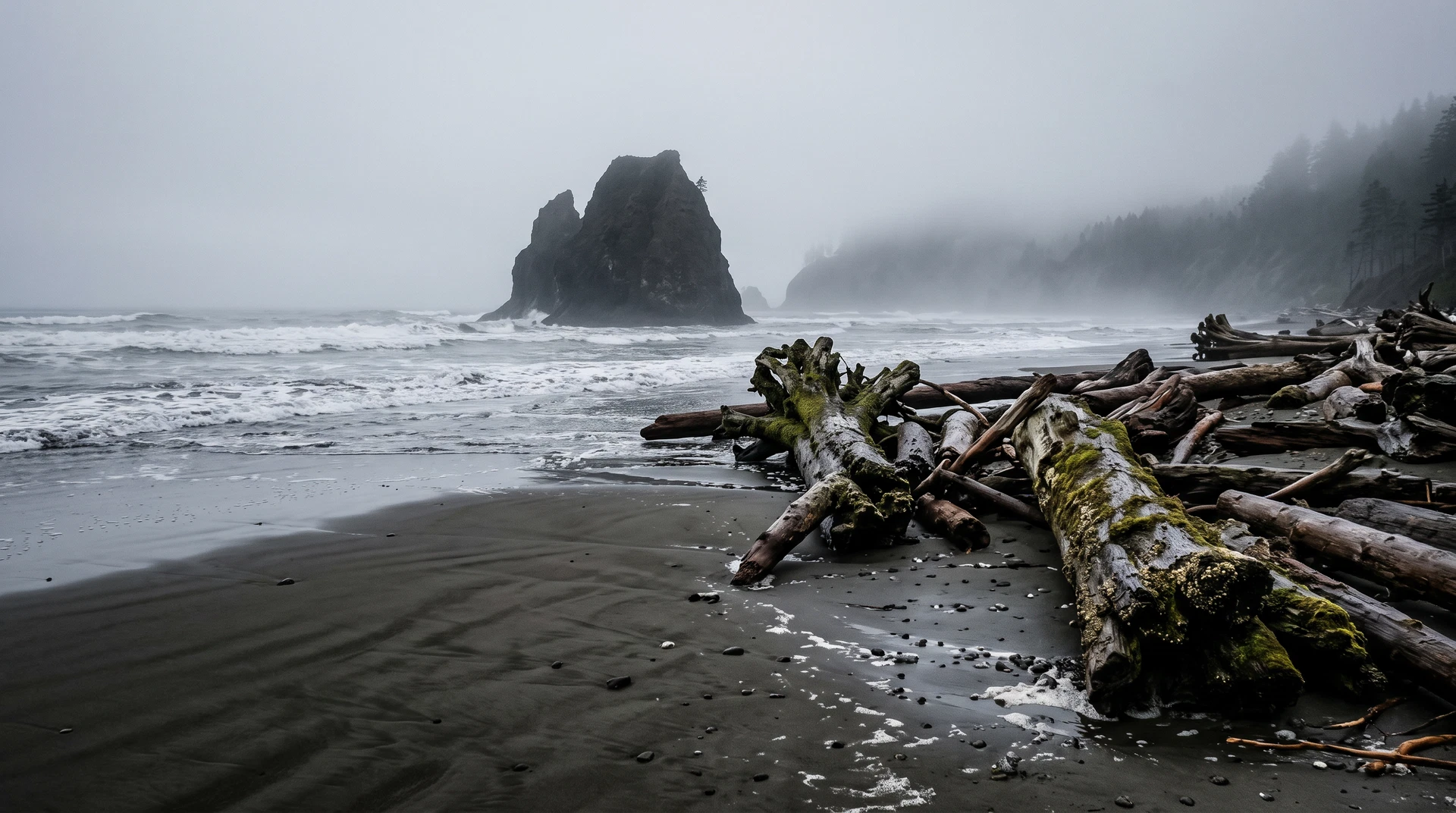
The park’s seventy-three miles of undeveloped coastline represent the longest such stretch in the contiguous United States, a jagged frontier where the forest literally meets the sea. At Ruby Beach or Rialto, the shoreline is a graveyard of giants—massive Sitka spruce and cedar logs, bleached bone-white by salt and sun, lie scattered like toothpicks across the dark, volcanic sand. Walking here requires a constant awareness of the moon’s pull. Coastal hikers must carry tide charts with religious devotion, as the rising waters frequently trap the unwary against sheer cliffs that offer no escape. The air is thick with the scent of salt and the roar of the surf, a reminder that on this wild edge, human presence is merely a fleeting observation.
Moving inland, the atmosphere shifts from the kinetic energy of the ocean to the profound, damp stillness of the Hoh Rainforest. As one of the largest and most pristine temperate rainforests on the planet, the Hoh receives upwards of twelve feet of rain annually, creating a lush world where every available surface is claimed by life. Towering Sitka spruce and Western hemlocks reach toward a perpetually gray sky, their limbs draped in heavy curtains of clubmoss and licorice fern. The ground is a springy carpet of needles and decaying wood, serving as the foundation for this ancient ecosystem. In the deep silence of the Hoh, where moss softens every footfall, one realizes that time here is measured not in hours, but in the slow, inexorable growth of spruce.
There is a specific quality to the silence in these woods—a heavy, acoustic dampening that makes one’s own heartbeat feel like a localized intrusion. This auditory purity allows for a different kind of observation. You begin to hear the subtle click of a Roosevelt elk’s hooves against a river stone or the distant, high-pitched whistle of an Olympic marmot, a species found nowhere else on Earth. The marmot serves as a living reminder of the peninsula’s geological isolation. Cut off from the mainland by ice and water during the last glacial period, the Olympic mountains became a laboratory for evolution, fostering life forms that exist only within this emerald sanctuary.
As the road winds upward toward Hurricane Ridge, the rainforest gives way to the stark, windswept beauty of the high country. Here, the perspective shifts again, offering a panoramic view of the Olympic Mountains’ jagged spine. Mount Olympus, the highest peak in the range, stands cloaked in massive glaciers that feed the rivers below, sustaining the very rainforests that seem so distant from these icy heights. The transition from sea level to over five thousand feet occurs in a matter of miles, a vertical journey that showcases the park’s extraordinary diversity. In the summer, the subalpine meadows erupt in a brief, frantic bloom of wildflowers—lupine, paintbrush, and glacier lilies—before the heavy snows of autumn return to bury the landscape once more.
Preparation for a journey into the Olympic interior is less about gear and more about a mental readiness for the unpredictable. The weather here is not merely a backdrop; it is a primary actor in the narrative of the park. The Olympic Mountains create a significant rain shadow, meaning that while the western slopes are drenched in rainfall, the eastern side near Sequim remains remarkably dry. A traveler might start the day in a downpour at the Quinault River and end it under clear skies at Lake Cushman. This volatility requires a humble respect for the elements. Sudden shifts in temperature and visibility are common, and the park’s rugged terrain offers little in the way of shelter once you leave the visitor centers behind.
The stewardship of this wilderness is a delicate balancing act, managed with an emphasis on preserving the "wild" in wilderness. Unlike many other national parks where paved roads provide easy access to every major landmark, the vast majority of Olympic is accessible only by foot or boat. This lack of infrastructure is intentional, protecting the fragile ecosystems from the pressures of modern tourism. Visitors are encouraged to practice "Leave No Trace" principles with a rigor that matches the environment’s sensitivity. Whether it is avoiding the disturbance of nesting shorebirds on the coast or staying on marked trails in the alpine meadows to protect the thin, volcanic soil, the responsibility of the traveler is to remain a quiet observer.
Ultimately, the allure of Olympic National Park lies in its refusal to be easily categorized or fully tamed. It is a place of contradictions—a rainforest in a temperate zone, a mountain range born of the sea floor, and a coastline that feels as ancient as the stars. To visit is to participate in a grand, quiet drama of survival and adaptation. As you stand on a high ridge, watching the fog roll in from the Pacific to swallow the valleys below, the modern world feels impossibly distant. You are left with the knowledge that some corners of the world still belong entirely to themselves. The Olympic Peninsula is not just a destination; it is a reminder of what the Earth looks like when we allow it to breathe.