Travel
Where the Appalachian spine meets the Atlantic salt: A journey to the edge of the Gaspé.
At the rugged tip of Québec, the Gaspé Peninsula stands as a prehistoric sentinel. From the Devonian fossil cliffs of Miguasha to the whale-patrolled waters of Forillon, this wild edge of the Appalachians offers a profound encounter with deep time and the untamed maritime spirit.
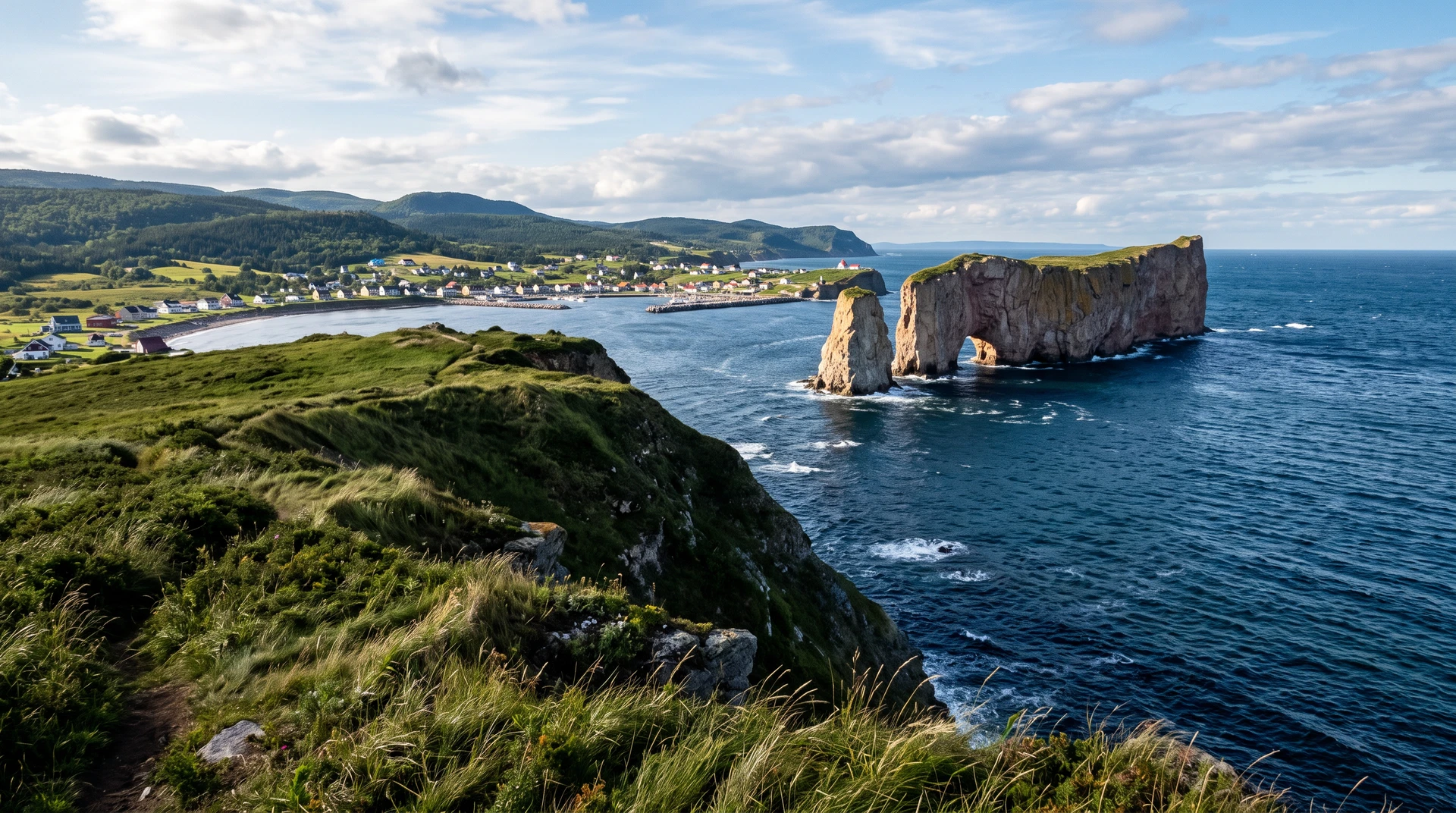
The Gaspé Peninsula, or Gaspésie, is a place that feels less like a destination and more like an ending. Tucked into the eastern reaches of Québec, where the Gulf of Saint Lawrence begins its slow widening into the Atlantic, the land tapers to a dramatic, wind-battered point. The landscape is defined by the collision of ancient mountains and cold Atlantic waters. To travel here is to leave the familiar comforts of the Saint Lawrence valley and enter a realm where the rhythm of the tides and the shifting mist against the cliffs dictate the pace of life. There is a wistful quality that clings to the salt-crusted fishing villages and the jagged headlands that have stood sentinel for eons.
The story of the Gaspé is written in stone, and nowhere is this more evident than at Miguasha National Park. Recognized as a UNESCO World Heritage site, Miguasha is a portal to the Devonian Period, a time roughly 380 million years ago known as the "Age of Fishes." The grey shale cliffs along the Restigouche River hold the world’s most complete record of this era, preserving the delicate impressions of fins and skeletal structures that tell the story of life’s transition from water to land. On these fossil-rich shores, one is struck by the fragility of the records; a simple shift in the tide can reveal a specimen that has remained hidden for eons.
Inland, the peninsula rises into the sky, forming the northernmost extension of the Appalachian mountain chain. The Chic-Choc and McGerrigle Mountains dominate the interior, boasting twenty-five summits that exceed 1,000 meters. These peaks are massive, rounded domes of ancient rock, weathered by ice and wind over millions of years. The high-altitude plateaus are home to a fragile alpine tundra, a relic of the last ice age that persists in the harsh conditions of the summits. Here, the air is thin and crisp, and the views stretch across a sea of green forest to the shimmering blue horizon of the Gulf. This rugged character feels worlds away from the shore.
At the very tip of the peninsula lies Forillon National Park, where the mountains finally succumb to the ocean. The park is a masterpiece of coastal erosion, featuring sheer limestone cliffs that plunge hundreds of feet into the churning surf. These cliffs are bustling cities of avian life; thousands of nesting birds, including razorbills and black-legged kittiwakes, cling to the narrow ledges. Forillon serves as a critical sanctuary for these species, offering a protected environment where the land and sea meet in a raw embrace. To stand at "Land's End" is to feel the immense power of the Atlantic, as the waves batter the base of the peninsula in a relentless display of geological force.
The waters surrounding the Gaspé are as teeming with life as the cliffs themselves. The Gulf of Saint Lawrence is a vital feeding ground for six different species of whales, including the massive blue whale and the acrobatic humpback. From the shores of Forillon, one can often witness the telltale blow of a minke or the dark, sleek back of a fin whale breaking the surface. The presence of these maritime giants adds a layer of majesty to the landscape, a reminder that the peninsula is part of a much larger, interconnected ecosystem. The deep, cold channels of the Gulf provide the necessary nutrients to sustain these leviathans, making the Gaspé a premier location for observant whale watching.
Protecting this unique intersection of ecosystems requires a delicate balance. The region’s alpine tundra and coastal nesting sites are highly sensitive to human interference. Strict prohibitions on recreational drones are in place to prevent the disturbance of wildlife, particularly the nesting birds that are easily spooked. Visitors are urged to stay on marked trails to avoid trampling the slow-growing mosses and lichens that characterize the high-altitude environments. These rules are essential measures to ensure that the fragile beauty of the Gaspé remains intact. The peninsula is a place that demands a quiet, observant presence, where the preservation of the natural world is prioritized over the convenience of the modern traveler.
The human history of the Gaspé is as layered as its geological strata. For thousands of years, the Mi'kmaq people have called this land Gespe'gewa'gi, meaning "where the land ends." Their deep connection to the territory is reflected in the traditions that still permeate the region. Later, French explorers and fishermen from the Channel Islands established the small, colorful villages that dot the coastline. These communities, built on the back of the cod fishing industry, retain a distinct maritime character. The houses are often painted in bright, weather-resistant hues to stand out against the grey Atlantic fog, and the local cuisine is a testament to the bounty of the sea.
As the sun sets over the Gulf, casting a long, golden glow across the red cliffs of Percé, the true essence of the Gaspé reveals itself. It is a place of transition—between the mountains and the sea, between the prehistoric past and the present day. The journey to the Gaspé is a long one, requiring hours of driving along winding coastal roads, but the reward is a profound sense of perspective. In a world that often feels increasingly small, the Gaspé remains a vast, open space where one can still feel the raw, unscripted power of nature. It is a wistful memory of a land that stands firm against the tide, holding its secrets with ancient dignity.