Travel
Where the Atlantic Breathes: Witnessing the World’s Highest Tides in the Bay of Fundy
Twice every day, the Atlantic Ocean performs a staggering disappearance act along the rugged coasts of New Brunswick and Nova Scotia. In the Bay of Fundy, the planet’s most powerful tides reveal a hidden world of ancient fossils and red-mud sea floors before returning with terrifying, silent speed.
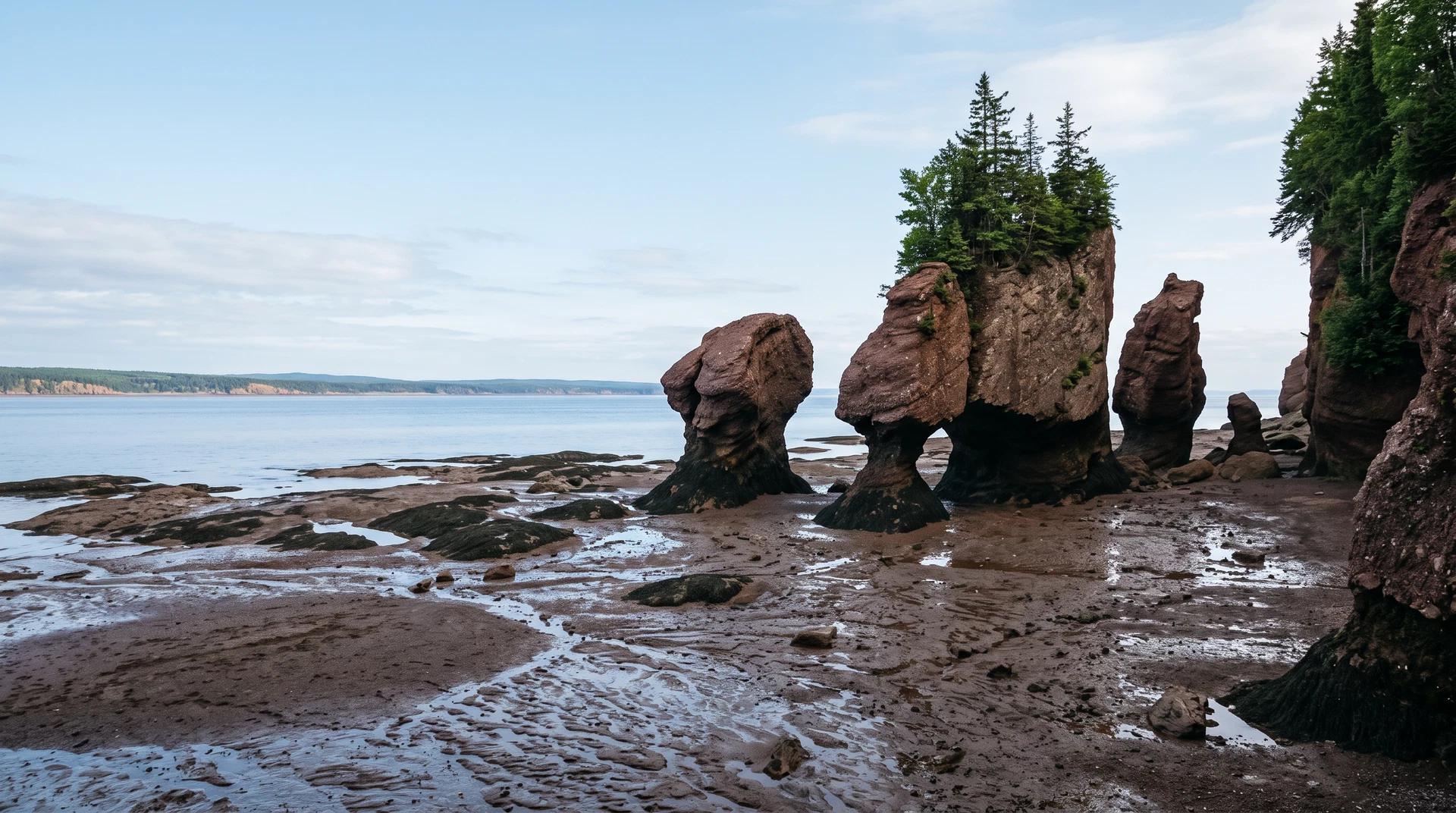
The Atlantic does not merely lap at the shores of the Bay of Fundy; it breathes with a deep, gravitational lung that dictates the rhythm of life along the coasts of New Brunswick and Nova Scotia. Here, the boundary between the terrestrial and the maritime is not a fixed line but a shifting, ephemeral frontier that advances and retreats with a silent, absolute power. To stand on the red-sand flats of the Minas Basin is to witness a landscape in a constant state of becoming and dissolving. It is a place where the concept of "shoreline" is a temporary agreement between the moon and the sea, renegotiated every six hours with a volume of water that defies easy comprehension.
When the tide pulls back, it exposes an alien world usually reserved for the exclusive domain of bottom-feeding fish. The ocean floor here is a vast, undulating expanse of copper-colored mud and seaweed-draped basalt, stretching toward a horizon that seems suddenly and impossibly distant. Walking upon this seabed is a disorienting experience, a literal step into an abyss temporarily vacated by the Atlantic. The air carries the heavy, briny scent of salt and decaying kelp, and the only sound is the squelch of boots in the thick, iron-rich silt. It is a rare opportunity to stand at the bottom of the world, knowing that in a few short hours, this space will be crushed under the weight of the sea.
The numbers associated with this phenomenon are so large they risk becoming abstract. Twice daily, the Bay of Fundy moves approximately 160 billion tonnes of seawater—a mass exceeding the combined flow of every freshwater river on the planet. This isn't a gentle swell; it is a massive displacement driven by the bay’s unique funnel shape and a geological quirk known as tidal resonance. Because the natural frequency of the bay matches the rhythm of the Atlantic’s tides, the water is amplified until it reaches a global maximum of sixteen metres. It is a hydraulic masterpiece of nature, a localized concentration of planetary energy that reshapes the coastline with every cycle.
The cliffs that hem in this surging sea are the pages of a deep-time chronicle spanning over 300 million years. Within the UNESCO Global Geopark, the eroding force of the tides acts as a natural excavator, peeling back layers of sandstone to reveal the fossilized remains of a world that existed long before the continents took their current form. Here, one can find the delicate imprints of prehistoric ferns and the footprints of early reptiles now frozen in stone. The Bay of Fundy is one of the few places where the violent energy of the present is the very tool that preserves the fragile evidence of the past, creating a paradox where destruction and discovery are inextricably linked.
Navigating this landscape requires a level of practical vigilance that most travelers are unaccustomed to. The "stewardship of the self" here begins with a tide table and a constant eye on the horizon. Because of the bay’s geography, the tide does not always creep in; in some areas, it arrives as a "tidal bore," a leading wave that signifies the ocean’s return with startling punctuality. The danger is not just the depth, but the speed of its advance, which can outpace a running person on the uneven seabed. To visit Fundy is to acknowledge that the sea does not wait for slow hikers. Safety is a requirement for participation in this aquatic transformation.
There is a specific, wistful beauty in the way light interacts with the exposed mudflats during the golden hour. As the sun dips low over the Chignecto Bay, the wet silt reflects the sky like a bruised mirror, turning from ochre to deep violet. The "flowerpot" rocks—massive sea stacks topped with resilient evergreens—stand like lonely sentinels in the receding waters, their bases carved into narrow stems by the relentless scouring of sand and tide. These formations are temporary monuments to the bay’s power, destined to eventually topple into the surf, yet they possess a stoic grace. They are a reminder that even the most solid stone is eventually softened by the persistence of the sea.
For local communities, the tides are not a spectacle but a clock. Fishing boats in harbors like Alma do not bob at their piers; they sit lopsided on the mud, their hulls exposed, waiting for the ocean to return. The entire economy and culture of the region are calibrated to these twelve-hour intervals. There is a profound patience in the way people live here, a rhythmic acceptance of the fact that the sea itself is only ever on loan. This connection to the water is visceral, influencing everything from the timing of the harvest of salt-crusted seaweed to the architectural resilience of the coastal towns that have stood against the Atlantic’s surge for generations.
As the tide begins its return, the transformation is mesmerizing. The small streams that trickled through the mudflats suddenly begin to flow backward as the Atlantic pushes its way back into the estuaries. The silence of the low-tide flats is replaced by the low, guttural roar of the incoming sea, a sound that vibrates in the chest. The water rises with a relentless momentum, swallowing the rocks and the footprints of the day’s visitors until the bay is once again a deep, churning expanse of grey-green power. The towering height of the return is a sobering reminder of our own scale in the face of the moon’s gravitational pull and the immense, liquid clockwork of our planet.