Travel
Where the Stone Breathes and the Sea Remembers the Ancient Hearts of Orkney
Beyond the northernmost reach of mainland Scotland lies an archipelago where time is measured in millennia rather than minutes. From the domestic intimacy of Neolithic Skara Brae to the sunken ghosts of Scapa Flow, Orkney offers a profound meditation on endurance and the relentless Atlantic tide.
The crossing to Orkney is a transition through one of the most volatile stretches of water in the world. As the ferry navigates the Pentland Firth, the turbulent meeting of the Atlantic and the North Sea, the mainland fades into a smudge of grey, replaced by the rising red sandstone of the Old Man of Hoy. This towering sea stack stands as a sentinel for an archipelago that feels both exposed to the elements and deeply anchored in the earth. The air here carries a salt-laden clarity that peels back the layers of the modern world, preparing the traveler for a landscape where the boundary between the present and the prehistoric is exceptionally thin.
On the western shore of the Mainland lies Skara Brae, a site that challenges our understanding of the distance between ourselves and our ancestors. Discovered after a fierce storm in 1850 stripped away the protecting sand dunes, this Neolithic village dates back to approximately 3100 BC, making it older than the Pyramids of Giza. Walking the narrow paths between these semi-subterranean dwellings, one is struck by their profound domesticity. The stone-built furniture—beds, cupboards, and central hearths—remains intact, offering a familiar glimpse into a life where the rhythms of the sea and soil were the only constants. It is a place that feels less like a ruin and more like a home briefly vacated.
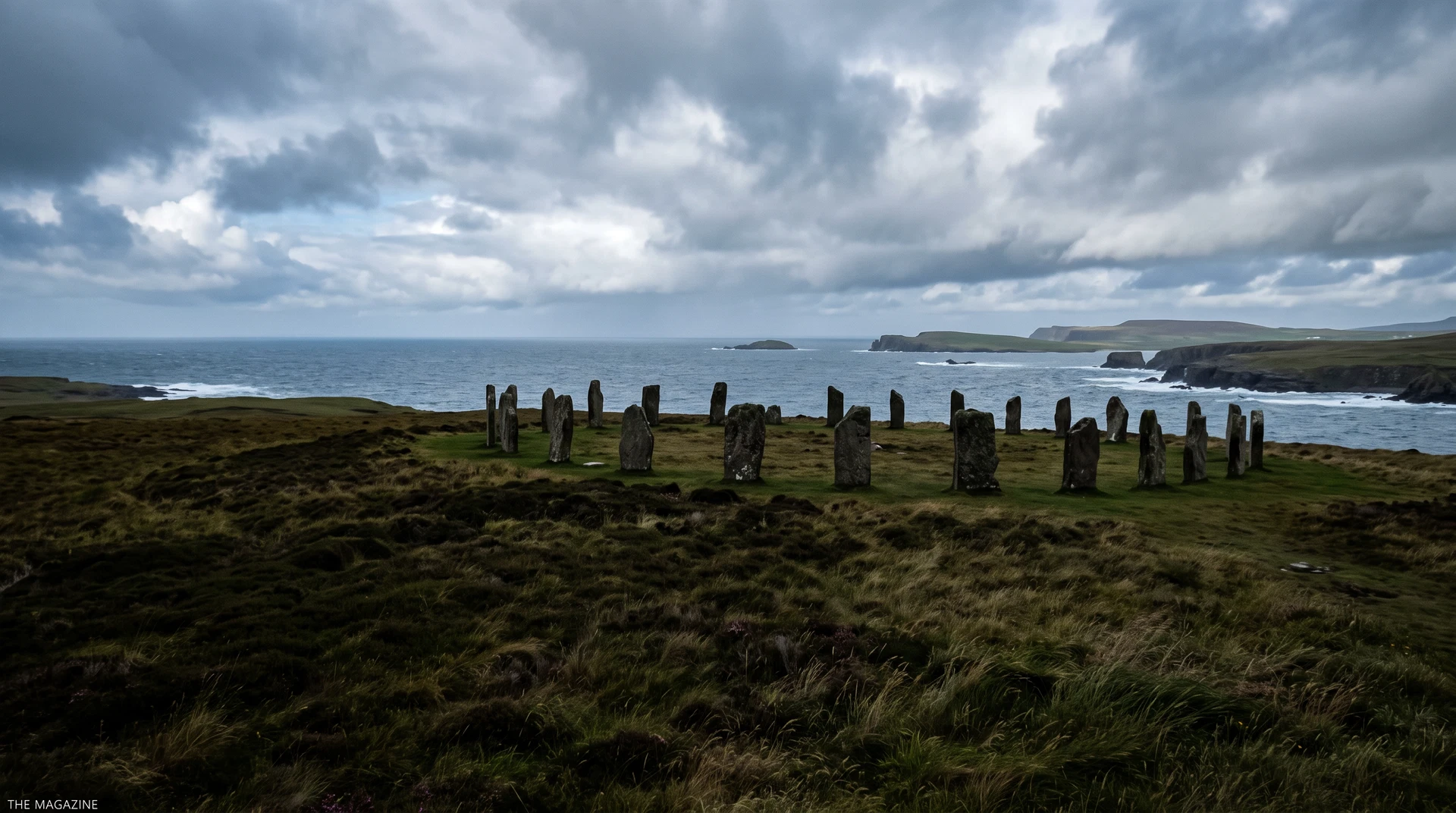
A short distance away, the landscape opens into the ceremonial heart of the islands, where the Ring of Brodgar and the Stones of Stenness stand in silent conversation across the lochs of Harray and Stenness. The Ring of Brodgar, a massive circle of twenty-seven surviving monoliths, is a masterpiece of prehistoric engineering. Standing amidst these weathered giants as the wind howls across the heather, one feels the weight of the collective effort required to erect such monuments in an era before metal tools. Their purpose remains shrouded in mystery, yet their presence creates a sacred geometry that defines the Orcadian horizon, serving as a reminder that these islands have long been a center of spiritual gravity.
The layers of Orkney’s history are also deeply etched with the mark of the Northmen. For six centuries, these islands were a Norwegian territory, a vital hub in a Viking maritime empire that stretched from Scandinavia to the Americas. This Norse heritage is palpable in the names of the places—Kirkwall, Stromness, Egilsay—and in the magnificent St Magnus Cathedral, built from local red and yellow sandstone in the 12th century. The transition to Scottish rule in 1472 did not erase this identity; instead, it created a unique cultural hybridity. To explore Orkney is to walk through a land where the sagas of the Vikings are as much a part of the soil as the ancient stones themselves.
Beneath the surface of Scapa Flow lies a more recent, yet equally evocative, chapter of human history. This vast expanse of sheltered water served as the main base for the British Grand Fleet during both World Wars, but it is best known for the dramatic events of June 1919. In a final act of defiance, the interned German High Seas Fleet was scuttled by its own crews, sending seventy-four warships to the seabed. While many were later salvaged, the remaining wrecks have become a world-renowned underwater heritage site, a silent graveyard of steel that now supports a thriving marine ecosystem. These sunken giants serve as a poignant counterpoint to the Neolithic ruins, reclaimed by the sea.
The Orcadian landscape is one of constant motion, shaped by the relentless energy of the North Atlantic. The cliffs are perpetually besieged by waves that have traveled thousands of miles, carving out sea caves and arches with a slow, patient violence. This environmental pressure is the greatest threat to the islands' archaeological treasures; coastal erosion is a persistent concern, literally washing away the evidence of the past. Sites that have survived for thousands of years are now at risk of being lost in a single generation. This reality lends a sense of urgency to any visit, a realization that the stones we touch today may not be there for the generations that follow.
Practical stewardship is a necessity for the survival of these fragile sites. The UNESCO-designated Heart of Neolithic Orkney is a testament to human ingenuity, but it is also a delicate ecosystem of stone and turf. Visitors are asked to adhere strictly to marked paths and to resist the urge to climb upon the ancient monoliths, as the cumulative impact of thousands of footsteps can cause irreparable damage to the weathered surfaces. The preservation of these sites depends on a collective respect for their vulnerability, ensuring that the stories they tell are not silenced by the very people who come to hear them. It is a quiet contract between the traveler and the past.
As the long summer days of the "simmer dim"—the northern twilight where the sun barely dips below the horizon—stretch the evenings into a golden infinity, the true essence of Orkney reveals itself. It is a place where the scale of time is recalibrated, where the struggles of the present are viewed through the lens of five thousand years of human endurance. Whether standing on the windswept cliffs of Birsay or sheltered within the thick stone walls of a Kirkwall pub, there is a profound sense of belonging to a narrative that is much larger than oneself. Orkney is a landscape to be inhabited, a place where the stones speak and the sea remembers.