Travel
Navigating the ochre silence and sculpted badlands of Spain's Bardenas Reales
Beyond the verdant foothills of the Pyrenees lies a stark, sun-bleached wilderness of clay and gypsum. In Spain’s largest semi-desert, ancient transhumance routes intersect with a lunar landscape of fragile monoliths, where the relentless Cierzo wind continues to carve a cinematic masterpiece out of the Ebro Valley.
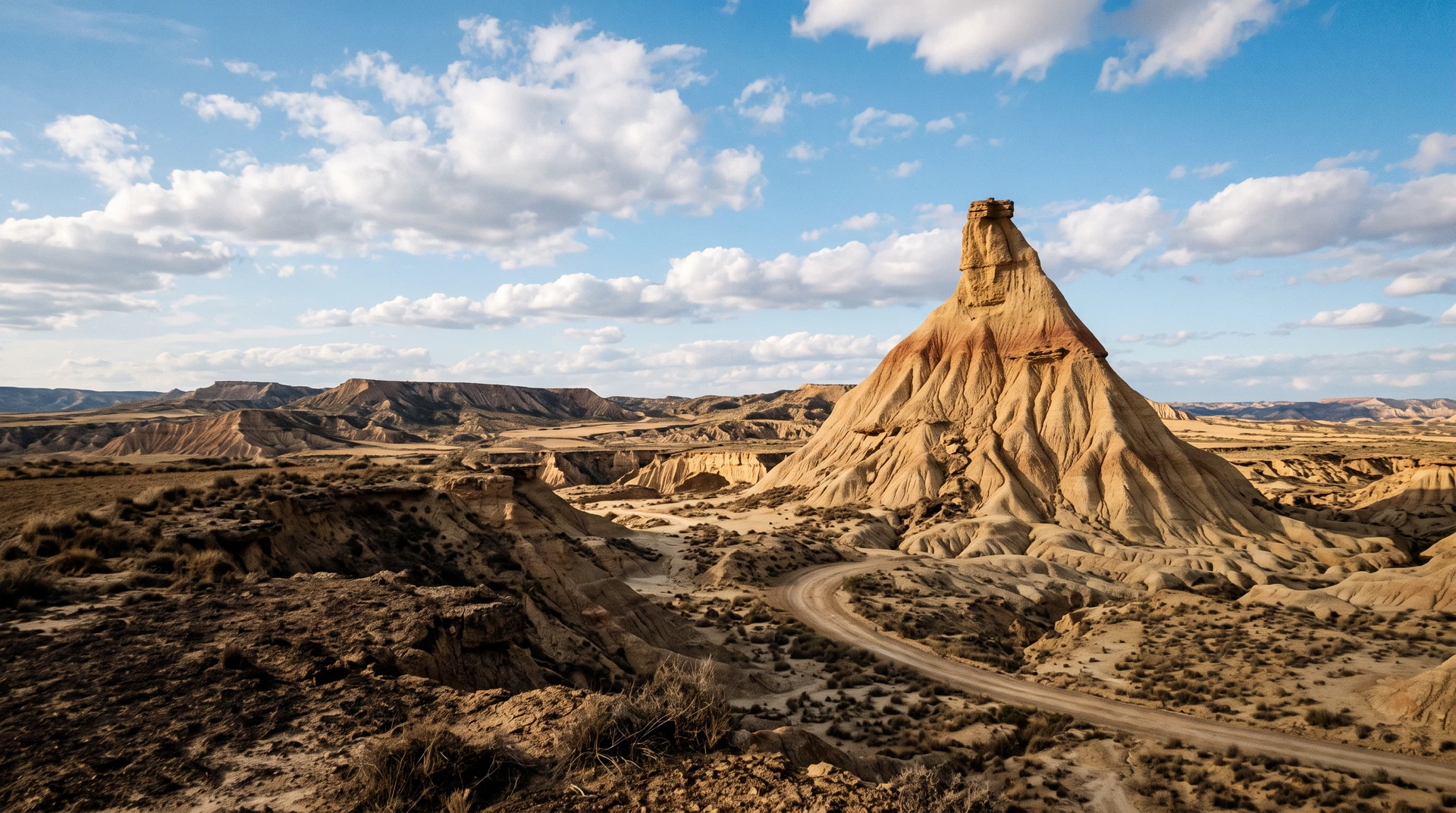
The transition is as abrupt as it is disorienting. Leaving behind the emerald valleys of Navarre, the road south toward the Ebro Valley descends into a landscape that feels misplaced in Western Europe. Here, the Bardenas Reales Natural Park spreads across 42,500 hectares of arid badlands, a UNESCO Biosphere Reserve that swaps oak forests for a surreal expanse of ochre dust and geological decay. It is a place defined by its absence—of water, of shade, and of the familiar green heartbeat of the peninsula—yet it possesses a gravitational pull that has drawn kings and shepherds into its silent, scorched depths for centuries.
This is a kingdom of erosion, where the elements have spent millennia dismantling the earth. The geology of the Bardenas is a fragile sandwich of clay, chalk, and sandstone, materials that lack the stubborn resilience of granite. When the infrequent but violent Mediterranean rains fall, they do not soak into the parched ground; instead, they tear through it, carving deep, labyrinthine canyons and leaving behind "cabezos"—isolated hillocks that stand like skeletal remains of a vanished plateau. The Cierzo, a fierce northwest wind that scours the valley, acts as the final sculptor, polishing these formations into the smooth, haunting shapes that define the park’s distinct zones.
Standing at the center of La Blanca is the park’s most fragile icon, the Castildetierra monolith. This spire, a solitary finger of clay topped by a cap of sandstone, serves as a reminder of the desert’s ephemeral nature. It is a geological clock, slowly ticking away as the soft clay base erodes under the weight of its own crown. Visitors are strictly prohibited from climbing its slopes, a rule designed to protect the delicate soil crust from human impact. To touch the Bardenas is to accelerate its disappearance; here, the most respectful way to experience the landscape is to witness it from a distance, acknowledging that these monuments are destined to return to the dust.
Despite its desolate appearance, the Bardenas Reales is a storied cultural landscape. For over a millennium, it has been the destination for the "transhumance," the seasonal movement of livestock that defines the life of the Navarrese shepherds, or Bardeneros. Every September, thousands of sheep are driven from the high Pyrenean valleys down to the Bardenas for winter grazing. They enter through "El Paso," a traditional gateway marked by the Monumento al Pastor, a tribute to the men and animals who have navigated these trails since the Middle Ages. This ancient right of usage, granted by royalty, ensures that the desert remains a living workspace, where the clatter of sheep bells occasionally breaks the heavy silence.
The geography of the park is divided into three distinct personalities. El Plano is a vast, elevated plateau that serves as a transition from the agricultural lands to the north. Bardena Blanca, the most famous region, is the true heart of the badlands, where the white gypsum and clay create a blinding, lunar aesthetic. Further south lies Bardena Negra, where the soil darkens and Aleppo pines begin to cling to the slopes, offering a rare glimpse of shadow. Curiously, the very center of this protected wilderness is occupied by a restricted military firing range, a jarring reminder of the modern world that exists just beyond the borders of this prehistoric-looking sanctuary.
Wildlife in the Bardenas has adapted to the extremes of a climate that swings from torrid summers to bone-chilling winters. While the crocodiles that once roamed these wetlands millions of years ago are long gone, their fossilized remains are still occasionally unearthed by the shifting sands. Today, the skies are patrolled by griffon and Egyptian vultures, whose shadows drift over the canyons like ghosts. Golden eagles and eagle owls nest in the crags, while on the ground, foxes and wildcats navigate the scrubland. It is a resilient ecosystem, where life persists in the cracks of the gypsum, waiting for the brief windows of moisture to bloom.
Navigating the park requires a shift in pace and a high degree of environmental awareness. A 34-kilometer loop road allows vehicles to traverse the perimeter of the military zone, providing access to the most dramatic viewpoints, but the true spirit of the Bardenas is best captured on two wheels or on foot. Bicyclists and hikers must adhere strictly to marked routes to avoid disturbing the fragile clay soil, which can take years to recover from a single stray tire track. There is a profound, meditative quality to moving through the dust, where the lack of landmarks and the repetition of the ochre ridges can make a three-hour trek feel like a journey through deep time.
The visual drama of this landscape has inevitably drawn the attention of global film productions, which often utilize the Bardenas as a surrogate for alien worlds or ancient, mythical kingdoms. However, the cinematic quality of the park is not a product of artifice but of raw, unshielded nature. The way the light hits the ridges at sunset, turning the ochre to a deep, bruised purple, creates a spectacle that requires no digital enhancement. It is a place that demands a quiet, observant presence, rewarding those who are willing to endure the heat and the wind with a sense of profound isolation. The beauty here is not found in a grand, static view, but in the shifting interplay of shadow and grit across the sculpted clay.
Leaving the Bardenas as the sun dips below the horizon, one is struck by the fragility of the experience. The park’s UNESCO status is a testament to the need for careful stewardship in an era of increasing global travel. The rules—no wild camping, no climbing, no straying from the path—are essential safeguards for a landscape that is literally washing away. As you return to the green vineyards of Navarre, the memory of the ochre silence lingers, a reminder that even in the heart of Europe, there are still corners of the earth that remain wild, weird, and wonderfully indifferent to the passage of human time.