Travel
In the shadow of the Caucasus, the ancient towers of Svaneti stand as silent guardians.
Hidden within the rugged peaks of the Greater Caucasus, Georgia’s Upper Svaneti remains a high-altitude sanctuary where medieval stone towers rise against the clouds. Here, the Svan people preserve a language and polyphonic song as ancient and enduring as the granite peaks surrounding their remote mountain home.
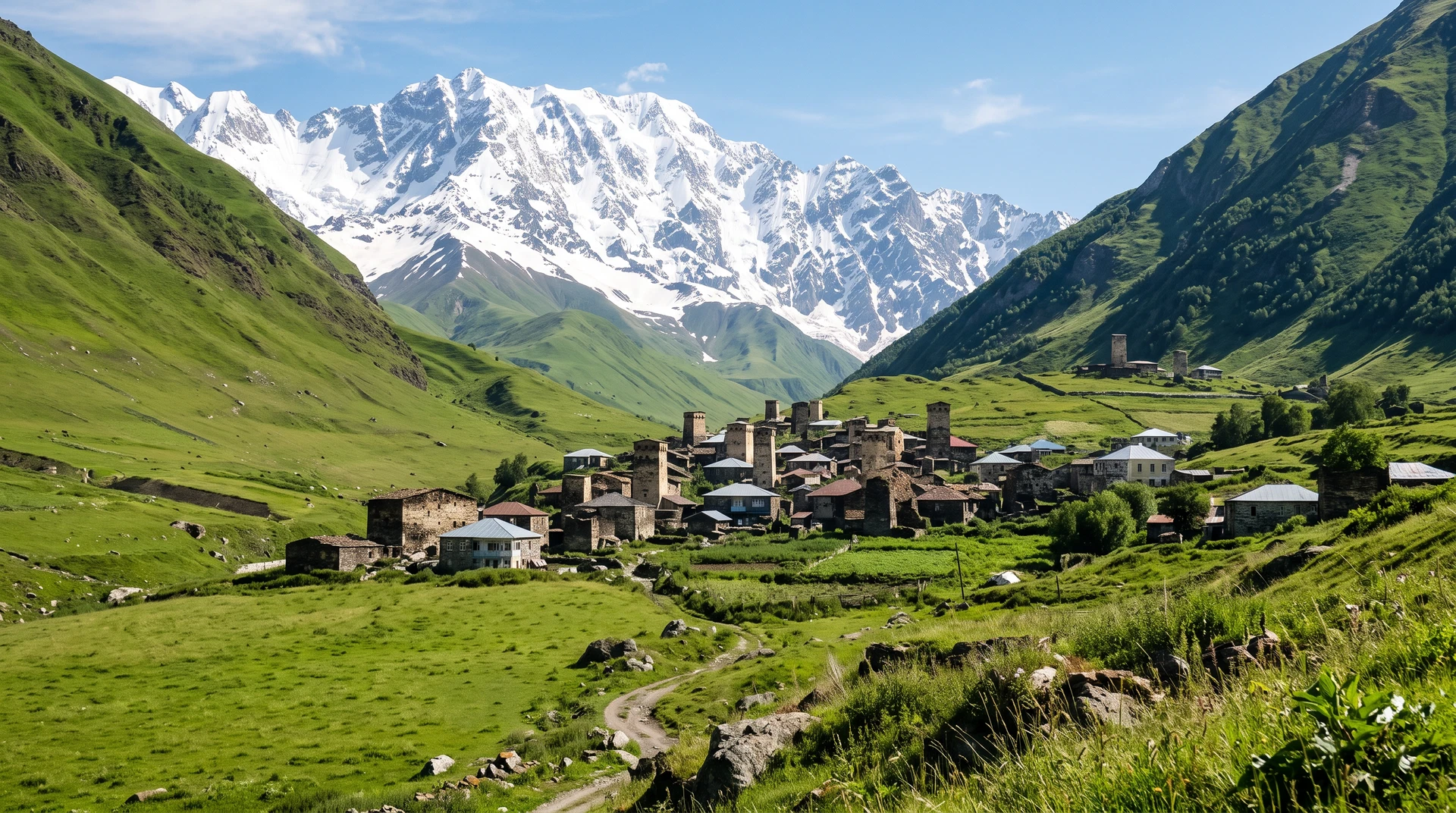
The road into Upper Svaneti is a winding testament to the region's historical isolation, a path carved into the steep flanks of the Greater Caucasus where the air thins and the light takes on a crystalline quality. As the Enguri River churns far below, the first glimpse of the Svanetian towers—known locally as *koshki*—appears like a mirage against the jagged skyline. These tapered stone structures, some dating back to the 9th century, are the vertical soul of a landscape that has long resisted the homogenization of the lowlands. To arrive here is to step into a world where the verticality of the terrain dictates the rhythm of life, and where every granite block tells a story of survival in one of Europe’s most formidable mountain ranges.
Originally constructed between the 9th and 13th centuries, the two hundred remaining towers of Svaneti were born of a dual necessity: defense against invaders and protection from the devastating avalanches that frequently sweep the slopes. Each tower was typically attached to a family home, serving as a multi-story fortress where villagers could retreat during times of strife or natural disaster. The ground floors were often used for livestock, while the upper levels provided living space and a final, crenelated vantage point for defense. Today, these towers stand in clusters, their weathered surfaces reflecting the shifting moods of the Georgian sky. They are silent sentinels, enduring symbols of a feudal past that refused to be conquered by the passing centuries.
The people who built these towers, the Svans, are as distinct as the architecture they inhabit. Though part of the broader Georgian nation, they possess a unique Kartvelian language, Svan, which is unintelligible to those from the plains of Tbilisi. This linguistic isolation is a direct result of the geography; for much of history, Svaneti was accessible only by treacherous mountain passes that remained closed for half the year. In the high valleys, the Svan language has acted as a vessel for oral histories and ancient laws that predated modern statehood. It is a tongue shaped by the wind and the rock, spoken with a quiet intensity by elders who remember a time before the paved road brought the world to their doorstep.
Nowhere is the cultural depth of Svaneti more audible than in its polyphonic singing, a complex and haunting tradition recognized by UNESCO as a masterpiece of intangible heritage. Unlike the more melodic harmonies found elsewhere in Georgia, Svan polyphony is characterized by dissonant intervals and powerful, rhythmic chants that seem to echo the starkness of the surrounding peaks. These songs are often performed during religious festivals or community gatherings, their three-part harmonies weaving together to create a sound that is both mournful and celebratory. To hear these voices rise within the thick stone walls of a medieval church is to understand that the Svans have not just survived in these mountains; they have created a sophisticated art form that translates the grandeur of the Caucasus into human breath.
Further up the valley lies Ushguli, a community of four villages that holds the distinction of being among the highest continuously inhabited settlements in Europe. Situated at approximately 2,200 meters above sea level, Ushguli sits at the base of Mount Shkhara, Georgia’s highest peak, whose massive glaciers provide a dramatic, frozen backdrop to the village’s cluster of towers. Life at this altitude is a constant negotiation with the elements. The growing season is short, and the winters are long and unforgiving, yet the residents of Ushguli have maintained their way of life for over a millennium. There is a profound sense of permanence here, a feeling that the village is not just located in the mountains, but is an organic extension of the rock itself.
The environment of Upper Svaneti is one of raw, unfiltered beauty, where alpine meadows are carpeted with endemic wildflowers during the brief summer months and glacial streams run cold and clear. The Greater Caucasus range provides a natural barrier that has protected the region's biodiversity, making it a haven for species that have disappeared elsewhere. However, the fragility of this ecosystem is increasingly apparent. The retreat of the glaciers and the changing patterns of snowfall are subtle reminders that even a sanctuary as remote as Svaneti is not immune to global shifts. For the visitor, the landscape demands a high degree of physical respect; the trails are steep, the weather is unpredictable, and the mountains themselves possess a scale that humbles even the most experienced trekker.
In recent years, the rapid growth of tourism has brought new challenges to the preservation of Svaneti’s authentic heritage. While the influx of visitors has provided economic opportunities for local families, it has also placed a strain on the historic stone architecture and the traditional social fabric. The delicate balance between modernization and conservation is visible in the town of Mestia, where new guesthouses stand alongside ancient towers. Preservationists worry that the very qualities that make Svaneti unique—its isolation and its untouched medieval character—could be eroded by poorly planned development. Respectful travel is not just a suggestion here; it is a necessity for ensuring that the *koshki* continue to stand for another thousand years.
Practical travel to Svaneti requires a willingness to embrace the journey as much as the destination. While flights from Tbilisi to Mestia are available, they are notoriously subject to cancellation due to mountain weather, leaving the six-hour drive from Zugdidi as the most reliable route. This journey, though long, offers a gradual introduction to the changing landscape, as the subtropical vegetation of the coast gives way to the dense forests and high peaks of the interior. Once in the region, the best way to experience Svaneti is on foot or by horse, following the ancient paths that connect the villages. It is a slow way of traveling that rewards the patient observer with glimpses of a world that operates on a different, more ancient clock.
As the sun sets over the peaks, casting long shadows across the valleys, the towers of Svaneti begin to glow with a soft, amber light. In these moments, the modern world feels incredibly distant, replaced by a sense of deep, geological time. The enduring presence of the Svan people and their stone sentinels serves as a reminder of the power of place and the resilience of culture. To visit Svaneti is to witness a rare continuity, a high-altitude sanctuary where the past is not a memory, but a living, breathing reality. It is a place that stays with you long after you have descended from the mountains, a wistful reminder of the beauty that exists when humanity lives in harmony with the most rugged corners of the earth.