Travel
Beneath the Three-Headed Peak Where Emerald Waters Carve Through the Julian Alps
Spanning four percent of Slovenia, Triglav National Park serves as a sanctuary for limestone summits and the legendary Goldenhorn. From the crystalline Soča River to the heights of Mount Triglav, this Alpine realm balances ancient mountain traditions with rigorous modern conservation.
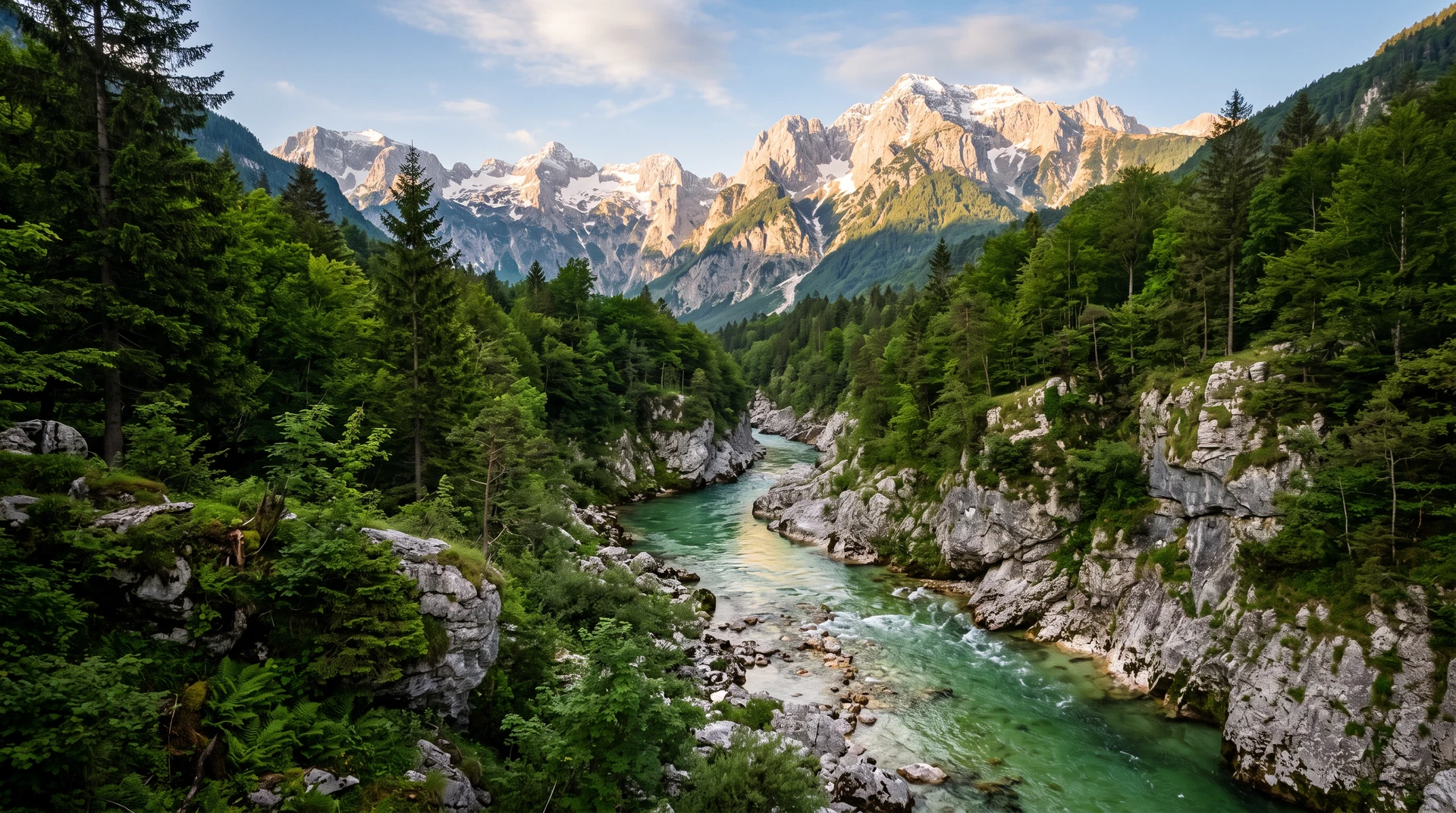
The Julian Alps rise with a sudden, vertical conviction in the northwestern corner of Slovenia, a jagged crown of limestone that defines the nation’s horizon and its spirit. At the heart of this range lies Triglav National Park, a protected expanse established in 1981 that encompasses four percent of the country’s entire landmass. It is a place where the air carries the sharp scent of pine and the cold promise of snow, even as summer sun warms the valley floors. Named for the three-headed Mount Triglav, which stands at 2,864 meters, the park is more than a mere collection of peaks; it is a meticulously preserved ecosystem where the transition from sub-Mediterranean warmth to high-Alpine tundra happens within a few hours of vertical ascent.
Geologically, the park is a masterclass in karst topography, where the solubility of limestone has created a landscape of dramatic contrasts. The mountains here are not rounded by age but sharpened by it, their white faces scarred by deep fissures and punctuated by hidden caves. This porous rock ensures that water is both a visible spectacle and a subterranean mystery. While the summits remain arid and windswept, the valleys below are lush, fed by springs that burst forth from the rock with startling intensity. The interplay of light on these pale cliffs creates a shifting palette of grays and ochres, particularly during the "golden hour" when the peaks seem to glow from within, reflecting the prehistoric origins of the reefs that once lay beneath an ancient sea.
Perhaps the most striking feature of the park is the Soča River, a waterway so vividly turquoise that it appears almost surreal against the dark green of the surrounding forests. Carving through the Trenta Valley, the Soča is a living ribbon of glacial melt, its waters maintaining a clarity that allows every pebble on the riverbed to be counted. The river’s path is marked by narrow troughs and deep pools, where the current slows just enough to reveal the subtle gradients of emerald and sapphire. This is not merely a scenic backdrop; the Soča is the lifeblood of the western park, a cold, rushing force that has shaped the human history of the region as much as the geological one.
Deeper within the park’s boundaries, Lake Bohinj offers a different kind of aquatic serenity. Unlike its more famous neighbor, Bled, Bohinj remains anchored in a sense of wild isolation. Surrounded by steep mountain walls that reflect in its mirror-like surface, the lake is the largest natural permanent lake in Slovenia. Its shores are largely undeveloped, honoring the park’s commitment to preserving the "quiet zones" that allow wildlife to thrive. On a misty morning, the lake feels like the edge of the world, where the water merges seamlessly with the low-hanging clouds and the only sound is the occasional call of a bird or the distant chime of a cowbell from the high pastures.
The biodiversity within these borders is staggering, with the park serving as a UNESCO Biosphere Reserve that protects over 7,000 animal species. Among the crags, the chamois and ibex navigate near-vertical slopes with an agility that defies gravity, while golden eagles circle the thermals above the treeline. The park is also the setting for the legend of Zlatorog, the Goldenhorn, a mythical chamois whose blood is said to have created the Alpine flowers that bloom in the high meadows. This folklore is not just a story for children; it reflects a deep-seated cultural reverence for the environment, a recognition that the mountains are a realm that belongs first to the wild and only secondarily to the traveler.
Human presence in the park is defined by centuries of Alpine tradition, particularly the practice of high-altitude pastoralism. During the summer months, shepherds move their flocks to the mountain pastures, or "planinas," where the grass is rich and the air is cool. The architecture of these settlements—small stone huts with steep, shingled roofs—is designed to withstand the heavy snows of winter while providing a functional base for cheese-making. Visitors who trek through these areas can still find active dairies where traditional methods are preserved. This cultural landscape is a vital part of the park’s identity, demonstrating a historical balance between human utility and environmental respect that modern conservationists strive to maintain.
Preserving this delicate balance requires a rigorous approach to stewardship. The park’s management emphasizes the importance of staying on marked trails and respecting the designated quiet zones, where human interference is kept to an absolute minimum. Wild camping and open fires are strictly prohibited, a necessary measure to protect the fragile flora and prevent the disruption of nesting sites. These rules are not intended to restrict the experience but to ensure its longevity. By adhering to these guidelines, travelers become participants in the park’s survival, acknowledging that the beauty of the Julian Alps is a finite resource that requires active protection from the pressures of modern tourism.
For Slovenians, a pilgrimage to the summit of Triglav is often considered a rite of passage, a physical manifestation of national identity. Yet, the park offers a profound experience even for those who never reach the highest peaks. It is a place that demands observation and patience, where the rewards are found in the details: the scent of a wild orchid, the texture of weathered limestone, or the sudden appearance of a rainbow in the spray of a waterfall. Triglav National Park stands as a testament to the idea that nature, when treated with humility and care, can remain a source of wonder and renewal, a jagged, emerald sanctuary in the heart of Europe.